What Helps a Child Return to School After a Long Absence?

Compare full-day, gradual, and temporary at-home return plans, plus health checks and school supports that can help a child reenter safely.
The 5-year-old period is considered an important turning point in the process of physical, skill and cognitive development, creating a foundation for the formation of personality and capacity in the future .
5 years old is the time when children achieve many important developmental milestones from physical, intellectual to social relationships. A 5 year old child will perceive things more clearly than a younger child.
In addition, at this age, children can also sit still for a period of time to listen to the adult instructing something. Besides, the age of 5 - 6 is also the time when children start entering grade 1 with many changes. Therefore, the baby will need great attention, love and encouragement from parents.
Please watch the following shares of aFamilyToday Health to better understand the feelings and emotions of 5-year-old children.
Children 5 years old have the ability to walk, stand, run and jump quite steadily. The baby is even able to move at a very fast speed and has precise coordination between movements. You will see your baby wandering on the playground and sweating all the time while playing with his friends.
Not only that, at this age, your baby is also considered a tiny athlete with 20/20 vision, each year he will increase 2kg and about 6cm taller.
The child's fine motor and gross motor skills are gradually improving. Therefore, at this age, children will achieve physical development milestones such as:
The ability to coordinate better, the young body also becomes more flexible and supple
Children can run and jump high with good balance
Children can ride a 2 or 3 wheeled bicycle
1 foot balance for long
Children can dress themselves , buttons and zippers, and can tie their own shoelaces
Children can proficient use of chopsticks and spoons when eating and drinking.
To help your 5-year-olds develop at their best, you need:
Let children be comfortable, free to run and play.
Encourage your baby to dress himself , especially practice for him to button / unbutton his own clothes.
Teach your baby to brush their teeth properly to prevent tooth decay . You can let your baby do it himself but still supervise him.
Don't let your baby watch TV, play on the phone or on the computer for more than 1 hour, encourage him to go out to play more.
Come up with fun movement games or exciting sports activities for your child to play such as hopscotch, swing, acrobatics, running, ball throwing ...
Encourage your child to join a swimming class as it is both a life skill and very good in physical development.
Put your baby to sleep early and get enough sleep, about 8-10 hours per night.

By the time they turn 5, they will know how to control and regulate their emotions better. Not only that, but children are also very excited about social communication activities such as making friends and want to receive positive feedback from adults.
Even though the psychological crises of the age of 3 have passed, sometimes children still emerge negative emotions when something is not satisfied. Babies may feel narcissistic, feel sad when they are not being noticed or are ready to rush in to get their toys back ...
In addition, this is also the age at which many children begin to speak their own feelings, for example, children can say to you: "Mom, I feel unhappy when I have to go to bed early". If your baby feels sad about something, he can honestly share it with you, such as: "Mom, I'm mad at you Y.!".
Five-year-olds can be away from their parents for a certain time without feeling excessively sad
Know how to share toys with other children
Tends to want to be in command, especially when playing with you
You can lie to please your parents and friends
Enjoys going out, even if it's just a short ride
Enjoy playing stunt games , playing with your imaginary friend .
This is an important time to start teaching your child how to control his or her emotions. In addition, you should also note the following:
Encourage your child to make friends and participate in extracurricular activities.
Teach your baby about the manners when communicating such as saying sorry, thank you, please ...
Talk to your child about how to be a leader. Give your child a chance to show leadership skills such as making a menu for dinner, instructing parents to do something according to their child's wishes (play together, play simulation games ...).
Always focus on listening when your child wants to talk. Be ready to answer all your heavenly and earthly questions.
In addition, children this age may also face a bullying risk at school. Therefore, you need to monitor it closely. Because at this age, the child still lacks the skills to handle, so adult intervention is a very important factor.
Children at this age begin to understand the difference between "right" and "wrong". Children also understand the basic rules and want to follow to make you happy.
In addition, a 5 year old child also has a lot of questions and curiosity about the world around him. Babies are always eager to discover and learn new things. Therefore, you will see your baby ready to take apart everything to see how they work. Children are also very interested in the blocks and colors through puzzle games, lego ...
At this age, children can express their needs and wants with words. Your child's language gradually becomes easier to understand and he is also able to understand more complex instructions from you. In addition, there will also be times when you encounter a situation where your child talks non-stop, constantly asks and uses proficient expressions of exclamation and words.

Understand a simple concept of time
Can count up to 10 or more
Remember and name at least 4 colors
Memorize some letters
Name familiar things
Can write some letters and numbers
Can tell a clear and unambiguous story
Correctly use pronouns like child, aunt, uncle ...
Understand and execute three-step commands, such as: changing, having breakfast, and going to school
Understand the sequence of a story, what happens first, what happens next, and how it ends
At this age, you need to avoid pressure, forcing children to learn to read and write if they are not ready. Instead, encourage your child to draw and write through games to make them more interested.
Maintain reading habits with children . Give children the opportunity to ask questions, explore the world in their favorite children's books.
Take your baby to museums, parks, and children's events to give them a chance to discover new things and meet new friends.
Lego games, puzzles, plays ... will be very suitable to help children develop cognitive in this period.
Encourage your child to talk about their day with suggestive questions such as: Who do you play with today, what do you do in class, what do you like best ...
Play vocabulary games with your child like reading poems, singing, finding names of animals ...

Each child has a different growth rate, so your baby does not have to reach all of the above developmental milestones above for 5-year-olds. However, if your baby has the following symptoms, you should see a specialist for advice:
Children have difficulty running and jumping, unable to stand on one foot for at least 10 seconds
Children are not interested in physical activities
Children have trouble seeing and hearing
Children cannot hold a pen
Children cannot focus on any activity for at least 5 minutes
Can't say his own name, can't count to 10, can't name the colors
Frequent anger, shouting, fierce protest
Hates playing with friends of the same age, does not like leaving home
Not understanding what the other person said or answering only superficially
Do not understand simple instructions or questions
Doesn't like talking to other people
Unable to brush teeth, change clothes, wash hands ...
5 years old is an important period for both children and adults, so it is understandable if you are wondering if your child is not ready to go to school. If you feel too worried or see your child showing unusual signs, please take your child to see a specialist for advice and timely intervention.
Compare full-day, gradual, and temporary at-home return plans, plus health checks and school supports that can help a child reenter safely.
Learn when a child can try to solve a friendship problem, when adults should step in, and how to tell whether support is helping or needs to change.
Separated parents can support better sleep by aligning a few core bedtime rules across homes without making both households identical.
A fair response to a child’s lie is calm, brief, and tied to what needs fixing. Learn how to address the lie, repair harm, and rebuild trust.
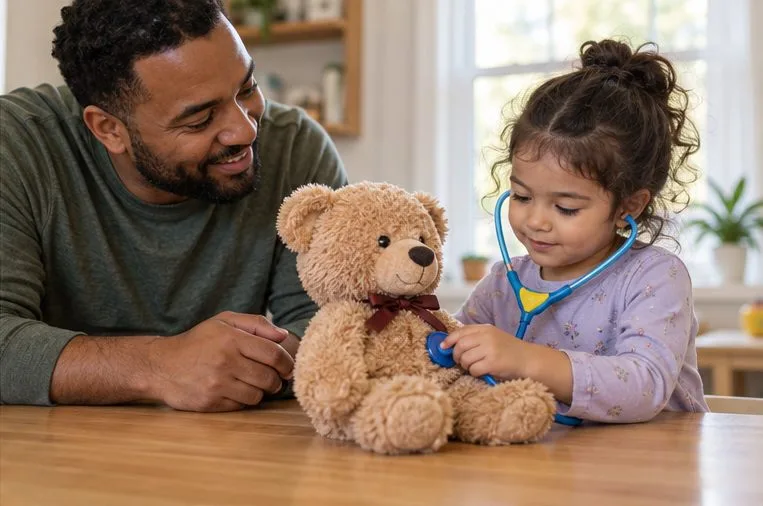
Help your child feel more prepared for a doctor visit with honest, age-appropriate explanations, simple choices, comfort items, and a practical plan for questions or procedures.
When homework runs long, track where time goes, check the task and routine, and work with the teacher if the pattern repeats. Learn what to watch for and when to ask for support.
Learn how one flexible family meal, a familiar food, and low-pressure repeat exposure can make dinner easier for picky eaters—plus when to ask a pediatrician for help.
The clocks fall back on November 1, 2026. Use a gentle bedtime plan, familiar routines, and morning light to help your child adjust.
Plan five low-cost October half-term outings with a preschooler, from libraries and museums to parks and art trails. Check dates, booking, and total costs first.
Learn how to determine your baby’s caloric needs, including the calories in breast milk and formula, to ensure your infant gets the right nutrition for healthy growth.