Home
» Parenting
»
When a Child Behaves Well at School but Melts Down at Home: What Parents Can Do
When a Child Behaves Well at School but Melts Down at Home: What Parents Can Do
A child who seems composed, cooperative, or even exceptionally well behaved at school can still come home and fall apart. The contrast can be confusing: if they can hold it together for teachers, why not for family?
The most useful starting point is not to decide that the child is being manipulative or that school reports must be wrong. Behavior can change by setting. A child may be tired, hungry, socially overloaded, managing sensory discomfort, anxious about performance, or using a great deal of effort to meet expectations during the school day. Some autistic children also camouflage, or “mask,” traits and distress at school and then show the strain later in a safer environment. That pattern can be relevant, but it is not proof of autism or any other diagnosis.
The goal at home is not to eliminate every difficult emotion. A better outcome is that the child becomes safer, recovers more reliably, has fewer or less intense blowups over time, and can gradually tell you more about what makes the transition from school to home hard.
Start by judging the outcome you actually want
Parents often measure success too narrowly: “Did the meltdown happen?” A more realistic set of measures looks at the whole transition.
What to watch
Signs the plan may be helping
Signs to change the approach
Safety
No hitting, dangerous running, self-injury, or destructive behavior
Risk is increasing or adults cannot keep everyone safe
Intensity
Crying or anger is less explosive, even if still present
Outbursts are becoming more severe
Recovery
The child settles with less conflict and returns to ordinary activity
Recovery takes longer or the child stays distressed for much of the evening
Communication
The child can later name hunger, noise, conflict, worry, fatigue, or another trigger
The child becomes more withdrawn or cannot discuss what happened even when calm
Function
Homework, dinner, sleep, and family relationships become more manageable
Outbursts regularly interfere with sleep, friendships, school attendance, or family life
Improvement may be uneven. Look for a trend across multiple school days rather than expecting one successful afternoon to prove that a strategy works.
1. Make the first 20 to 60 minutes after school lower-demand
The transition home is often the worst time to ask for a detailed school report, start homework, correct minor behavior, or stack several chores together. Try a predictable landing routine instead: greet the child warmly, offer food and water if appropriate, reduce unnecessary questions, and give access to a quiet or preferred activity.
This is not the same as removing all expectations. It is a timing decision. The U.S. Centers for Disease Control and Prevention emphasizes that predictable routines can help children know what to expect and that changes are easier to discuss when a child is calm. Its April 2026 parenting guidance describes consistency, predictability, and follow-through as the core of helpful structure. See the CDC guidance on routines and rules.
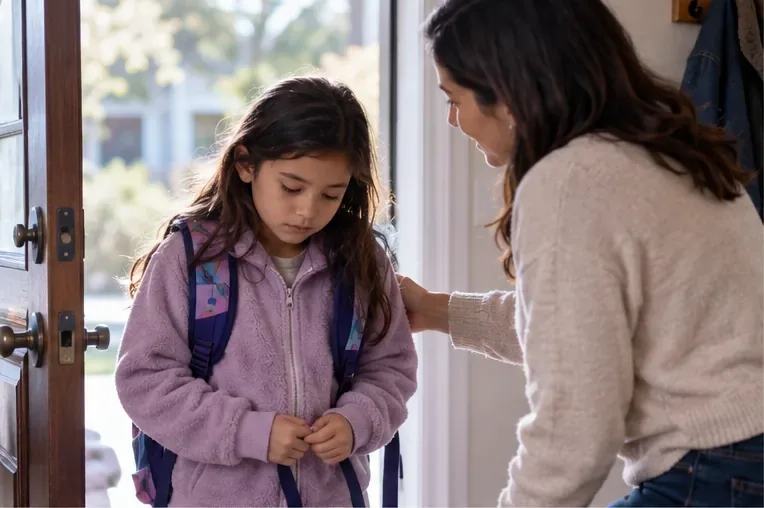
A low-pressure arrival can give a child time to shift from school demands to home before questions and tasks begin.
2. Regulate first; problem-solve later
When a child is already overwhelmed, lengthy explanations, lectures, or demands for an apology usually add more language and pressure to an overloaded moment. Focus first on safety and calm. Use a steady voice, fewer words, and simple limits such as, “You can be angry. I won’t let you hit.”
For younger children, the CDC’s April 2026 emotion-coaching guidance recommends staying calm, ensuring safety, validating feelings, and still setting limits on behavior. The same basic principle is useful with many older children too: feelings can be accepted without permitting unsafe actions. See CDC guidance on noticing and naming emotions.
Once the child has settled, keep the debrief short. Ask one or two concrete questions: “What was hardest about the last part of today?” “Were you hungry, worried, crowded, rushed, or just exhausted?” If the child does not know, that is useful information too. Do not turn the conversation into an interrogation.
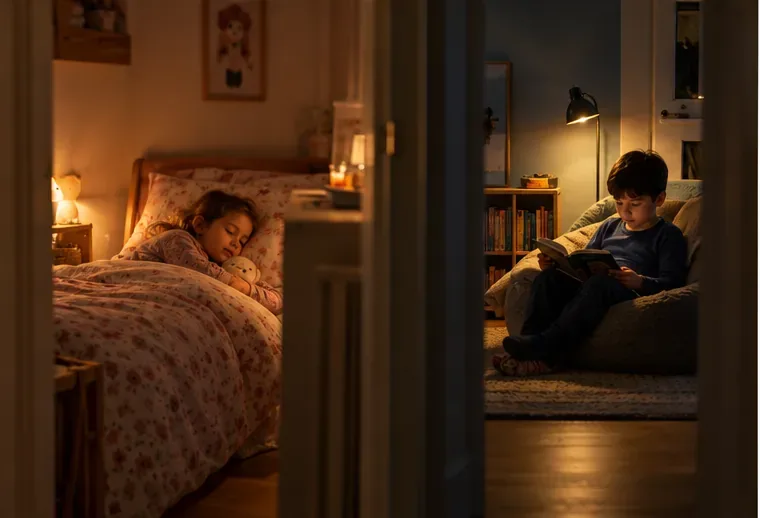
Food, hydration, quiet, and a calm adult presence can be part of a predictable decompression routine after school.
3. Keep limits simple and consistent
Lowering demands does not require tolerating aggression, cruelty, or property destruction. Choose a small number of non-negotiable rules and apply them calmly. Examples might include “People are safe,” “Objects stay on the floor,” or “If you need space, you can go to your quiet spot.”
Try to separate the emotional state from the behavioral limit. A child can be allowed to cry, complain, or request space while still being stopped from hitting a sibling. Consistency matters more than having a large set of consequences. CDC parenting guidance notes that rules work best when caregivers are consistent, predictable, and clear about what the child should do instead. See CDC guidance on creating family rules.
4. Track the pattern instead of arguing about motives
For one or two weeks, make brief notes rather than writing a long diary. Record the time of the meltdown, what happened immediately before it, food and sleep, homework load, after-school activities, transportation, and anything the child mentions about peers, noise, transitions, or academic pressure.
The purpose is not to prove that school caused the problem. You are looking for repeatable patterns. Does the child do much better on days with a snack before the ride home? Are Mondays harder? Do blowups cluster after physical education, tests, crowded assemblies, extracurricular activities, or late bedtimes?
If you find a pattern, change one variable at a time when practical. That makes it easier to tell whether the adjustment helped.
A short pattern log can help families test practical changes without labeling the child or guessing at motives.
5. Compare notes with school without asking, “Is my child really good there?”
A child can genuinely behave well at school and still be working extremely hard to do so. Ask the teacher for specific observations rather than a general rating. Useful questions include:
Does the child ask for help when confused, or stay quiet and push through?
Are transitions, lunch, recess, group work, tests, or noisy periods harder than academic lessons?
Does the child look tense, perfectionistic, unusually quiet, or exhausted by the end of the day?
Are there peer conflicts, teasing, friendship changes, or avoidance that may not show up as “bad behavior”?
Are there simple supports already available, such as a quieter transition, movement break, check-in, or clearer schedule?
For autistic children, an NHS Trust resource notes that masking can involve suppressing distress or sensory needs in public and that some children appear fine at school but have meltdowns or shutdowns at home. It recommends downtime and collaboration with school. That information can help explain one possible pattern, but parents should not use masking alone to diagnose autism. See Leicestershire Partnership NHS Trust guidance on communication and meltdowns.
Specific school observations about transitions, noise, peer interactions, and help-seeking are more useful than a simple “good at school” label.
What not to assume
“They save the bad behavior for me, so they must be choosing it.”
Children can have more self-control in one setting than another, and effort can be costly. Home may also be the place where a child finally relaxes enough to show distress. That does not mean every outburst is unavoidable, and it does not remove the need for boundaries. It means motive should not be guessed from the school-home contrast alone.
“If school sees no problem, there cannot be one.”
School performance is only one part of functioning. Emotional distress can show up mainly at home, in sleep, in physical complaints, or in the energy required to get through the day. The CDC notes that behavior or emotional difficulties can also be reactions to stress and change, and that a thorough evaluation may be needed when the cause is unclear. See CDC guidance on children with multiple behavioral or emotional concerns.
“A calm-down routine should fix this quickly.”
A routine can reduce friction, but it cannot by itself address bullying, an untreated learning problem, significant anxiety, sleep disorders, family stress, neurodevelopmental differences, or another health concern. If the pattern is persistent or severe, the next step is not to make the home routine stricter and stricter. It is to get a broader assessment.
When should you change course or seek professional help?
The American Academy of Child and Adolescent Psychiatry (AACAP) updated its Emotional Dysregulation Resource Center in August 2026. It notes that recurrent, impairing outbursts can occur with several different conditions and are not a diagnosis by themselves. AACAP recommends assessment when outbursts are extreme or interfere with daily life. See the AACAP Emotional Dysregulation Resource Center.
Talk with the child’s pediatrician or a qualified child mental health professional when any of the following are true:
meltdowns are frequent, severe, or getting worse;
the child is school-age and has recurrent intense tantrums or prolonged irritability;
aggression, property destruction, or self-injury occurs;
the pattern disrupts sleep, friendships, learning, school attendance, or ordinary family life;
there are major changes in eating, sleeping, mood, concentration, or physical complaints;
the child seems persistently anxious, depressed, withdrawn, or unable to recover between episodes;
you suspect bullying, trauma, a learning difficulty, sensory overload, ADHD, autism, or another concern that needs proper evaluation.
AACAP’s guidance on temper tantrums specifically says recurrent or severe tantrums in school-age children deserve attention, especially when aggression, self-harm, inability to calm, or interference with life is present. See AACAP guidance on temper tantrums and outbursts.
When is it an emergency?
Get immediate help if an outburst involves a weapon, serious risk of injury, intentional self-harm, or a stated intent to hurt oneself or someone else. In the United States, call 911 for immediate danger or call/text 988 for a mental health crisis. Outside the United States, use your local emergency or crisis service. AACAP lists these situations as reasons for urgent evaluation in its current emotional dysregulation guidance.
A practical test for the next school week
Pick a modest plan rather than trying ten changes at once:
Use the same low-demand arrival routine every school day.
Offer a snack, water, movement, quiet, or another appropriate decompression option.
Keep one or two safety rules consistent.
Delay problem-solving until the child is calm.
Write one brief note about what happened before and after any meltdown.
Ask school one or two specific questions about the hardest parts of the day.
At the end of the week, judge the plan by safety, intensity, recovery, communication, and impact on family functioning. If those measures are improving, continue and refine the routine. If they are unchanged or worsening, broaden the investigation rather than assuming the child simply needs more discipline.
The school-home difference is a clue, not a verdict. The best response combines empathy with limits, observation with collaboration, and enough flexibility to seek professional help when home strategies are not enough.