Home
» Parenting
»
Why Does a Child Ask the Same Reassurance Question Repeatedly?
Why Does a Child Ask the Same Reassurance Question Repeatedly?
Your child asks, “Will you be there when school ends?” You answer clearly, and a few minutes later they ask again. The repetition can feel frustrating, especially when you have already explained the plan. Often, though, the child is not ignoring you or trying to argue. They may be checking that things still feel safe, seeking connection, or trying to quiet a worry that returns after a brief moment of relief.
Children sometimes repeat questions as they learn, process an answer, or cope with ordinary uncertainty. Repeated reassurance can also become part of a stronger anxiety pattern. The words alone cannot tell you which is happening. Notice what tends to come before the question, how your child responds to your answer, and whether the pattern is affecting sleep, school, friendships, or family routines.
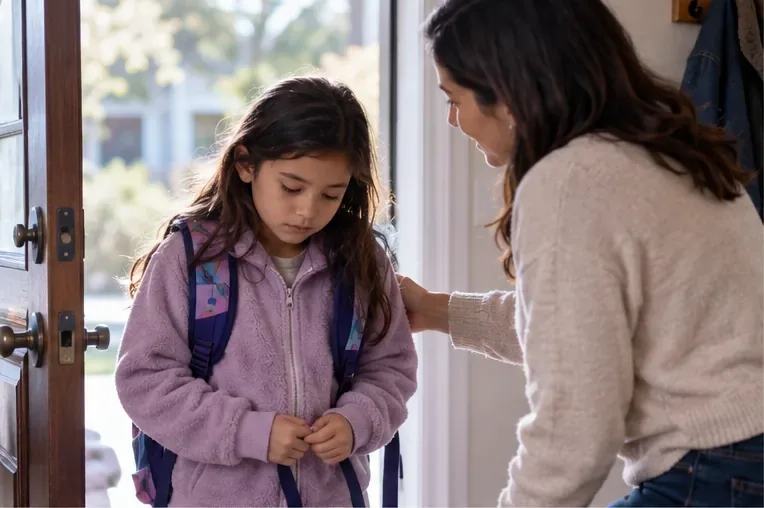
A parent listens while a child asks a question at home. A calm response can help the child explain what feels uncertain.
Why might a child ask the same question again?
They are still learning what the answer means
Young children may need to hear information more than once, particularly when it involves time, a future event, or several steps. “I’ll pick you up after school” can still feel abstract if a child does not know when “after school” is or what will happen between now and then. Repeating the question can be a way to check the plan, not a sign that the child has failed to listen.
They need connection as well as information
Sometimes the literal question carries a second message: “Will you come back?” may mean “I miss you,” “I feel nervous about being apart,” or “I need to know you are thinking about me.” A warm, age-appropriate answer and a moment of attention can help. The American Academy of Child and Adolescent Psychiatry notes that childhood fears can be normal at some stages, while children with anxiety may seek a lot of reassurance and have worries that interfere with activities.
The answer calms a worry only briefly
When a child feels anxious, asking for reassurance can bring relief. If the worry returns, they may ask again, even though they remember your answer. After a stressful event or a major change, children may also ask repeated questions because the world feels less predictable. Some health-service guidance describes this as a possible reassurance cycle: a child asks, feels better briefly, then becomes worried again. This pattern is worth noticing, but it does not by itself establish a diagnosis.
They are checking for certainty or a particular response
A repeated question can sometimes appear with other repetitive behaviors, such as checking, counting, repeating words, or needing a routine to feel “just right.” The American Academy of Pediatrics describes constant reassurance seeking as one possible sign among many that can occur with obsessive-compulsive disorder (OCD). One repeated question alone is not enough to identify OCD or any other condition. A clinician would consider the child’s wider experience, distress, control over the behavior, and its effect on daily life.
What can a parent do in the moment?
1. Answer clearly and honestly
Give a brief answer that fits your child’s age and the situation. If you know the plan, make it concrete: “I’ll pick you up when your class ends. Your teacher will stay with you until I arrive.” If you do not know something, say so rather than promising certainty: “I don’t know the exact time yet. I’ll tell you when I find out.” Avoid guarantees no adult can make, such as “Nothing bad will ever happen.”
2. Acknowledge the feeling behind the question
Try, “You want to know I’ll come back, and waiting feels hard.” Then pause. A child who feels understood may be better able to explain what part is worrying them. Ask one gentle follow-up, such as, “What are you picturing might happen?” Do not turn the moment into a cross-examination; a younger child may not have words for the feeling yet.
3. Make the next step easier to picture
Use a simple routine, visual schedule, or specific cue if it genuinely helps your child understand what comes next. For example, name the person who will meet them, the event that signals pickup, or what they can do while waiting. If the question comes before a predictable transition, review the plan once at a calm time instead of explaining it repeatedly during a rush.
4. If the question returns, support coping without withdrawing comfort
When you have answered and the child asks again, keep your tone kind and steady. You might say, “I’ve told you the plan. I can see the worry is back. Let’s take a slow breath and choose what will help while we wait.” You can offer closeness, help the child name the feeling, or redirect them to the next manageable activity. The aim is not to punish the question or refuse all reassurance; it is to help the child practice handling the uncertainty as well as hearing your answer.
Repeatedly giving a new guarantee may not help if the fear keeps returning. At the same time, abruptly ignoring the child or telling them to “stop worrying” can make them feel alone or ashamed. Keep the facts consistent, show that you are available, and gently return to the coping plan. If a clinician is helping your child, ask how the family should respond so that home and treatment strategies fit together.
When should you seek extra support?
Consider speaking with your child’s pediatrician or family doctor if the questions are frequent, intensifying, difficult to interrupt, or beginning to control family routines. It is also a good idea to ask for guidance when worries interfere with attendance or participation at school, sleep, friendships, play, or everyday activities. The NHS advises seeking professional help when a child is constantly anxious, is not improving or is getting worse, self-help is not working, or anxiety affects school, family life, or friendships.
Before the appointment, write down a few examples: the exact question, when it happens, what seems to trigger it, how long reassurance helps, and what the child avoids or has trouble doing. Ask the teacher or another caregiver whether they notice a similar pattern in a different setting. These observations help a professional consider developmental stage, recent stress, anxiety, communication needs, and other possible explanations without assuming the cause in advance.
If your child talks about wanting to hurt themselves or someone else, or their behavior is unsafe, seek immediate professional help. If you believe there is an immediate danger, contact local emergency services. NIMH advises caregivers to seek help immediately when a child’s behavior is unsafe or the child talks about harming themselves or someone else.
A simple way to check what is happening
For several days, notice four things without turning each question into a test: what happened right before it; what the child may be feeling; whether your answer helps for a while or only for a moment; and whether the repetition disrupts normal activities. If it appears around a specific transition and your child can move on with a clear plan and support, ordinary reassurance may be enough. If the worry keeps returning across situations, grows more intense, or limits the child’s life, bring your notes to a pediatrician or child mental-health professional.
The most useful response is usually both reassuring and steady: answer the real question, recognize the emotion, and help your child take the next small step. Repeated questions are information about what your child may need; they are not, by themselves, proof of a disorder or a parenting failure.