How to Teach Chores Without Redoing Every Task for Your Child

Teach kids to do chores with fewer reminders: set a clear finish line, model one task, step back, and correct only what is unsafe or unfinished.
Yes—siblings can often share a bedroom even when one is ready for bed earlier than the other. The practical approach is to protect each child’s sleep need, create two comfortable sleep spaces, and stagger the parts of bedtime that would otherwise disturb the child who is trying to fall asleep. “Same room” does not have to mean “same lights-out time.”
Before moving beds or setting rules, remember that children’s sleep needs vary by age, naps, health, and morning schedule. A predictable routine can help, but no single room setup works for every sibling pair. If one child has a sleep disorder, significant sensory needs, or a medical condition, tailor the plan with their pediatrician.
A sleep schedule is the pattern of when a child goes to sleep, wakes, and naps. A younger child may need an earlier bedtime or a nap, while an older sibling may stay awake longer. The goal is not to force both schedules to match; it is to reduce interruptions while each child gets enough opportunity to sleep.
The American Academy of Sleep Medicine’s consensus ranges are 11–14 hours per 24 hours for children ages 1–2, 10–13 hours for ages 3–5, 9–12 hours for ages 6–12, and 8–10 hours for teenagers ages 13–18. The younger age ranges include naps. These are general recommendations for healthy children, not exact bedtimes or a substitute for a clinician’s advice. The American Academy of Pediatrics notes that children in the same family may appropriately have different lights-out times based on age and sleep need.
Make a quick starting note for each child: usual wake-up time, naps, current bedtime, how long it takes to fall asleep, and whether noise or light wakes them. This gives you a useful baseline before you make changes.
A sleep window is the period that gives a child enough time to sleep before the next required wake-up. Start with each child’s age-related sleep range, then account for naps and school or childcare wake times. Don’t average the siblings’ needs into one bedtime. For example, if a preschooler naps and needs more total sleep than a school-age sibling, the younger child may need lights out first while the older child has quiet time elsewhere.
Ask each child what tends to wake or bother them—talking, light, movement, a door opening, or worry about being alone. Younger children may need help describing this; ask about specific moments rather than “Do you like sharing?”
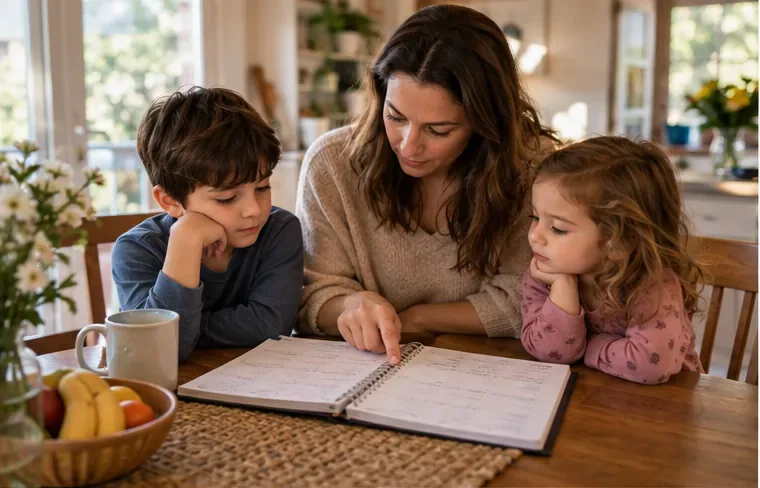
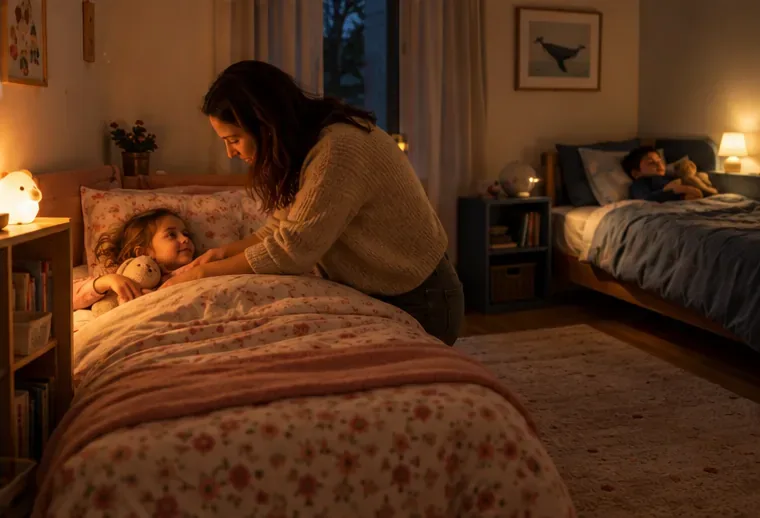
Give each sibling their own bed or other appropriate sleep surface, bedding, and a small place for personal items. Keep the route to the door clear, and place belongings where they will not tempt one child to cross the other’s sleep area. If there is room, separate the beds so each child has a little visual space; a divider is optional and should not block an exit, airflow, or an adult’s view of the room.
If you use a bunk bed, follow the manufacturer’s directions and safety labels. The AAP advises that a child younger than 6 should not sleep on the upper bunk. Check that guardrails and the mattress fit the bed as specified.

Do not treat a sibling’s bed as an infant sleep surface. For every sleep, place a baby on their back in their own firm, flat, safety-approved crib, bassinet, portable crib, or play yard with only a fitted sheet. Keep pillows, loose blankets, stuffed toys, and other soft objects out of the infant sleep space. The AAP recommends that a baby share a room with a parent, but not a bed, for at least the first 6 months. A sibling being in the room is not the same recommendation. Ask the baby’s pediatrician how to arrange the room safely if you are considering room-sharing with an older child.
A wind-down is a quiet sequence that helps a child shift from active play to sleep. The AAP’s “Brush, Book, Bed” routine is one simple example for younger children. Choose a calm routine for the early sleeper first—bathroom, pajamas, teeth, a story, and a goodnight cue are common elements—then let the older sibling do a quiet activity outside the bedroom until it is time to come in.
If the older child needs to stay in the room, agree on a realistic quiet activity and clear boundaries: use a small directed light only if it does not shine at the other bed, keep the voice low, and avoid games or videos that invite conversation. When the older child is ready to sleep, have them enter quietly and go straight to their own bed. If the younger child’s sleep is easily interrupted, an adult can supervise the older child’s quiet time in a common area instead.
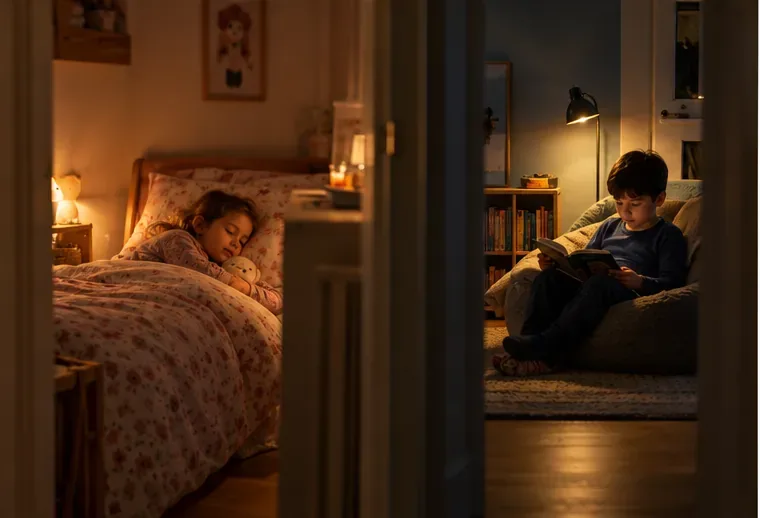
Explain the plan during the day rather than negotiating it after the lights are off. A child-friendly version might be: “Younger sibling’s story starts first. You can read in the living room, then come in quietly when it’s your bedtime.” Give both children a chance to suggest a comfort item or a small room preference, while adults set the sleep and safety limits.
For a week, make a simple log of lights-out time, wake time, how long each child seemed to take to fall asleep, and any wake-ups or complaints. Look for patterns, not one difficult night. If the younger child wakes when the older sibling enters, move the older child’s quiet activity farther away or adjust the order. If the older child feels pushed aside, plan some one-on-one time earlier in the evening rather than using a later bedtime as a reward.
Room-sharing may not work well if one child’s sleep is repeatedly disrupted, the siblings feel distressed or unsafe, or the family cannot create appropriate separate sleep spaces. If possible, consider temporary separate sleeping locations, even if one is a safe sleep space in another room. Discuss persistent sleep difficulty, loud snoring, breathing pauses, frequent night waking, or strong daytime sleepiness with a pediatrician. The clinician can check for causes beyond the room arrangement.
In short, begin with each child’s sleep need, set up safe individual sleep spaces, put the earlier sleeper down first when that works for the pair, and keep the other child’s wind-down quiet and predictable. Review how both children are sleeping before deciding whether to keep or change the plan.
Sources: American Academy of Pediatrics, “The Importance of Family Routines” (updated June 28, 2024); American Academy of Pediatrics, “Brush, Book, Bed” (updated February 2, 2024); American Academy of Sleep Medicine, pediatric sleep-duration consensus recommendations; American Academy of Pediatrics, “How to Keep Your Sleeping Baby Safe” (updated September 11, 2026); American Academy of Pediatrics, bunk-bed safety information (page lists last update September 5, 2013).
Teach kids to do chores with fewer reminders: set a clear finish line, model one task, step back, and correct only what is unsafe or unfinished.
Learn why toilet-trained children may start having pee or poop accidents again, what patterns to track, how to respond calmly, and when to call the pediatrician.
A child may repeat a reassurance question to process information, seek connection, or manage worry. Learn how to respond and when persistent anxiety needs support.
Learn how to set screen-time boundaries with predictable routines, warnings, calm follow-through, and better transitions—without turning every device handoff into a fight.
Teach children to handle losing without shame or explosive anger by validating feelings, setting behavior limits, modeling recovery, and practicing at the right difficulty.
A calm, practical plan for after-school meltdowns: reduce overload, keep limits clear, track patterns, coordinate with school, and know when to seek help.
Learn how to respond when a child feels unwanted, ask supportive questions, recognize bullying or ongoing distress, and know when to seek extra help.
Learn how to set up a shared bedroom for siblings with different bedtimes, from planning around age-based sleep needs to creating separate sleep spaces and quiet routines.
Compare full-day, gradual, and temporary at-home return plans, plus health checks and school supports that can help a child reenter safely.
Learn when a child can try to solve a friendship problem, when adults should step in, and how to tell whether support is helping or needs to change.