Home
» Pets
»
Why Does a Dog Suddenly Refuse to Walk in One Direction?
Why Does a Dog Suddenly Refuse to Walk in One Direction?
If your dog suddenly refuses to walk in one direction, do not assume it is stubbornness. Pain, weakness, fear, or something about that particular route can all make a dog stop. The direction alone cannot identify the cause. Because new reluctance to move can be an early sign of discomfort, first stop pulling and check whether your dog seems physically unwell or hurt.
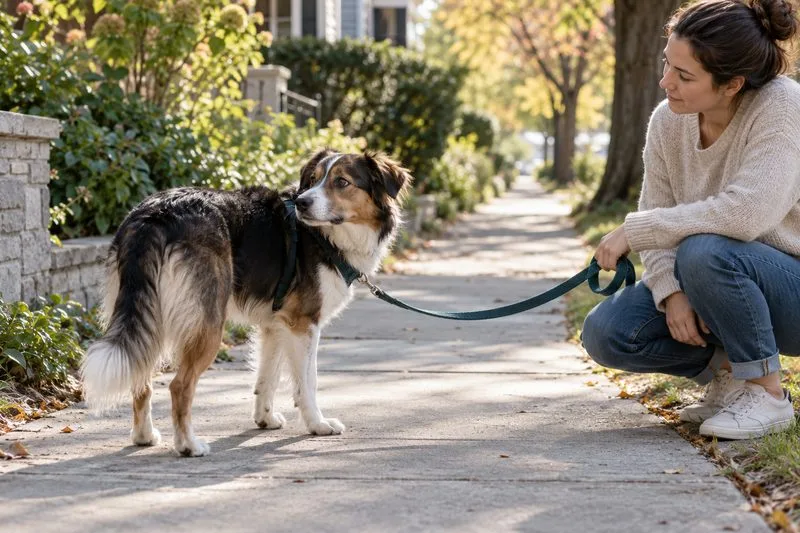
A dog pauses on a neighborhood sidewalk while its handler gives it room and keeps the leash loose.
Could the refusal be caused by pain or injury?
Yes. A sore paw, broken nail, cut pad, something caught between the toes, a muscle strain, joint problem, or back or neck pain can make a dog hesitate. The dog may appear to refuse only one direction because turning, stepping onto a different surface, or moving at a certain pace changes how the body feels. That is a possibility to consider, not a way to diagnose a specific injury.
Look for signs that support a pain concern: limping, a shortened stride, favoring one leg, stiffness, repeated licking of a paw or limb, difficulty getting up, reluctance to jump or climb stairs, a lowered head, a hunched posture, yelping, or unusual irritability when approached. Some dogs hide pain or show only subtle behavior changes. Cornell’s veterinary guidance notes that trouble walking can reflect pain or weakness and may involve a limb or the nervous system; a veterinary exam is needed to locate the cause. See Cornell University College of Veterinary Medicine’s guidance on limping dogs.
If your dog is calm and allows it, make a visual check of the paws for obvious debris, a torn nail, swelling, or a visible cut. Do not dig into a paw, bend a limb, press sore areas, or continue testing the movement if your dog resists. Pain can make even a gentle dog defensive. A short video of the dog’s natural gait, taken only if safe and without making the dog walk farther, may help the veterinarian understand what you saw.
Could one place, sound, or surface be worrying the dog?
Also yes. If the dog walks comfortably elsewhere but stops at the same corner, driveway, bridge, or stretch of sidewalk, consider what changes at that spot. There may be a sound you do not notice, a slick or hot surface, traffic, construction, another dog, a visual object, or a memory of an unpleasant encounter. Dogs can associate a location with a frightening or uncomfortable event and become hesitant there later. VCA notes that a dog may refuse to move when frightened by a place and advises against scolding or forcing the dog forward; see VCA’s veterinary guidance on fear of places in dogs.
Body language can help you decide whether fear might be involved. A dog that freezes, backs away, tucks its tail, trembles, scans the area, pants when it is not hot, or tries to hide may be distressed. These signs do not rule out pain: discomfort and fear can occur together, and a painful experience may make a route feel unsafe. A route-specific pattern is useful information to share with a veterinarian or qualified behavior professional, but it is not proof that the cause is purely behavioral.
Should you keep walking, turn around, or carry the dog?
Stop where it is safe and give the dog slack on the leash. Do not drag, jerk, or repeatedly lure the dog toward the direction it is avoiding. If the dog is alert, moving normally, and comfortable turning back, calmly leave the immediate area or choose a short, familiar route home. Keep the rest of the outing brief. If walking itself appears painful, the dog cannot bear weight, or the dog seems weak or unsteady, do not ask it to finish the walk; call a veterinary clinic for advice about transport.
Do not pick up a large or painful dog unless you can do so safely. An injured animal may snap when handled, and moving it incorrectly can worsen an injury. If the dog cannot walk, call the clinic or emergency hospital and ask how to move it. VCA’s first-aid guidance for limping dogs advises restricting activity and taking care during transport.
When is this an emergency?
Seek urgent veterinary care for sudden severe lameness, severe or constant pain, inability to stand or bear weight, staggering, dragging a limb, collapse, a visibly deformed limb, a major wound, or trouble breathing. These signs need faster assessment than a mild hesitation that resolves once the dog leaves a trigger. Merck Veterinary Manual lists sudden severe lameness, staggering or other walking problems, and severe or constant pain among reasons to see a veterinarian promptly; review its when-to-see-a-veterinarian table.
Call your veterinarian the same day if the refusal is new and keeps happening, if you see limping or tenderness, or if your dog is less active or acting differently. Merck identifies lameness that lasts more than 24 hours as a reason for veterinary attention, but that is not a reason to wait when pain is severe, walking is abnormal, or your dog’s condition is worsening. A veterinarian can decide whether an exam is needed sooner based on your dog’s signs and history.
What details should you note before calling?
When the change began and whether it happened suddenly or gradually.
Exactly where the dog stops, and whether the refusal happens on every walk or only in one spot or direction.
Whether your dog walks normally at home, turns both ways, bears weight, and gets up comfortably.
Any limp, paw licking, swelling, trembling, panting, yelping, appetite change, or unusual behavior.
Recent falls, strenuous play, nail trimming, new pavement or weather, loud events, or encounters with animals or people.
Write down observations rather than guessing at a diagnosis. A short clip of normal movement can help, but do not provoke the refusal to record it. Cornell recommends sharing photos, video, or notes with the veterinarian because behavior at home may differ from what the dog shows in a clinic. Its pain-recognition guidance also describes mobility, activity, and behavior changes to watch for.
Could weather or medication be part of the problem?
Conditions underfoot and weather can matter. Cold, ice, salt, or snow packed between the toes may make walking uncomfortable; Cornell lists paw lifting and reluctance to walk among signs a dog may not be tolerating cold. In hot weather, a dog that stops while panting heavily, drooling, weak, confused, or vomiting needs urgent veterinary advice because heat illness can become serious. If a weather or surface trigger seems likely, move the dog to a safer, more comfortable place and monitor for other symptoms rather than pushing through.
Do not give a human pain reliever such as ibuprofen, naproxen, aspirin, or acetaminophen unless a veterinarian specifically directs you. The FDA warns that human pain medicines can be unsafe for pets and that some can cause toxic effects. Call your veterinarian before giving any medication; FDA’s animal-drug guidance explains the risks.
What if the dog seems physically fine but keeps avoiding the same direction?
If a veterinarian has ruled out a medical cause, treat the location as a possible fear or learning issue rather than an obedience problem. Temporarily choose routes where the dog can relax. Note what is present near the refusal point and whether the dog’s body language changes as you approach. Avoid punishment and forced exposure. If the fear is mild, a veterinarian or qualified, reward-based behavior professional can help you plan gradual, comfortable practice at a distance where the dog remains calm. Cornell’s guidance on anxious behavior in dogs emphasizes that the appropriate behavior strategy depends on the cause.
The practical rule is simple: stop pulling, look for pain or distress, and note whether the problem follows the dog or the place. A persistent or sudden change deserves a veterinary conversation; severe pain, inability to walk, collapse, or abnormal coordination calls for urgent care. This guide can help you decide what to observe and report, but it cannot determine the cause or replace an examination.
Veterinary references checked September 30, 2026. Advice is general and does not diagnose an individual dog.