Home
» Pets
»
Why a Rabbit May Refuse Hay but Still Eat Treats—and What to Do Next
Why a Rabbit May Refuse Hay but Still Eat Treats—and What to Do Next
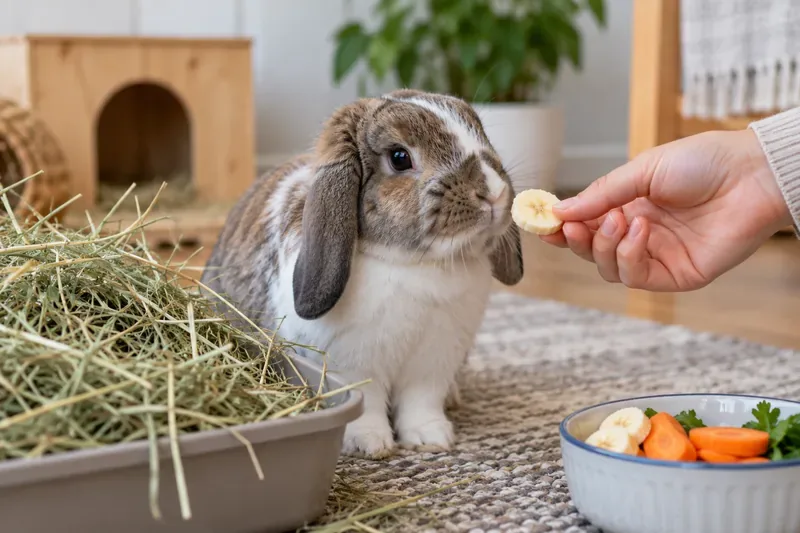
A rabbit that turns away from hay but still accepts banana, pellets, or another favorite food can look “picky,” but selective eating deserves attention. Hay requires sustained chewing, so refusing it while taking softer or sweeter foods can happen with dental discomfort. It can also appear early in gastrointestinal (GI) slowdown, during pain elsewhere in the body, after stress, or when a rabbit has learned to hold out for more appealing foods.
The practical challenge is deciding whether to adjust the diet at home, improve the hay setup, or contact a veterinarian. The safest approach is to look at the whole pattern: how much the rabbit is eating overall, whether fecal output has changed, whether chewing looks uncomfortable, and how long the change has lasted. Accepting treats does not prove that the rabbit is medically fine.
A rabbit may still show interest in a highly palatable treat even when hay intake has dropped, so treat acceptance should not be used as the only measure of appetite.
First, compare the main possibilities
Possible explanation
Clues that fit
Tradeoff in what you do next
Dental discomfort
Hay refusal, slower chewing, dropping food, wet chin, tooth grinding, weight loss, or preference for softer foods
Diet changes alone may delay treatment; a rabbit-savvy dental exam is often the more important next step
Early GI slowdown or GI stasis
Reduced total appetite, smaller or fewer droppings, less activity, hunched posture, abdominal discomfort
Waiting to see whether the rabbit “gets hungry enough” can be risky because GI problems can worsen quickly
Hay quality or presentation problem
Rabbit otherwise eats normally, has normal droppings, and prefers a fresher batch or another grass hay
Trying a fresh hay type is reasonable, but it should not replace a health check if appetite or stool output is reduced
Too many pellets or treats
Rabbit fills up on calorie-dense foods and consistently leaves hay
Reducing extras may restore hay intake, but do not sharply restrict food in a rabbit that is already eating less overall
Stress, pain, or another illness
Recent move, loud environment, surgery, injury, urinary signs, lethargy, or other behavioral change
Environmental support can help, but persistent appetite change calls for veterinary assessment
Dental pain is one of the first problems to consider
Rabbit teeth grow continuously, and normal chewing of long-fiber foods helps wear them down. The MSD Veterinary Manual's July 2026 rabbit dental guidance explains that malocclusion and overgrown cheek teeth can make eating and drinking difficult. Sharp points on back teeth can injure the tongue or cheeks, and deeper dental disease may require sedation and imaging to diagnose.
This matters because hay is mechanically demanding. A rabbit with a painful molar may still accept a small soft treat or pellet while avoiding long strands of hay. Signs such as drooling, wet fur under the chin, dropping food, reduced grooming, weight loss, or loud tooth grinding strengthen the case for a dental evaluation. The University of Illinois Veterinary Teaching Hospital also notes that rabbit dental anatomy is designed for frequent chewing of grass and hay; see its overview of dental problems in pet rabbits.
Best fit for this situation: if your rabbit suddenly stops hay but still wants treats, especially with any chewing difficulty, arranging a rabbit-savvy veterinary exam is more useful than simply buying a sweeter hay or increasing treats.
GI slowdown can start before a rabbit refuses everything
Rabbits rely on steady intake of high-fiber food to keep the digestive tract moving. The MSD Veterinary Manual's 2026 digestive-disease guidance states that rabbits with too little fiber, dental disease, pain, or other problems may stop eating and develop GI stasis. As gut movement slows, gas and discomfort can build, which further suppresses appetite.
A rabbit can therefore be in trouble even if it will still nibble something especially tasty. More important questions are:
Is total food intake lower than usual?
Are droppings smaller, fewer, misshapen, or absent?
Is the rabbit quieter, hiding, hunched, or reluctant to move?
Does the abdomen seem unusually distended or painful?
If these signs are present, the tradeoff favors prompt veterinary care rather than experimentation at home. GI stasis and intestinal obstruction can look similar to an owner, but treatment differs. The MSD manual notes that imaging may be needed to distinguish them. This is also why force-feeding without veterinary guidance can be unsafe when a blockage has not been excluded.
When changing the hay is reasonable
Not every hay refusal is caused by disease. Rabbits may reject stale, dusty, damp, moldy, or unusually coarse hay. They may also have preferences among timothy, orchard grass, meadow hay, or other appropriate grass hays.
If your rabbit is bright, active, producing normal feces, maintaining weight, and eating other normal foods rather than only treats, a hay-quality test is reasonable. Offer a fresh batch from a different bag or supplier, place it in several locations, and replace soiled hay frequently. Some rabbits eat more when hay is placed near the litter area.
The tradeoff is that repeated hay-shopping can create false reassurance. If a rabbit suddenly rejects a food it previously ate well, especially for more than a short period, treat the change as a health clue rather than assuming the hay is the only issue.
Too many treats and pellets can crowd out hay
The MSD Veterinary Manual's July 2026 diet guidance describes a healthy rabbit diet as predominantly grass hay, with a smaller amount of pellets. High-fiber intake supports both digestion and dental wear.
Fruit, commercial treats, and large pellet portions are easier to eat and more calorie-dense than hay. A healthy rabbit may learn that refusing hay results in a steady stream of better-tasting alternatives. In that situation, gradually returning treats to a small, occasional role may improve hay intake.
However, there is an important safety distinction: do not use treat restriction as a test when the rabbit's overall appetite is already reduced. A rabbit that is eating less than normal needs assessment for illness, not a hunger contest.
What you can check at home without delaying care
Look at fecal output
Normal, regular fecal pellets are one of the most useful day-to-day indicators of intake and gut movement. A sudden drop in number or size is more concerning than a simple preference for one food over another.
Watch how the rabbit chews
Notice whether the rabbit starts eating and then stops, chews on one side, drops pieces, stretches the neck oddly, or seems uncomfortable. Avoid trying to inspect the back teeth yourself; cheek teeth are difficult to evaluate properly without suitable equipment, and a superficial look can miss disease.
Check weight trends
Regular weighing on an appropriate scale can reveal gradual weight loss that is easy to miss visually. Weight loss together with selective eating strengthens the case for veterinary evaluation.
Check the hay itself
Hay should smell fresh and dry rather than musty. Discard hay that is damp or moldy. If the rabbit remains otherwise normal, offering another appropriate grass hay can help separate a preference problem from a broader loss of appetite.
When to call a veterinarian promptly
Rabbit appetite changes should be taken seriously because rabbits can deteriorate quickly when they eat less. Contact a rabbit-experienced veterinarian promptly if your rabbit:
has a clear reduction in total food intake;
produces markedly fewer or smaller droppings;
stops eating entirely;
appears lethargic, hunched, bloated, or painful;
grinds the teeth loudly, drools, or drops food;
has visible facial swelling or eye discharge that could be associated with dental disease;
loses weight;
has diarrhea, breathing difficulty, collapse, or another major change in condition.
The professional version of the MSD Veterinary Manual's rabbit disease guidance emphasizes that rabbits often hide pain and may be presented only after GI stasis has become advanced. That is one reason a “still eats treats” pattern should not be used to justify a long wait.
How to choose the next step
If the rabbit is eating a normal amount overall, producing normal droppings, acting normally, and simply dislikes one batch of hay, trying a fresh grass hay and cutting back excessive extras is a reasonable first move.
If the rabbit eats treats but total appetite is clearly down, the feces are changing, or chewing looks uncomfortable, the safer choice is veterinary assessment rather than continued diet experiments. Dental disease and GI slowdown are common enough—and potentially serious enough—that they deserve to be ruled out.
If the rabbit stops eating or fecal output falls sharply, treat it as urgent. Do not assume hunger will eventually force a rabbit to eat hay, and do not begin force-feeding or gut-motility medications unless a veterinarian has advised you after considering obstruction and other causes.
The key distinction is not “hay versus treats.” It is whether the rabbit's overall eating, fecal output, comfort, and behavior remain normal. Treat preference can be benign, but a new refusal of hay can also be the first visible clue that chewing hurts or the digestive tract is slowing. When those broader signs change, early veterinary attention is the lower-risk choice.