Home
» Pets
»
Help Your Cat Feel Safe in the Carrier Before a Vet Visit
Help Your Cat Feel Safe in the Carrier Before a Vet Visit
To help a cat feel safer in a carrier, make it a familiar, open part of home well before the veterinary appointment, then reward small voluntary steps toward entering. Do not wait until departure time to bring out a carrier the cat has only seen before stressful trips. If the appointment is soon, you can still reduce pressure: use a sturdy, familiar carrier, move slowly, and call the veterinary team for advice if loading the cat is difficult. Do not postpone needed care just to complete training.
The steps below are for cats, the species most commonly described in veterinary carrier-acclimation guidance. They are a practical reference, not a promise that every cat will love travel. Cats differ, and a comfortable carrier at home does not automatically make the car ride or clinic comfortable.
Quick reference: what helps
Goal
Try
Avoid
Make the carrier familiar
Leave a stable carrier open in a room the cat uses; add familiar soft bedding.
Only bringing it out just before an appointment.
Encourage entry
Place treats or a favorite toy near the entrance, then farther inside as the cat chooses.
Shoving, chasing, or repeatedly coaxing a hesitant cat.
Build comfort with closure
Close the door briefly after relaxed voluntary entry; increase duration gradually.
Closing the door for a long time at the first session.
Travel safely
Carry the carrier from underneath, cover part of it if helpful while keeping ventilation, and secure it in the car.
Carrying only by a swinging handle or letting the cat ride loose.
Choose a carrier the cat can use comfortably
Look for a sturdy, well-ventilated carrier that is large enough for the cat to stand, turn around, and lie down. A front-and-top-opening design, or one with a removable top, can make entry less awkward and may let the veterinary team examine the cat while it stays in the lower half. This can be useful for a cat that feels safer staying in the carrier. Make sure latches close securely and the handle or base feels stable when lifted.
A carrier is not a hiding box if it rocks, smells strongly of old accidents, or only appears before a car trip. Wash it with a mild, unscented cleaner if needed, rinse and dry it fully, and check that the door does not swing shut unexpectedly during practice. The Feline Veterinary Medical Association’s Cat Friendly Homes carrier guide recommends considering access, cleaning, ventilation, and a comfortable lining. Choose the type that suits your cat and your ability to transport it safely.
Four gradual steps for carrier training
1. Leave the carrier open in a familiar place
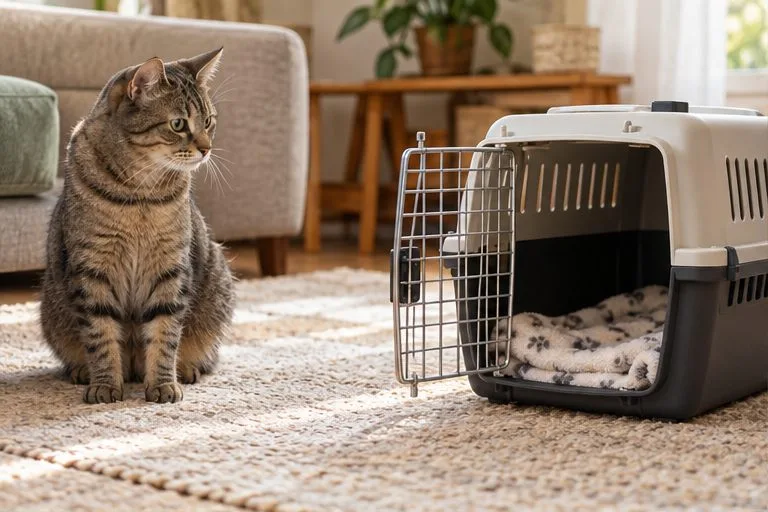
Set it in a quiet area where the cat already rests or passes through. Secure the door open or remove it during early practice so it cannot swing against the cat. Put a familiar blanket or towel inside; bedding that carries a familiar home scent may make the space less novel. Let the cat investigate on its own schedule. The carrier can stay available between visits, provided it is safe and does not block a walkway.
Leave the open carrier in a familiar room with soft bedding so it can become part of the cat’s everyday surroundings.
2. Reward interest without asking for too much
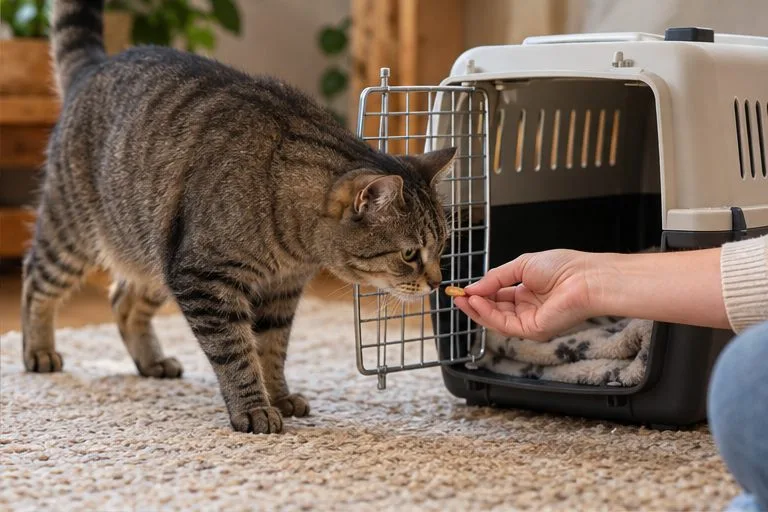
Start by placing a treat, toy, or other reward the cat likes near the carrier. If the cat approaches, sniffs, or looks inside, allow it to leave and return. Over later sessions, place the reward just inside the entrance, then a little farther in. Some cats will enter promptly; others may need days or weeks of low-pressure repetition. Keep each practice brief and stop while the cat is still comfortable.
Reward a voluntary approach with a treat near the carrier entrance; keep the door open and let the cat choose the distance.
3. Let the cat enter and settle voluntarily
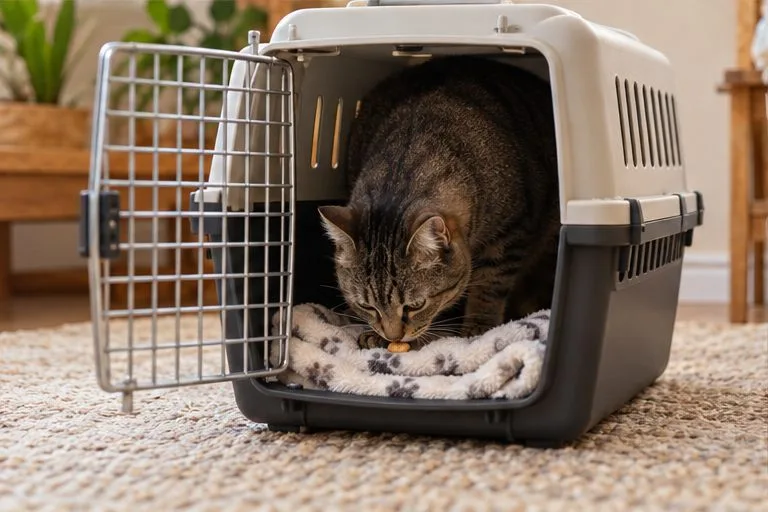
Once the cat steps inside for a reward, give it time to eat or explore with the door open. Do not close the door as soon as all four paws are inside if that would surprise the cat. Repeat until it can enter and stay briefly without stiffening, scrambling to leave, or avoiding the carrier afterward. A cat that only reaches partway in is still making progress; return to an easier distance rather than lifting it in.
When the cat is ready, place a treat farther inside and let it enter without being pushed or lifted in.
4. Add the door and movement in tiny increments
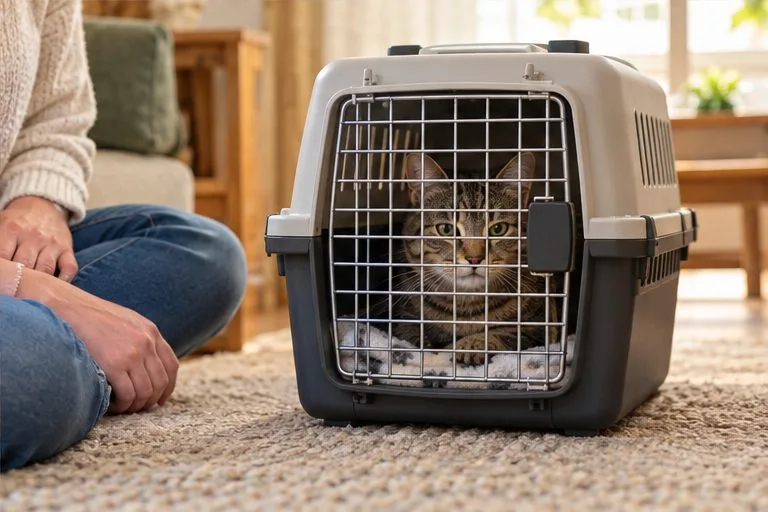
When the cat is comfortable entering, move the door gently, reward, and open it again. Later, close it for a second or two while the cat remains relaxed, then open it and reward. Build time gradually over multiple sessions. Next, practice lifting the carrier from underneath, holding it steadily for a moment, and setting it down. Only when these parts go smoothly should you consider a very short car practice trip. If the cat becomes tense or tries to escape, pause and return to the last easy step.
Practice a brief door closure only after the cat is comfortable entering, then reopen it before the cat becomes worried.
Read the cat’s response, not just whether it went inside
Voluntary approach, sniffing, taking a treat, entering and leaving, or resting in the carrier are useful signs that the cat is tolerating that stage. A cat that freezes, crouches, flattens its ears, pants, vocalizes intensely, scrambles to escape, or stops taking a normally valued treat may be uncomfortable. These behaviors do not diagnose a medical or behavior condition, and one sign alone can have more than one explanation. They do tell you to make the next repetition easier or stop and seek advice.
If the carrier itself seems to trigger a strong reaction, reconsider its style, stability, smell, or past associations. Ask your veterinary practice which carrier they prefer and whether the cat can remain in the bottom half during an exam. The 2026 FelineVMA Positive Reinforcement Training Educational Toolkit describes using rewards and gradual, cat-specific training to build a positive association. It does not mean every cat will progress at the same speed.
If the appointment is coming up soon
Start with what the cat already knows. Put the carrier in a small, quiet room with few places to hide, close the room door, and move calmly. Use a treat or toy if the cat will follow it. Avoid chasing the cat through the home. If gentle encouragement is not working, call the clinic and describe what is happening; staff can advise on a safe plan for that visit. For a cat that cannot be transported without a struggle, ask the veterinarian ahead of time whether a pre-visit medication plan is appropriate. Use only medication or supplements the veterinary team recommends for this cat, at the instructed dose and timing.
A synthetic feline pheromone product is sometimes suggested as an optional aid, but it is not a substitute for carrier practice and should not be presented as a guaranteed fix. Ask the veterinary team whether it makes sense for your cat and follow the product directions. Do not spray anything directly on the cat.
Vet-visit and car-ride checklist
Put a clean, familiar, absorbent blanket or towel inside; bring an extra in case the bedding becomes wet or soiled.
Use one carrier per cat. Keep the carrier level and support it from underneath when carrying.
A light cover can reduce visual stimulation for some cats, but keep air openings clear and check that the cat is not overheating.
Secure the carrier in the vehicle. The FelineVMA’s 2025 transportation position statement advises placing carriers on the floor behind the driver or passenger seat. Use a seat belt only with a carrier certified for crash protection; a belt can crush an uncertified carrier.
At arrival, keep the carrier closed until you are in a secure room or the veterinary team is ready to help. Ask the clinic whether you can wait somewhere quieter if the lobby unsettles your cat.
How to check whether the plan is working
After each short practice, note what the cat chose to do, whether it accepted a reward, and how quickly it returned to normal activity. Progress can be small: approaching the carrier, eating just inside the entrance, or staying relaxed for a short door closure. If the cat avoids the room afterward or becomes more distressed, go back to an easier step and contact your veterinarian for help. A safe carrier routine can make the trip more manageable, but it cannot control every part of a veterinary visit or replace professional guidance when fear is severe.