Home
» Pets
»
What Household Sounds Commonly Stress Birds, Cats, and Dogs?
What Household Sounds Commonly Stress Birds, Cats, and Dogs?
A vacuum starts in the next room, a smoke detector chirps, a blender spins up, or someone drops a pan. To a person, these may be ordinary household sounds. To a bird, cat, or dog, the same sound can be startling, difficult to predict, or hard to escape. The most important question is not simply “Is this sound loud?” but “Does this animal show a repeatable stress response to it?”
Current veterinary and animal-welfare guidance supports a practical approach: pay special attention to sudden, intermittent, high-pitched, very loud, or vibration-producing noises; watch the individual animal’s body language; and reduce exposure when the animal cannot settle. Evidence is strongest for dogs exposed to common household noises, while bird and cat evidence is more limited and often comes from veterinary or controlled environments. That means species-wide lists are useful starting points, not guarantees about how any one pet will react.
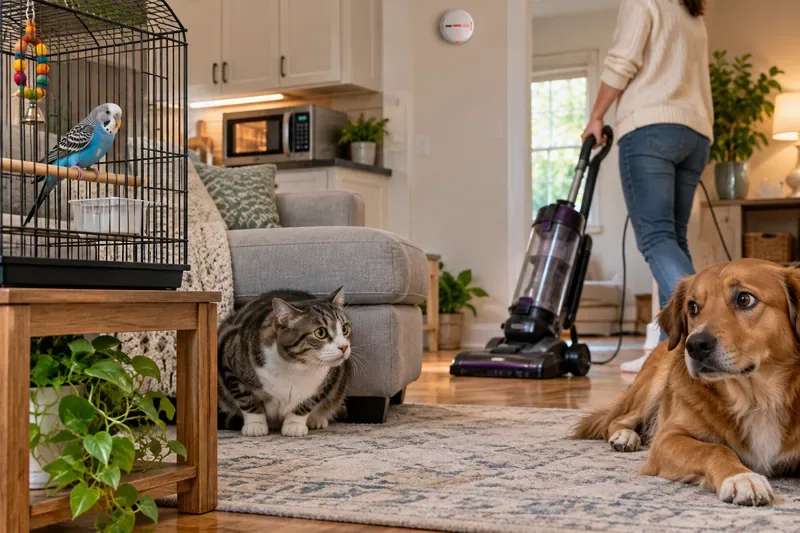
A vacuum cleaner is a common household sound worth monitoring because individual birds, cats and dogs may react very differently to the same noise.
Which household sounds are most likely to bother dogs?
For dogs, research points to two broad groups: sharp intermittent sounds and noisy appliances. A 2021 study from researchers at the University of California, Davis surveyed 386 dog owners and analyzed public videos of dogs reacting to household noises. The researchers found that reactions were stronger to high-frequency intermittent sounds than to lower-frequency continuous sounds. Examples included smoke detector chirps and alarms, alarm clocks, cellphone noises, carbon-monoxide test beeps, microwave beeps, sirens, and similar electronic alerts.
The same study also documented responses to vacuum cleaners, robot vacuums, washing machines and dryers, dishwashers, fans, plumbing, and microwave humming. Owners reported behaviors such as barking, retreating, pacing, whining, hiding, shaking, panting, yawning, and lip licking. Importantly, the authors warned that online videos cannot be used to estimate how common these reactions are in all dogs. The useful takeaway is narrower: ordinary household sounds can provoke genuine fear or stress in some dogs, and people may underestimate subtle signs. See the original UC Davis household-noise study.
Are beeps worse than the vacuum?
They can be for some dogs. In that study, extreme owner-reported reactions were more likely in the category of “beeping” sounds than in the appliance-noise category. That does not mean every beep is inherently more stressful than every vacuum. Volume, pitch, duration, predictability, distance, prior experience, and the dog’s individual temperament all matter.
Veterinary guidance from the American Animal Hospital Association also lists everyday household sounds such as vacuum cleaners and alarm clocks among possible triggers for noise aversion in dogs and cats. AAHA recommends providing a quiet safe space and discussing persistent or intense fear responses with a veterinarian. Its guidance was updated in December 2025: AAHA guidance on noise aversion in pets.
What sounds commonly stress cats?
Cats may react to sudden bangs, vacuum cleaners, loud appliances, construction, barking dogs, loud voices, alarms, and other unpredictable sounds, but household-specific research is thinner than it is for dogs. It is therefore better to avoid pretending there is a universal ranked list.
What has been shown is that high background noise can produce measurable stress responses in cats. In a 2022 study, cats exposed to a recording of common veterinary-clinic noises—including people talking, kennel doors shutting, and dogs barking—had higher heart and respiratory rates; freely moving cats also showed more behavioral signs of fear or stress. The setting was a veterinary environment rather than a normal home, so the result should not be stretched into a claim that any conversation or dog bark will stress every cat. It does support the broader idea that intense or sustained background noise can matter. See the original cat background-noise study.
A newer study of hospitalized cats also found that noisier wards were associated with greater stress measures than quieter conditions. Hospitalized animals are not the same as relaxed pets at home, but the findings reinforce the value of reducing unnecessary noise around cats that are already unsettled or unwell. See the hospital noise study in cats.
What should you watch for in a cat?
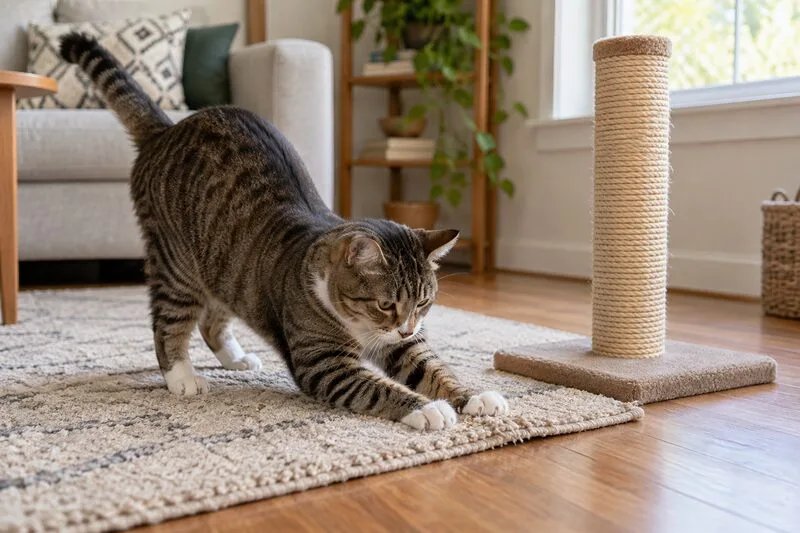
A cat may crouch, freeze, flatten the ears, widen the pupils, retreat under furniture, stop exploring, vocalize, swish or tuck the tail, or abruptly leave the room. Some cats become less visibly reactive and simply disappear to a hiding place. The pattern matters more than a single gesture: if a specific sound repeatedly causes the cat to flee, hide for a long time, refuse food, or avoid a room, that sound is worth modifying.
What household sounds can stress pet birds?
Bird responses can be especially individual. Some pet birds become animated or vocal during normal household activity, and the sound of a vacuum may even trigger flock-like vocal behavior in certain birds. That is not the same as saying vacuuming is harmless for every bird. Veterinary guidance notes that excessively loud television, stereo systems, construction noise, and loud appliances such as food processors can cause undue stress in some birds. The VCA bird-safety guidance discusses this variation directly: VCA guidance on household noise and pet birds.
Government animal-welfare standards also recommend keeping birds away from equipment that produces low-frequency vibration where possible. These standards are written for birds in research settings rather than household pets, but the physical principle is relevant when a cage sits next to a vibrating appliance, subwoofer, laundry machine, or mechanical unit. See the current UK advisory standards for bird housing and noise.
For a newly adopted bird, sudden unfamiliar sounds may be more difficult because the entire environment is new. Veterinary guidance recommends placing a new bird in a relatively quiet location and avoiding sudden loud noises while it acclimates. The MSD Veterinary Manual also notes that ill birds benefit from a quiet location away from barking dogs and excessive activity: MSD Veterinary Manual guidance on pet-bird management.
Whether distance and a quieter room reduce the response
How can you tell stress from ordinary alertness?
A brief head turn or startle followed by normal behavior is different from a pet that cannot recover. Ask three questions: How intense is the reaction? How long does it last after the sound stops? Does it happen repeatedly with the same trigger?
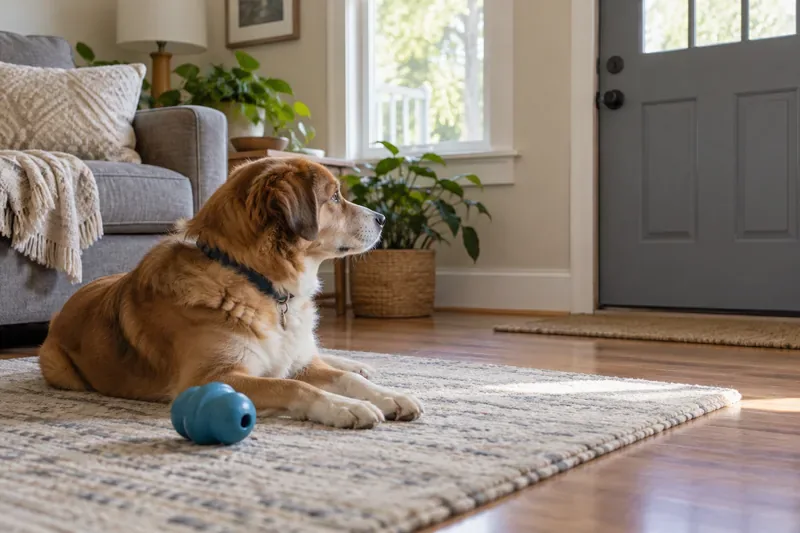
For dogs, repeated panting when not hot, trembling, hiding, frantic escape attempts, persistent pacing, or staying glued to the owner during a particular noise can indicate more than simple curiosity. For cats, prolonged hiding, crouching, freezing, refusal to return to the room, or repeated avoidance is more concerning than a quick ear flick. For birds, frantic flight inside the cage, repeated crashing into cage bars, prolonged alarm calling, open-mouth breathing, or a sustained change in normal behavior deserves attention.
No single behavior proves that noise is the cause. Pain, illness, separation distress, unfamiliar people, odors, changes in routine, or other environmental factors can produce overlapping signs. If the reaction is new, severe, or escalating, a veterinarian can help rule out medical contributors rather than assuming it is “just noise.”
Should you make the house completely quiet?
Usually no. Normal household sound is part of daily life, and many animals tolerate familiar routine noise well. The goal is not silence; it is control, predictability, distance, and the ability to retreat.
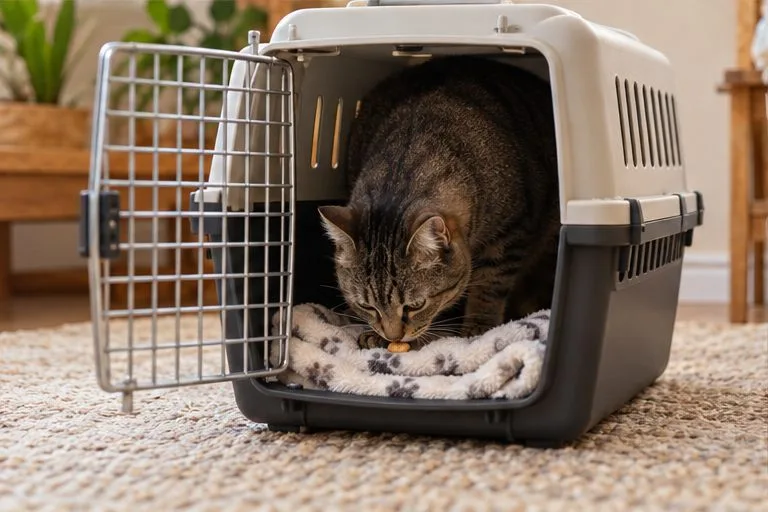
Give the animal access to a quieter room, covered retreat, crate used voluntarily, perch area, or hiding place before a known noisy activity starts.
Move cages, beds, and resting areas away from speakers, televisions, laundry machines, kitchen appliances, and other vibration sources.
Close doors or increase distance before vacuuming, blending, drilling, or moving furniture.
Fix low-battery smoke-detector chirps promptly rather than allowing repeated beeping. Never disable a working safety alarm to make the home quieter.
For predictable sounds, ask a veterinarian or qualified behavior professional about gradual desensitization and counterconditioning. Do not force exposure at a level that already triggers panic.
When should you involve a veterinarian?
Seek veterinary advice when sound-related behavior is intense, worsening, appears suddenly in a previously comfortable pet, causes injury, disrupts eating or sleep, leads to destructive escape attempts, or takes a long time to resolve. Birds should receive prompt avian-veterinary attention for persistent breathing changes, injury from frantic flight, marked appetite changes, or self-injurious behavior. Cats and dogs that panic, injure themselves, or cannot recover after ordinary household sounds also deserve professional assessment.
Medication is sometimes part of a veterinary plan for serious noise aversion, but it should not be improvised from human medications or leftover prescriptions. Environmental changes and behavior work are often part of the plan as well.
What is the simplest way to audit your home?
For one week, note only sounds that produce a visible reaction. Record the sound, time, distance from the source, what the animal did, and how long recovery took. Then look for patterns. If the smoke-detector chirp repeatedly sends the dog under a table, the vacuum makes the cat disappear for an hour, or a blender beside the bird cage triggers frantic movement, you have a concrete target to change.
This approach avoids two common mistakes: assuming every loud sound is harmful, and dismissing a repeated fear response because the sound seems ordinary to people. The pet’s behavior, not the owner’s familiarity with the appliance, is the better guide.
Bottom line
Common stress-triggering household sounds include alarms and beeps, vacuum cleaners and other motorized appliances, dropped objects and slamming doors, loud voices or barking, construction, loud television or music, and vibration-producing equipment. Dogs have particularly strong evidence for sensitivity to intermittent electronic beeps; cats show measurable stress responses to noisy environments; and birds vary widely, with excessive volume, sudden noise, and vibration being the main concerns supported by veterinary and welfare guidance.
Use the list as a screening tool, not a diagnosis. Watch the individual animal, provide a quieter escape option, reduce avoidable exposure, and seek veterinary help when reactions are severe, persistent, or changing.