Home
» Pets
»
What Causes Aquarium Water to Turn Cloudy After a Water Change?
What Causes Aquarium Water to Turn Cloudy After a Water Change?
You finish a routine water change, step back, and notice that the aquarium looks hazy or milky. The fish may still be visible, but the sudden change can be unsettling. Cloudiness has several possible causes, and its appearance alone cannot tell you whether the water is safe. Start by noting the color, timing, what you cleaned or added, and how the fish are behaving.
Most post-change cloudiness comes from fine particles stirred into the water, a temporary change in the tank’s microbial community, or algae. A separate issue—untreated chlorine or chloramine, or rising ammonia or nitrite—can threaten fish even when the water looks clear. Use the checks below to separate a clarity problem from a water-quality problem.
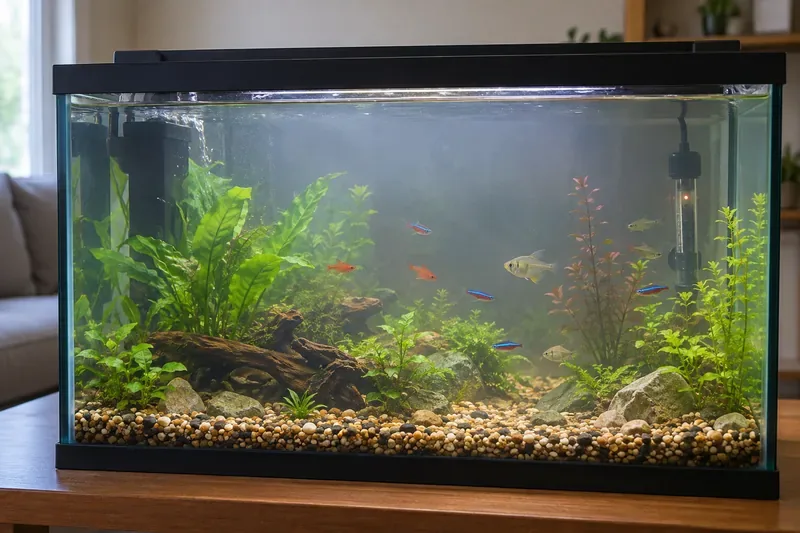
A mild haze can soften the view through an aquarium, but appearance alone cannot identify what is in the water.
What does the cloudiness look like?
“Cloudy” describes reduced visibility, not a single substance. Water can lose clarity when particles or microscopic organisms remain suspended. UF/IFAS Extension describes turbidity as cloudiness from suspended or colloidal materials such as clay, silt, organic or inorganic matter, plankton, and other microscopic organisms. Those categories help organize observations, but they do not provide a visual diagnosis for an individual aquarium.
What you notice
Possible explanation
Useful next check
Dusty or gray haze soon after gravel vacuuming, scrubbing, or refilling
Fine substrate, detritus, or other particles were stirred up
Look for particles settling or being caught by the filter; note whether the cloudiness followed a specific cleaning step
Uniform white or milky haze, especially after a tank or filter was recently disturbed
A temporary microbial bloom is one possibility
Check ammonia and nitrite, review whether filter media was replaced or cleaned, and observe the fish
Green water that develops over time
Free-floating algae may be growing in response to light and available nutrients
Review light exposure, feeding, and the tank’s maintenance pattern
Tea-colored water that is still fairly transparent
Dissolved color compounds, often from natural materials such as wood or leaves, may tint the water rather than make it turbid
Compare the color in a clear glass sample and check whether visibility is actually reduced
These clues are only a starting point. Fine particles and microbial growth can look similar, and a photograph or color description cannot measure ammonia, nitrite, disinfectant, pH, or oxygen.
Common reasons water turns cloudy after a change
Substrate or debris was stirred up
A gravel vacuum, hand cleaning, moving decorations, or pouring replacement water forcefully onto sand or soil can lift fine material into the water column. A filter may gradually capture some of it, while heavier particles may settle. If the clouding began immediately during maintenance and looks dusty, this explanation becomes more plausible. It does not prove the particles are harmless, especially if the substrate or a product used in the tank is unfamiliar.
The microbial balance shifted
A milky appearance can occur when free-floating microbes increase. It may coincide with a new aquarium, a change in feeding or stocking, accumulated organic waste, or major cleaning. This is not the same thing as the nitrifying bacteria that support the biofilter. UF/IFAS explains that nitrifying bacteria colonize surfaces in a biological filter and convert ammonia to nitrite and then nitrate. Replacing or aggressively cleaning filter media can disrupt that process; changing water alone does not establish that the biofilter has failed.
Research in a large artificial seawater aquarium also found that turbidity spikes coincided with increases in bacterial gene counts. That study supports the possibility that microbial changes can affect aquarium clarity, but it examined a managed marine exhibit, not every home freshwater tank. A milky haze should therefore prompt observation and testing rather than a confident guess that it is a harmless “good bacteria” bloom.
Algae or organic material is affecting clarity
A green tint suggests a different possibility from a white haze. Suspended algae can reduce clarity when light and nutrients support growth. A water change may happen around the same time as the change becomes noticeable, without being the underlying cause. Brown or amber water can instead be colored by dissolved organic material; color by itself is not the same as suspended particles. UF/IFAS notes that algal blooms and organic or inorganic particles can each affect water clarity in aquatic systems.
New water was not properly treated
Municipal tap water may contain chlorine or chloramine used for disinfection. These are not simply cosmetic cloudiness issues: they can harm fish and other aquatic organisms. Pennsylvania’s Department of Environmental Protection advises aquarium keepers to remove chloramine residuals from water added to aquariums and fishponds. UF/IFAS likewise explains that chloramine forms when chlorine is combined with ammonia and is toxic to aquatic life.
Use a water conditioner labeled for the disinfectant in your supply and follow its current product directions. Do not assume that letting water stand or aerating it will address chloramine; treatment depends on the disinfectant and product. If you are unsure what your utility uses, check its current water-quality information or ask the utility. Cloudiness does not confirm or rule out disinfectant exposure.
What should you check now?
Observe the fish. Note whether they are swimming and breathing normally, eating as usual, or showing a sudden change such as gasping at the surface, unusual lethargy, or erratic swimming.
Test water quality. If fish behavior changes, test ammonia and nitrite promptly using a reliable aquarium test and follow the kit’s instructions. UF/IFAS notes that ammonia is colorless and odorless—even at harmful levels—so appearance and smell cannot rule it out. Its guidance says a healthy tank should have no detectable ammonia.
Review the maintenance sequence. Write down how much water was changed, whether it was conditioned, whether the temperature was close to the tank’s, whether you vacuumed the substrate, and whether filter media was rinsed, replaced, or left alone.
Check the equipment. Confirm that the filter is running and water is circulating. Keep the filter media in service unless the manufacturer’s instructions or a qualified aquatic professional directs otherwise; avoid replacing several biological components at once.
Pause before adding remedies. Avoid stacking clarifiers, medications, or extra chemicals to chase the appearance. A product may change how particles look without addressing the cause, and overlapping treatments can make test results or fish reactions harder to interpret.
If fish are in distress, if ammonia or nitrite is detectable, or if you suspect untreated tap water entered the tank, treat it as a water-quality concern rather than waiting for the water to clear. Follow product directions for water conditioning and seek advice from an aquatic veterinarian, qualified fish-health professional, or the relevant equipment or water-treatment provider. The right response depends on the species, tank conditions, and test results; avoid making a large corrective change with water of unknown chemistry.
When is cloudiness less concerning?
A brief haze after careful substrate cleaning may settle or improve as the filter removes particles, while the fish continue to act normally and test results remain appropriate for the aquarium. A newly set up or recently altered tank may also show temporary changes as its biological system develops. That does not make every cloudy tank safe. Keep observing and test if cloudiness persists, returns after each water change, gets worse, or appears with abnormal fish behavior.
Do not use “the water looks clearer” as the only measure of success. A tank can look clear while ammonia or disinfectant remains a problem, and a tank can look hazy from particles without a dangerous chemical reading. Compare the same observations over time: clarity, filter flow, fish behavior, and measured water values.
Quick reference checklist
Did the haze start during the change or hours later?
Did you disturb gravel, sand, soil, decorations, or filter media?
Is the water white, green, dusty, or merely tinted brown?
Was the replacement water conditioned for chlorine or chloramine?
Are fish behaving normally, and are ammonia and nitrite detectable?
If you can answer these questions, you will have a clearer next step than simply repeating the water change. When the cause remains uncertain, share the tank size, species, maintenance details, test results, and a photo with an aquatic veterinarian or a trusted fish-health specialist.
Water-treatment practices and product directions vary by location and product. The references above support general mechanisms; they cannot identify the cause in a particular tank without observation and water testing.