Home
» Food & Drink
»
Why Roasted Vegetables Steam Instead of Brown
Why Roasted Vegetables Steam Instead of Brown
Roasted vegetables steam instead of brown when moisture is being produced or trapped faster than the oven can evaporate it from their surfaces. A packed pan, vegetables that are still wet, a covered or deep dish, or an oven that has not fully heated can all slow browning. The vegetables may soften normally while remaining pale and glossy.
This does not always mean the food is ruined. Tenderness and browning are separate outcomes: pale vegetables may be cooked through, while browned edges add a deeper, roasted flavor. The fix depends on whether the problem is moisture, spacing, heat, or the kind of vegetable—not simply on adding more oil or leaving the pan in longer.
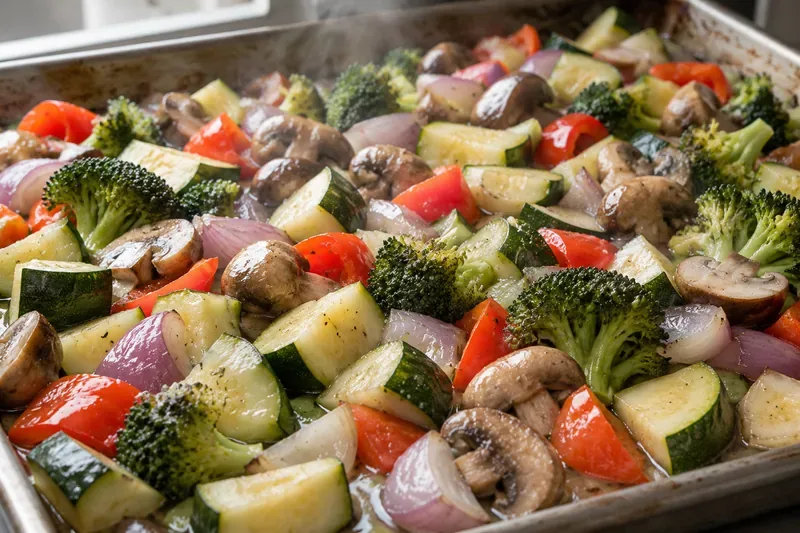
Zucchini, mushrooms, broccoli, onions, and peppers sit close together on a sheet pan with moisture pooling around them.
What creates browning on roasted vegetables?
Roasting uses hot, relatively dry oven air. Vegetables contain water, and they release some as they heat. While moisture remains on the surface, energy goes toward warming and evaporating that water; the surface takes longer to dry enough for browning reactions to build. Steam is therefore normal during cooking, but a crowded or covered pan can keep the area around the vegetables humid and slow that drying.
When vegetable pieces touch or overlap, their released moisture has less open space to escape. The pan can turn humid, and liquid may collect underneath the pieces. The vegetables then cook in a steamy environment before their surfaces dry. University of Minnesota Extension advises against crowding vegetables or using a pan that is too deep for roasting.
Try this: Spread the pieces in one layer with visible gaps. If they cover most of the pan or overlap, divide them between two pans or roast in batches. Use a shallow rimmed baking sheet rather than a deep casserole dish when you want more browning.
2. The vegetables went into the oven wet
Water left from washing adds moisture that must evaporate before the surface can brown. A thin oil coating does not remove that water. It can help distribute heat across the surface, but it cannot compensate for wet vegetables or a pan crowded with them.
Try this: After washing, drain and pat vegetables dry with a clean towel before cutting or tossing with oil. Use only enough oil to lightly coat the pieces. If liquid is already pooling in the pan, carefully drain it if practical, spread the vegetables out, and continue roasting uncovered.
3. The oven was not fully preheated, or the heat is low for the recipe
A cooler oven gives vegetable surfaces more time to release moisture and soften before browning. Extension recipes commonly use a fully preheated oven around 425°F for root vegetables, but that is a starting point, not a universal setting. Cut size, vegetable type, pan, and oven calibration all affect timing and the best temperature.
Try this: Preheat completely and follow a tested temperature for the vegetables you are cooking. If they are tender but still pale, raise the temperature modestly for a short final stretch and watch closely. If the edges are already dark while the centers are firm, lower the heat and give the pieces more time instead.
4. The pan is too deep, covered, or loaded with liquid
A lid, foil cover, deep dish, or generous pour of broth traps vapor. Those methods can be useful when the goal is tenderness, but they work against dry-surface browning. Wet marinades and watery sauces create a similar effect.
Try this: Roast uncovered on a shallow sheet pan. Add a glaze, vinegar, or other liquid near the end, after the vegetables have had time to brown, or serve it at the table.
5. Different vegetables are releasing moisture and cooking at different rates
Mushrooms, zucchini, tomatoes, and other water-rich vegetables can release more liquid than dense roots such as carrots or potatoes. If they share a crowded pan, the wetter ingredients can keep neighboring pieces from browning. Large root-vegetable chunks may need longer than tender florets, while small pieces can dry or burn first.
Try this: Roast vegetables with similar cooking times together. Give watery vegetables their own pan or add them later; cut dense vegetables into evenly sized pieces. If mixing them is more convenient, check the pan early and move tender pieces out as they finish.
6. The vegetables are moved too often
Turning helps expose new sides to heat, but stirring every few minutes interrupts contact with the hot pan and oven air. The exact effect depends on the pan and cut, yet constant movement rarely helps create a well-browned contact side.
Try this: Let the vegetables roast undisturbed long enough for the undersides to color, then turn once or twice. A flat cut side facing down can increase contact with the pan, especially for halved Brussels sprouts, squash wedges, or cut root vegetables.
Quick diagnosis: what does the pan look like?
What you see
Likely issue
Useful adjustment
Liquid pooling and glossy surfaces
Too much surface moisture, crowding, or watery vegetables
Drain if needed, spread out, and roast uncovered; use another pan.
Soft, pale vegetables with little steam or liquid
Oven may be cool, pan may be deep, or cook time may be too short for browning
Confirm the oven is fully preheated; use a shallow pan and allow more time.
Brown edges but firm centers
Pieces may be too large, uneven, or cooking too hot for their size
Cut uniformly next time; for this batch, lower the heat and continue until tender.
Some vegetables burnt while others remain wet
The mix has different moisture levels or cooking times
Separate types or add quick-cooking vegetables later.
Misconceptions worth correcting
“More oil will stop steaming.” Not reliably. Oil can improve surface contact and flavor, but the amount of water and how well it escapes matter more. Use a light, even coating.
“Every brown vegetable is caramelized.” Not necessarily. Maillard browning and caramelization are different chemical pathways, and both can contribute to flavor. You do not need to identify which one occurred to fix a wet pan; focus on surface moisture, spacing, and heat.
“Pale means undercooked.” Color alone cannot tell you whether vegetables are tender. Check texture with a fork and use browning as a flavor and texture preference, not the only doneness test.
“A single temperature works for every vegetable.” Roasting guidance varies with the vegetable, size, amount, and pan. A 425°F recipe is a useful reference for many root vegetables, but not a rule for every oven or every tray.
What to change on the next tray
Dry washed vegetables and cut them into pieces of similar size.
Preheat the oven and use a shallow, uncovered pan.
Toss with a light coating of oil, then spread in one layer with gaps.
Group vegetables by cooking time and moisture level when possible.
Let them roast before turning; check tenderness and browning separately.
If the vegetables are already tender but pale, the simplest rescue is often to spread them over a larger hot surface and continue roasting uncovered. If they are swimming in liquid, separate the liquid first. The amount of additional time depends on the vegetable and how much moisture remains, so use the color and texture in front of you rather than a fixed number of minutes.