Home
» Food & Drink
»
Why Homemade Bread Splits on the Side Instead of the Top
Why Homemade Bread Splits on the Side Instead of the Top
Homemade bread usually splits on the side because the loaf expands in the oven but its top score does not open enough to release that expansion. The dough then tears at another weak spot, often a shallow score, a shaping seam, or a crust that set before the loaf finished rising. The most useful clue is the shape and location of the tear: a side split does not point to one cause in every recipe.
This is especially common with free-form crusty loaves, such as boules and bâtards, which have no pan holding their sides in place. For a soft sandwich loaf baked in a tin, check the pan size and dough amount as well as the score. The notes below were checked against current King Arthur Baking guidance on September 30, 2026; exact scoring and proofing needs vary with dough, shape, and recipe.
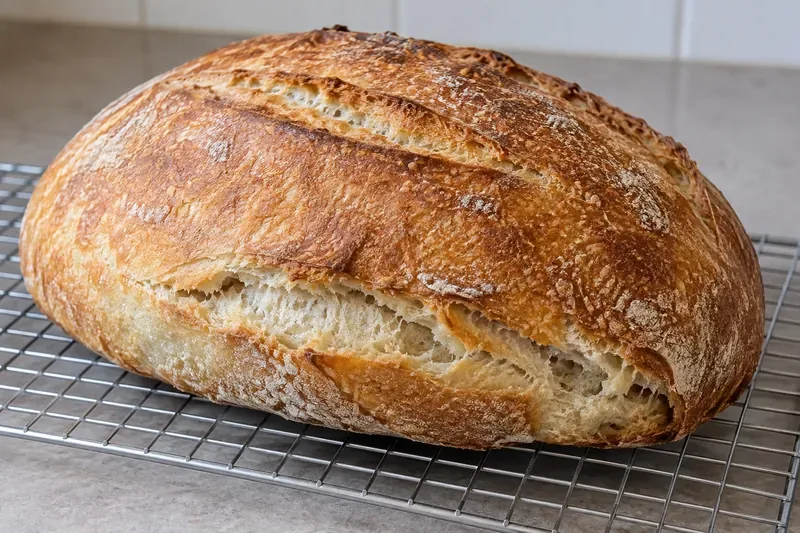
A rustic homemade loaf has split along its lower side, while the cut across the top has opened only slightly.
Why the loaf opens somewhere other than the top
In the first part of baking, yeast and heat make the dough expand quickly. Bakers call this oven spring. Before the outer crust firms, a score—a cut made in the shaped dough before baking—gives that expansion a planned route. If the score is too shallow, poorly placed, or unable to open, the dough can rupture at another weak point. King Arthur Baking explains that scoring guides expansion and that bread without an effective score can blow out at the side or top.
Think of a free-form sourdough boule with a faint line across its crown but a broad tear near the base. If the top line stayed almost closed while the side opened, the dough likely did not get an effective release at the score. That is a useful starting clue, not proof of a single mistake: the seam, proof, dough strength, and early baking conditions may also matter.
Read the split before changing the recipe
What you see
What it may point to
What to check next
The top score is faint or mostly closed, but the side tore open
The score may not have cut through the dough’s outer skin, or it may have been positioned so it could not open well
Review the blade sharpness, cut placement, and whether this dough needed a deeper or shallower cut
A long, fairly straight split follows the underside or side seam
The shaping seam may have been left weak, or the loaf may have been turned or placed differently than the recipe intended
Check how the seam was pinched and which side faced up or down during proofing and baking
The loaf bursts strongly and the crumb is unusually tight or dense
Underproofing may have left more expansion for the oven; it is only one possible factor
Compare dough readiness with the recipe’s visual cues, not just its clock time
The crust looks firm early and the planned score barely opens
A dry baking environment may have let the crust set too soon, especially for a hearth-style loaf
Check whether the recipe expects steam, a covered pot, or another moisture-retaining method
A soft pan loaf shreds along one side or rises unevenly
The pan may not support that particular dough well, or the dough amount may not match the pan
Verify the pan dimensions and dough quantity specified by that recipe
These clues are not a guaranteed diagnosis. A loaf can show more than one at once: for example, a shallow score and a dry oven can both limit controlled opening. Change one variable on the next bake and compare the result, rather than changing proof time, flour, scoring, and oven setup all together.
When the score is the likely issue
If the score is barely visible after baking, look first at how it was made. A blunt blade can drag, and an extremely shallow mark may not penetrate the dough’s outer skin. A cut that is too deep can create a different problem by releasing too much structure, so “cut deeper” is not a universal answer.
Scoring depth depends on the loaf. King Arthur’s scoring trials distinguish between chilled loaves, whose surface may have dried and thickened in the refrigerator, and loaves proofed at room temperature, whose skin can be thinner. Their examples use different depths for those different dough conditions. Follow the recipe’s approach and observe the score after baking; do not copy a depth from a sourdough boule onto a soft sandwich dough without checking that the recipe calls for it.
Try this when: the top cut seems etched rather than open and the loaf has a side blowout. Use a sharp blade and a deliberate cut suited to that recipe, then bake again under the same conditions. If the score opens and the side stays intact, the change addressed the likely weak point.
When steam or early crust formation may matter
For many crusty hearth loaves, moisture at the start of baking keeps the outer surface flexible for longer. That gives the loaf time to expand and allows the score to open before the crust sets. King Arthur’s home-steaming guide describes this early flexibility as one function of steam. Its scoring trials also show that even a well-scored loaf may expand less predictably without enough moisture in the baking environment.
This does not mean every bread needs added steam. A covered Dutch oven traps moisture released by the dough and is often used for round or oval hearth loaves. A sandwich loaf in a pan follows a different method, and an enriched dough may not need the same crust treatment as a lean artisan loaf. Use the method specified by your recipe. If a free-form loaf’s crust seems to set quickly and the score remains tight, a covered bake or the recipe’s recommended steam method may be worth checking.
Try this when: the score stays closed even though it looks adequate, and the crust seems to firm early. Keep the dough and score technique the same, then test the recipe’s stated steam or covered-bake method. Avoid pouring water into an oven unless the recipe and oven instructions make that safe; steam can burn, and some ovens are not designed for improvised water additions.
When shaping, proofing, or pan fit is more likely
A side tear that traces a straight line may be the shaping seam reopening. During shaping, bakers bring folds together and create a taut outer surface; King Arthur’s boule guidance describes how gentle tension helps support the loaf’s structure. If a seam was not closed well or the loaf was handled in a way that disturbed it, the seam can become the weak point. The seam’s position depends on the recipe: a boule may proof seam-side up in a basket and then be turned out before baking.
Proofing can also affect how much expansion remains. Baking dough too early may leave it with strong oven spring, while overproofed dough can feel fragile and may collapse when handled. A side split alone cannot tell you whether dough was underproofed. Look for other clues: unusually tight crumb and a forceful burst may fit underproofing; a slack, fragile loaf with little lift may fit overproofing. King Arthur notes that rise time changes with dough temperature, room conditions, loaf size, and shaping, so recipe times are guides rather than a universal clock.
For pan bread, confirm the recipe’s pan dimensions. A pan that is too wide may give a soft dough less side support than intended; too much dough for the pan may also push expansion upward and outward unevenly. King Arthur documents one specific sourdough sandwich loaf that rose unevenly and shredded along its sides in a wider 9-by-5-inch pan because that soft dough needed more support. That is a recipe-specific example, not a rule that all bread should use that company’s pan.
Try this when: the split follows a seam or appears in a pan loaf that mushrooms over the rim. Keep the formula steady and correct the seam closure, proof cues, or pan match first. If the same split remains after that single change, return to the score and early baking conditions.
Limits of the fix
A controlled top opening is partly a visual goal. Some bakers prefer a rustic side burst, and some bread recipes intentionally use a seam or decorative scoring pattern to create a particular shape. A side split does not automatically mean the loaf is ruined. It may affect the loaf’s appearance, height, or crumb, but judge the bread against the recipe’s intended style.
Scoring also cannot compensate for every dough problem. A very weak or overly slack dough may not hold a defined opening, while a score that is too deep can make a loaf spread. Moisture, flour choice, fermentation, shaping tension, pan geometry, and oven setup interact; without seeing the formula and the finished crumb, no article can identify the exact cause from the split alone.
A practical next-bake check
Did the top score open clearly, or did it remain a faint mark?
Does the side tear follow a seam, the base, or a random weak area?
Was the loaf free-form or baked in a pan that matches the recipe?
Did the dough look ready according to the recipe’s cues, not only the stated minutes?
For a crusty hearth loaf, did the recipe call for steam or a covered bake?
Use the answer to choose one adjustment. A closed score suggests checking the cut; a seam-shaped tear points toward shaping; a tight, explosive loaf invites a closer look at proofing; and a soft pan loaf that shreds calls for checking pan fit. Keeping the other variables steady makes the next loaf more informative.