Home
» Food & Drink
»
Why Cooked Rice Gets Hard in the Fridge—and How to Reheat It Safely
Why Cooked Rice Gets Hard in the Fridge—and How to Reheat It Safely
Chilled rice can firm up in the refrigerator; adding a little water and reheating it covered helps restore moisture.
Cooked rice often turns firm or hard in the refrigerator because its starch changes as it cools, and uncovered storage can dry the grains further. That texture change alone does not mean the rice is spoiled. To soften rice that was cooled and stored promptly, sprinkle it with water, cover it, and reheat it until steaming throughout and at least 165°F (74°C). Food safety depends on how quickly rice was cooled and how long it sat out—not on whether it feels dry.
Why does refrigerated rice get hard?
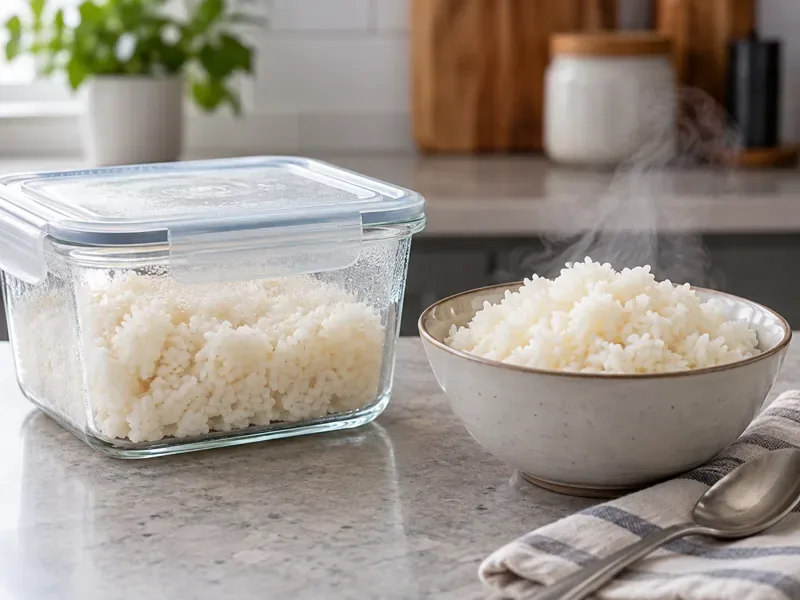
Rice contains starch granules that absorb water and swell during cooking. As cooked rice cools, some starch molecules begin to realign and form firmer structures, a process called starch retrogradation. It is one reason cooked rice becomes less soft and less sticky after chilling. Cooling also lets moisture move within the grains; if rice is stored uncovered or in a container that does not seal well, water can escape into the refrigerator air. The surface then feels especially dry and firm.
The amount of firming varies. Rice variety, how much water it absorbed, cooking method, storage time, and how tightly it is covered all matter. Long-grain rice may stay more separate than a sticky short-grain variety, but either can harden. A day-old container may still be soft in the center and dry at the edges. These are quality changes, not a reliable safety test: rice can be unsafe even if it looks and smells normal, and dry rice can still be safe if it was handled correctly.
Reheating adds heat and moisture, loosening some of the firm texture. It can make cold rice pleasant again, although it may not have exactly the softness of freshly cooked rice. If a small portion is merely a little dry, adding a teaspoon or two of water per cup of rice is a practical starting point; use more for a larger amount or very dry grains, then adjust after heating.
How should you store leftover rice?
Cooked rice deserves prompt handling because Bacillus cereus, a bacterium associated with rice and other foods, can form heat-resistant spores. Cooking may not destroy every spore. If rice stays warm at room temperature for too long, bacteria can multiply and some strains can make a toxin. Reheating does not reliably undo unsafe storage: heat can kill many bacteria, but it may not destroy toxin that has already formed. The practical protection is to cool rice quickly and keep it cold.
Move leftovers into clean, shallow containers so they cool faster. Divide a pot of rice into meal-size portions rather than refrigerating it as one deep, warm mass.
Refrigerate promptly. U.S. food-safety guidance says perishable food should not sit out for more than two hours, or one hour when the surrounding temperature is above 90°F (32°C). For rice specifically, the UK Food Standards Agency advises cooling it as quickly as possible, ideally within one hour.
Keep the refrigerator at 40°F (4°C) or below. Cover the rice once it has been portioned and chilled; do not wait for a large pot to reach room temperature before refrigerating it.
Use a rice-specific storage limit. The UK Food Standards Agency recommends keeping cooked rice in the refrigerator for no more than one day before reheating. USDA guidance gives a general three-to-four-day window for most leftovers, but that broader rule is not rice-specific. For a simple, cautious household routine, use or freeze refrigerated rice within one day.
If you know you will not use the rice by the next day, freeze it soon after cooling in small, airtight portions. Thaw it in the refrigerator or reheat it from frozen, adding water as needed. Avoid leaving rice to cool on the counter for hours, placing a deep hot pot in the refrigerator, or relying on smell as proof that rice is safe.
How can you reheat rice safely and keep it soft?
Reheat only rice that was cooled and stored safely. Take out the portion you plan to eat, add a small splash of water, and heat it covered. The lid or microwave-safe cover traps steam, helping the grains absorb moisture rather than drying out further. Stirring breaks up clumps and helps heat spread evenly.
Microwave method
Place a single serving in a microwave-safe bowl and separate any large clumps with a fork.
Sprinkle with water. Start with about 1 to 2 teaspoons per cup, then add a little more if the rice remains dry.
Cover with a microwave-safe lid or plate, leaving a small vent if the cover requires one.
Heat until hot and steaming throughout. Pause partway through to stir, rotate the bowl if needed, and break up cold pockets.
Check the center and several spots with a food thermometer. USDA recommends reheating leftovers to 165°F (74°C). Let microwaved food stand briefly after heating so the temperature evens out, then check again if needed.
Stovetop method
Put the rice in a saucepan with a splash of water, cover, and warm it over low to medium-low heat. Stir once or twice as steam loosens the grains. Add small amounts of water if the pan becomes dry before the rice is hot. Check that the whole portion reaches 165°F (74°C), especially in the middle of a larger batch.
Fried rice or another cooked dish
Rice added to fried rice, soup, or a casserole still needs safe handling. Heat the complete dish evenly and verify 165°F (74°C) in several places. Do not assume that browning the outside or seeing steam on top means every part is hot enough. If reheating a larger quantity, divide it into smaller portions first.
For example, if you cooked extra rice at dinner and refrigerated a shallow, covered container within an hour, a lunch portion the next day can be reheated with a splash of water, covered, stirred halfway through, and checked at the center for 165°F. If the same rice was left on the counter overnight, reheating it until piping hot does not make it a safe choice; discard it instead.
Can you reheat rice more than once?
Food Standards Agency advice is to reheat rice only once. This limits repeated warming and cooling, which creates more opportunities for time-temperature mistakes and does not improve the food. Portion leftovers before storing so you heat only what you intend to eat. If reheated rice remains uneaten, do not cool it again for another cycle; discard what has been served or warmed.
Quick safety and texture check
It became hard in the fridge: usually a starch and moisture change. Add water and reheat covered if it was stored safely.
It sat out too long: discard it, even if it smells fine. Reheating is not a rescue for rice that was left in the danger zone.
It was chilled promptly and stored cold: use it within a day as the rice-specific cautious limit described here, or freeze it for later.
It is reheated: stir to remove cold spots, heat until steaming, verify 165°F (74°C), and reheat only once.
These steps follow consumer guidance available as of October 1, 2026. Storage recommendations differ by jurisdiction: U.S. agencies publish a general leftover window, while the UK Food Standards Agency gives rice-specific advice. This article uses the shorter rice-specific timeframe as a conservative practical rule; local public-health guidance may differ.