Home
» Food & Drink
»
Why Does Sauce Separate After Reheating, and Can You Fix It?
Why Does Sauce Separate After Reheating, and Can You Fix It?
A sauce that looked smooth yesterday can come out of the refrigerator oily, grainy, watery, or curdled after reheating. That usually does not mean the recipe suddenly “went bad.” More often, the structure that kept fat, water, proteins, and starch evenly mixed has weakened during cooling, storage, freezing, or reheating.
The useful first question is not simply “Can I stir it back together?” It is “What kind of sauce is this, and what actually separated?” An emulsion such as hollandaise behaves differently from a starch-thickened gravy, a cheese sauce, or a cream sauce. The right fix depends on that distinction.
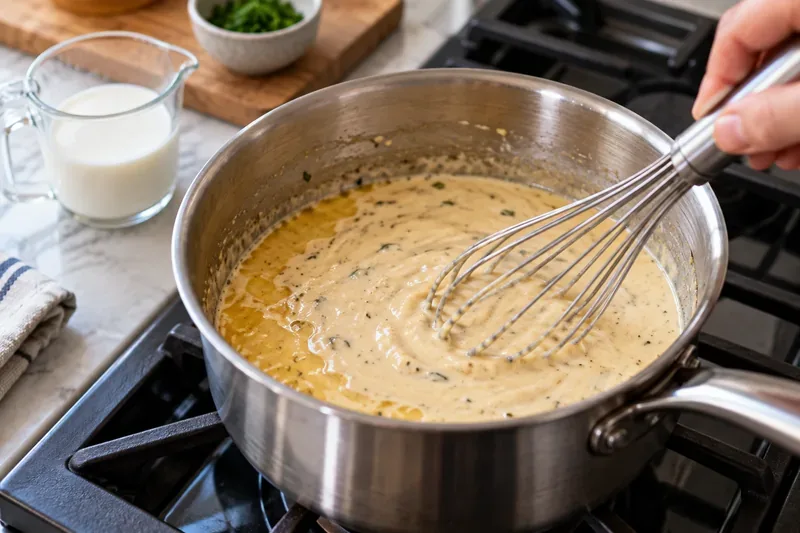
A cream-style sauce with visible fat separation being whisked gently; lowering the heat and restoring a little moisture can help some sauces come back together.
Why does sauce separate when you reheat it?
Most sauces are mixtures that are only stable within a certain range of temperature, water content, acidity, and agitation. Refrigeration can firm fats, tighten starch gels, and change how proteins hold water. Reheating then adds another stress: if the sauce gets too hot too quickly, the ingredients may no longer stay evenly dispersed.
Several common mechanisms can be involved:
An emulsion breaks. In butter, cream, egg-yolk, or pan sauces, tiny fat droplets are suspended in a water-based phase. Excessive heat, too little water, or insufficient mixing can let those droplets merge into a greasy layer.
Dairy proteins tighten and clump. High heat or strong acidity can make milk proteins aggregate, producing a grainy or curdled appearance.
Starch changes after cooling. Flour- or cornstarch-thickened sauces can become very firm in the refrigerator and then loosen unevenly on reheating. Some starch systems tolerate freezing and thawing poorly and may release water.
Water has evaporated. A sauce that was balanced when fresh may become too concentrated during reheating. Once there is not enough water to support the original texture, fat can separate more easily.
Microwave hot spots overheat part of the sauce. Microwaves can heat unevenly, which is why the FDA advises covering and stirring food during reheating to reduce cold and hot spots. See the FDA reheating guidance.
Is a separated sauce unsafe to eat?
Separation by itself is a texture problem, not a reliable food-safety test. A sauce can look broken and still be safely handled, or look perfectly smooth and still be unsafe because of time and temperature abuse.
For refrigerated leftovers, the FDA recommends reheating leftovers to 165°F (74°C) and bringing leftover sauces, soups, and gravies to a boil. It also advises refrigerating perishable food within two hours, or within one hour when the ambient temperature is above 90°F (32°C). Those rules matter more for safety than whether the sauce looks glossy or split. See the FDA safe food handling guidance.
If a perishable sauce sat at room temperature too long, do not assume boiling will make it safe again. Some bacterial toxins can survive ordinary reheating. USDA guidance specifically notes that reheating does not necessarily destroy all toxins that may form when food has been mishandled. See the USDA FSIS explanation.
Can you fix a sauce after it separates?
Often, yes. The easiest sauces to rescue are those that have only slightly lost their balance. A sauce that is severely curdled, scorched, or overcooked may not return to its original texture.
What the sauce looks like
Likely issue
Best first move
Oily layer on top
Emulsion has loosened or there is too little water
Take off heat, add a small splash of warm water, milk, cream, or stock, then whisk
Very thick and pasty
Starch set during chilling or water evaporated
Reheat gently while adding liquid a little at a time
Grainy cheese sauce
Proteins and fat have separated from overheating
Lower heat immediately; whisk in a little warm liquid
Watery with soft lumps after freezing
Freeze-thaw damage to starch or dairy structure
Stir while reheating; expect partial, not always complete, recovery
Egg-butter sauce looks scrambled or very greasy
Delicate emulsion overheated
Stop heating; rescue may require rebuilding the emulsion
What should you try first?
1. Stop adding heat
If you see fat pooling or the sauce turning grainy, remove the pan from the burner. Continuing to boil a delicate sauce usually makes the separation worse.
2. Restore a little moisture
Add liquid in small amounts rather than flooding the pan. Water, milk, cream, stock, or the original sauce base may work depending on the recipe. Whisk or stir between additions. This is especially useful when reheating has simply concentrated the sauce too much.
3. Use gentle agitation
Whisking helps redistribute fat droplets and smooth out starch-thickened sauces. Penn State Extension notes that stirring during reheating helps keep frozen sauces and gravies smooth, and that some modified starches tolerate freezing better than conventional starch systems. See Penn State Extension on modified food starches.
4. Reheat gradually
Low-to-moderate heat gives you more control. Missouri Extension recommends gentle reheating and frequent stirring for cream-based soups and notes that milk sauces and gravies may curdle or separate after freezing. See University of Missouri Extension guidance on freezing prepared foods.
Why are cheese and cream sauces especially prone to splitting?
Cheese and cream sauces contain both fat and proteins. When heated aggressively, proteins can contract and squeeze out moisture and fat. That is why a cheese sauce may shift from smooth to grainy while an oily film appears around the edges.
The practical fix is usually to lower the temperature before doing anything else. Then whisk in a small amount of warm milk, cream, or water. If the sauce is already heavily curdled, blending may improve the appearance, but it cannot always undo protein damage. For future batches, slower reheating and avoiding prolonged boiling usually give better results.
What about flour- or cornstarch-thickened sauces?
Starch-thickened gravy and white sauce often change texture in the refrigerator because starch molecules continue reorganizing as the sauce cools. The sauce may set into a gel, then appear lumpy or loose unevenly when reheated.
For these sauces, gradual reheating with regular stirring is usually more useful than vigorous boiling. Add a small amount of liquid if the sauce has become too thick. If it has gone watery after freezing, stirring can help, but some sauces never return completely to their pre-freezing texture.
Penn State Extension specifically notes that modified starches can help reduce curdling and separation in sauces intended for freezing. That is useful if you regularly batch-cook gravy or dairy-based sauces for the freezer.
Can hollandaise or béarnaise be reheated?
These are unusually delicate emulsions because egg yolk must hold melted butter and water together without the eggs overheating. They are best treated more cautiously than ordinary gravy or cream sauce.
The Exploratorium’s cooking science material advises keeping hollandaise over low heat and serving it warm rather than hot. See its hollandaise science and recipe guidance. Once an egg-butter emulsion has been overheated badly, simply boiling and whisking harder is not a reliable rescue strategy.
For food-safety reasons, do not let egg-based sauces sit warm for extended periods. If they are being stored as leftovers, follow standard refrigeration and reheating guidance rather than relying on appearance alone.
Does freezing make separation more likely?
Yes, particularly in milk-based and starch-thickened sauces. Ice crystals and freeze-thaw changes can disrupt the structure that held water, fat, and starch together. Missouri Extension notes that milk sauces and gravies often curdle or separate after freezing, although stirring during reheating can improve smoothness.
If you plan to freeze sauce regularly, it can help to freeze it in small portions, cool it promptly, and choose recipes or thickeners known to tolerate freezing. Reheat from thawed or frozen according to food-safety guidance and stir often.
Is the microwave a bad choice?
Not necessarily, but it requires more attention. Because microwave heating can be uneven, one area can become much hotter than another before the whole container is warmed through. That local overheating is exactly what can destabilize dairy or emulsified sauces.
Use a microwave-safe container, cover it loosely, heat in short intervals, and stir thoroughly between intervals. The FDA recommends stirring and rotating foods during microwave reheating and checking temperature in more than one area.
When should you stop trying to rescue the sauce?
Texture can often be repaired, but there are limits. Discard rather than rescue when the sauce has been stored unsafely, has obvious spoilage, or has been left at room temperature beyond recommended limits. Also stop if it is scorched; a burnt flavor will not disappear when the emulsion is restored.
From a quality standpoint, some sauces are not worth forcing back together. A badly scrambled egg sauce or severely curdled dairy sauce may remain grainy no matter how much it is whisked. In that case, starting a fresh sauce is usually more predictable.
How can you prevent separation next time?
Reheat over lower heat instead of bringing delicate cream, cheese, or egg sauces rapidly to a hard boil.
Stir frequently so the sauce heats evenly.
Add a splash of liquid if the sauce became very thick in the refrigerator.
For microwave reheating, use short intervals and stir between them.
Freeze sauces in small portions when possible, and expect some dairy and starch sauces to change texture after thawing.
For food safety, cool leftovers promptly and follow current FDA/USDA reheating recommendations rather than judging by texture alone.
Quick answer
A reheated sauce usually separates because its emulsion, dairy proteins, starch structure, or water balance has been disturbed by chilling, freezing, or excessive heat. Many sauces can be improved by stopping the heat, adding a small amount of liquid, and whisking gently. Delicate egg-butter sauces and severely curdled dairy sauces are harder to rescue. And if the sauce was stored unsafely, texture repair is irrelevant: discard it rather than trying to “boil it safe.”