Home
» Food & Drink
»
School-Safe Halloween Snacks: A Practical Food Allergy Planning Checklist
School-Safe Halloween Snacks: A Practical Food Allergy Planning Checklist
A school Halloween snack is ready to share only when it fits the school's rules, the children who will receive it, and the way the food will be served. “Nut-free” on a party note does not answer every allergy question. A child may need to avoid milk, egg, sesame, wheat, or another ingredient, and a label that looked suitable last year may have changed. The practical goal is a celebration in which each child has a verified option and staff know what to do if something goes wrong.
This guide uses U.S. labeling and school-health guidance checked in September 2026. Your district's event rules and each student's individual allergy plan take priority for a particular classroom. Do not ask another family to disclose a child's diagnosis to the whole class; coordinate through the teacher, school nurse, or designated event organizer.
Quick decision table: what can go to school?
Option
Check before you send it
When to change course
Factory-sealed single-serve food
School permits it; each unit or its original outer package has current, reviewable ingredients; the child's care plan allows it.
Packaging is missing, label is unclear, or the school cannot approve it.
Homemade or bakery food
School specifically accepts it and the receiving families and staff have a reliable way to assess ingredients and preparation.
Recipe, bakery handling, or shared equipment cannot be verified; choose another option.
Non-food item
School permits it; size and material suit the children's ages.
It has small detachable parts, latex, or an ingredient such as wheat in some modeling doughs.
Child-specific snack from home
Teacher knows whose item it is, where it will be kept, and who may serve it.
It could be mixed into a communal bowl or offered to another child.
1. Confirm the classroom rules and the allergy plan
Ask the teacher what kind of celebration is planned, whether outside food is allowed, when it must arrive, and whether only sealed store-bought items are accepted. Also ask who will approve the item and whether a non-food contribution would be easier. Rules vary by school, and an event advertised as “allergy-aware” does not certify that every snack is suitable for every child.
For a child with a diagnosed allergy, parents should check that the school has the child's current food allergy and emergency care plan, medication arrangements, and trained adults for the party and any after-school event. The CDC's school food allergy guidance calls for plans that cover both prevention and response, including anaphylaxis, a sudden severe reaction. Do this before the day of the party, rather than expecting a substitute teacher or volunteer to infer the child's needs.
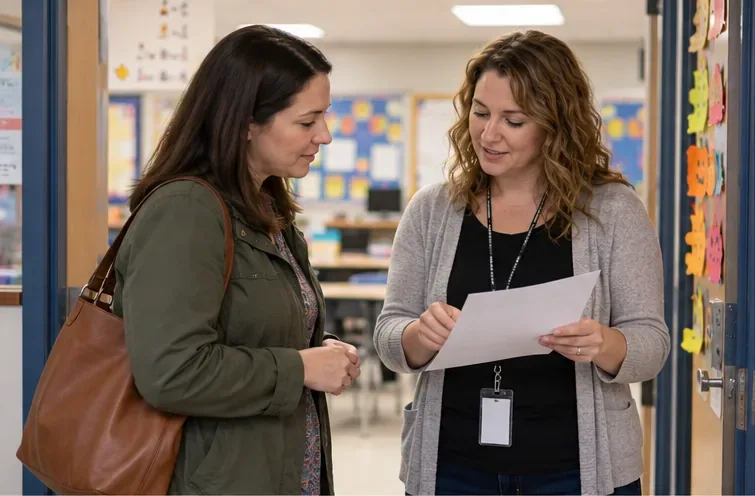
A parent and teacher review a paper at the classroom doorway. The useful first check is the school’s actual food policy and the child’s individual care plan.
2. Read the exact package you intend to bring
Under U.S. rules for most FDA-regulated packaged foods, nine major allergens must be identified when used as ingredients: milk, egg, fish, crustacean shellfish, tree nuts, wheat, peanuts, soybeans, and sesame. The food source can appear in the ingredient list or in a nearby “Contains” statement. A product does not have to use a separate “Contains” box, so read the full label. Also remember that a child may be allergic to a food outside those nine. The FDA's label-reading guidance explains both the required disclosures and their limits.
“May contain” and “made in a facility” are voluntary precautionary statements about possible unintended presence. Their absence is not a guarantee against cross-contact, the transfer of an allergen from another food or surface. If a child's plan says to avoid products with a particular precautionary warning, follow that plan. If the label leaves a relevant question unresolved, contact the manufacturer using the package details or choose another item. Do not decide from the front-of-package slogan alone.
Check the actual Halloween-sized unit, not a full-size bar with a familiar name. The allergy organization FARE notes that miniature candies can have different ingredients and recommends reviewing current labels. Keep the outer bag available if individually wrapped pieces omit complete ingredient information. If staff or a parent cannot positively identify a piece, it should not be served to a child with that allergy.
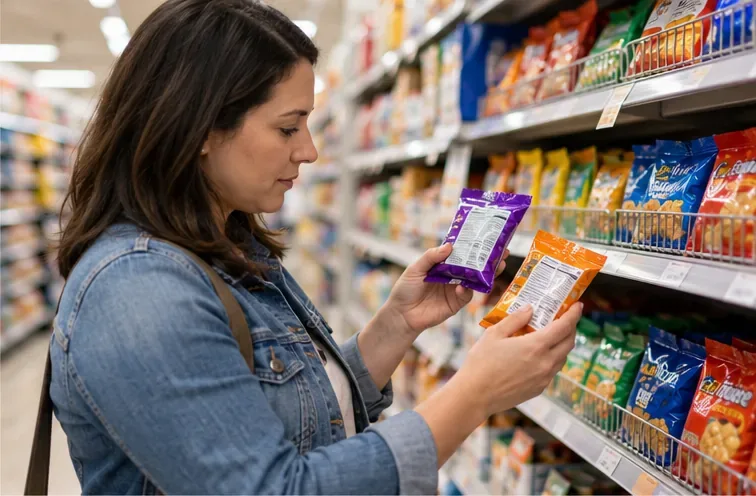
A shopper compares two sealed packages in a store. The package actually purchased, including a fun-size version, needs its own label review.
3. Pack for a controlled handoff, not a communal bowl
Choose a small number of approved, unopened items and keep them in their original packaging. Give the teacher the product name, a photo or copy of the ingredient panel if requested, the count, and the date by which the school needs to review it. Ask whether it should go to the nurse, main office, or classroom. A sealed, labeled package helps the person serving food make a decision; it does not override the child's personal restrictions.
If you prepare any food at home and the school permits it, ask the receiving family or school how it will be assessed. An ingredient list alone cannot establish what happened on shared pans, utensils, or countertops. FARE's cleaning guidance recommends washing hands with soap and water to remove food allergens; plain water and hand sanitizer are not effective substitutes for that purpose. For a class with multiple restrictions, a no-food craft or individually checked commercial items may be more manageable than homemade treats.
Keep non-food favors separate from food, and check age suitability. A sheet of paper stickers or a simple coloring page may be easier for staff to distribute than a bag of tiny toys. Non-food does not automatically mean risk-free: FARE notes that some modeling doughs contain wheat and some items contain latex. Avoid suggesting that children trade snacks or open wrappers together at the table.
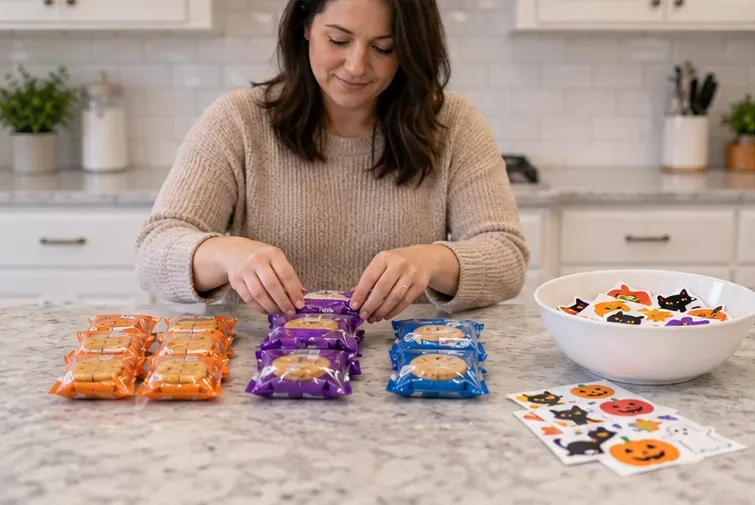
Sealed snack packets and stickers are arranged separately on a kitchen counter. Keep original packaging intact and let the school approve distribution.
4. Agree on how the snacks will be served
Before the event, the organizer should know which adult checks packaging, who handles each child's approved item, whether shared surfaces will be cleaned, and how children will be reminded not to swap food. The child who needs a separate snack should receive it without a public announcement about their medical history. If the class uses an “everyone gets the same” plan, it still requires confirmation for each known restriction; “free of the top nine” is not the same as safe for every student.
Confirm where the emergency plan and prescribed epinephrine are available and who is trained to act. Follow the child's school plan if symptoms occur. The CDC warns that recognizing and treating a severe reaction quickly matters; its school toolkit is intended to help staff prevent and respond to reactions. For a suspected anaphylactic reaction, staff should use prescribed epinephrine promptly according to the plan and call 911. A Halloween party is not the time to improvise a new protocol.
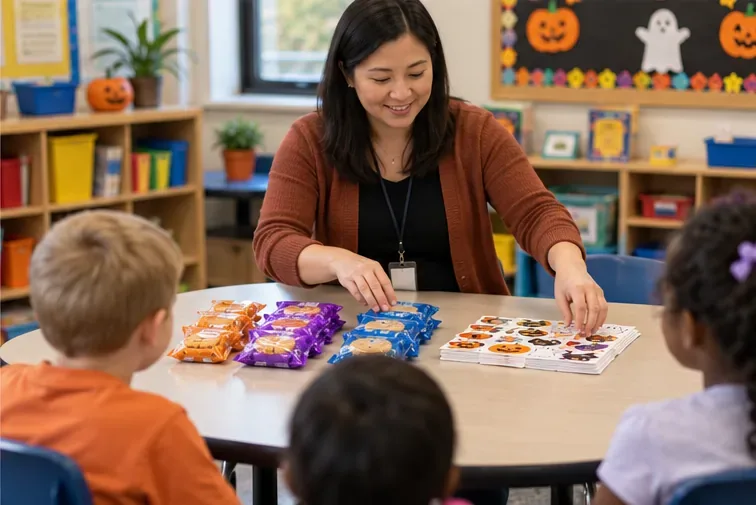
A teacher sets unopened snacks apart from sticker sheets at a classroom table. The serving adult still needs to follow each child’s approved plan.
Five-minute check before the event
Is the event's food policy current, and has the teacher approved this specific item?
Is the full label for this exact package or size available, including the ingredient list and any precautionary statement?
Can the school tell which child may have which snack without a shared bowl or swapping?
Is there a comparable non-food option, with age-appropriate materials?
Are the child's emergency plan, medications, and responsible staff arrangements confirmed?
When any answer is uncertain, the practical move is to pause distribution, clarify with the school or manufacturer, or use a non-food activity that the school has approved. A sticker, a story, or a costume parade can preserve the fun without asking a child to gamble on an unreadable wrapper. FARE's Teal Pumpkin Project describes non-food treats as an inclusive option, while also noting that food and non-food treats should be kept separate.
There is no universal “school-safe Halloween snack” brand or recipe. The useful result is a plan that staff can actually carry out: clear approval, a current label or an appropriate non-food choice, a controlled handoff, and a known emergency response. Review the details again if a product changes, a new student joins, or the event moves to a different classroom or after-school setting.