Home
» Food & Drink
»
How to Freeze Herbs Without Losing All Their Texture and Aroma
How to Freeze Herbs Without Losing All Their Texture and Aroma
Freezing fresh herbs can preserve a surprising amount of their aroma, but it cannot keep delicate leaves exactly like fresh ones. The central trade-off is simple: freezing is excellent for herbs you plan to cook, blend, stir into sauces, or add to soups, while thawed leaves usually lose the crisp structure needed for a fresh garnish. The National Center for Home Food Preservation (NCHFP) specifically notes that frozen herbs become limp after thawing and are generally better chopped into cooked dishes than used decoratively.
The best method therefore depends on what you want to do with the herb later. Whole or loosely packed leaves give you flexibility. Water cubes are convenient for soups and braises. Oil cubes can better protect color and make aromatic herbs easy to add to sautés, sauces, and stews. A flat bag of chopped herbs is space-efficient and lets you break off small portions. None of these methods completely preserves fresh texture, so the goal is to protect aroma and usability while accepting the structural changes caused by freezing.
Why texture changes even when the herb still smells good
Herb leaves contain water. As that water freezes, ice crystals form inside and around plant cells. USDA food-safety guidance explains that faster freezing tends to produce smaller ice crystals, while slow freezing allows larger crystals that can damage cell structure. Once the herb thaws, that damage shows up as limp or soft leaves. This is a quality change, not proof that the herb is unsafe.
Aroma behaves differently from texture. Many of the volatile compounds that make basil, dill, parsley, cilantro, rosemary, thyme, mint, and similar herbs smell distinctive can remain useful after freezing, especially when the herbs are frozen while fresh, protected from air, and kept consistently cold. But aroma can gradually fade or pick up freezer odors if packaging is poor. That is why moisture-vapor-resistant, tightly sealed packaging matters.
For long-term freezer storage, USDA and FDA guidance continues to recommend a freezer temperature of 0°F (-18°C) or below. USDA's freezer-temperature knowledge article was last updated February 4, 2025. The recommendation is about both safety and quality: properly frozen food remains safe at 0°F, while flavor, aroma, color, and texture gradually decline with time.
Choose the freezing method by how you cook
Method
Best for
Main advantage
Main trade-off
Whole or loose leaves in a freezer bag
Rosemary, thyme, parsley, dill, basil for cooked dishes
Flexible portions and minimal prep
Leaves become limp after thawing and can stick together
Chopped herbs in water cubes
Soups, stews, braises, sauces
Easy pre-portioned additions
Extra water may not suit dry dishes
Chopped herbs in oil
Sautés, pasta sauces, soups, stews
Good color retention and easy portioning; especially useful for basil
Oil changes how the herb can be used and must be handled safely
Thin flat bag with chopped herbs and a little oil
Frequent cooks who want small amounts
Space-efficient; pieces can be broken or scraped off
Less visually tidy than cubes and still intended mainly for cooking
Step 1: Start with herbs worth freezing
Freeze herbs while they are still at good quality rather than waiting until they are wilted. USDA emphasizes that freezing does not improve food; the quality going into the freezer strongly affects the quality coming out. Discard slimy, moldy, badly bruised, or decaying leaves.
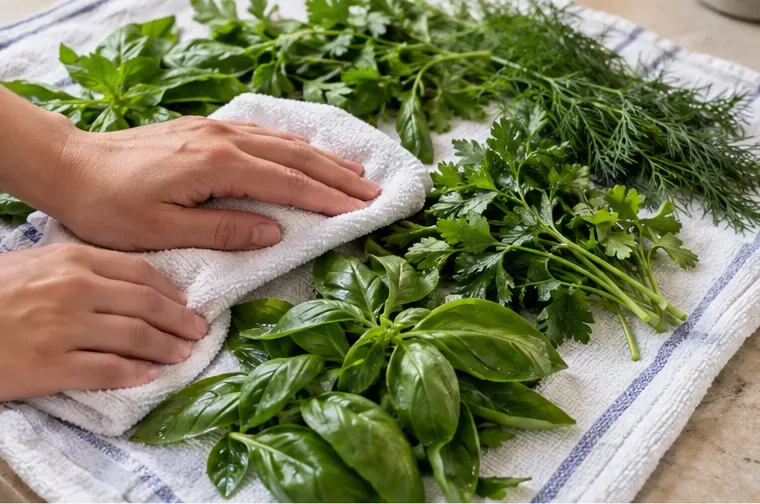
Rinse the herbs in clean water, drain them, and dry them gently. NCHFP recommends washing, draining, and patting herbs dry before packing. Penn State Extension likewise advises rinsing and then patting or spinning herbs dry without crushing them. Removing excess surface water helps reduce clumping and unnecessary ice on the leaves.
Dry washed herbs gently before packing them so excess surface water does not turn into unnecessary ice around the leaves.
Step 2: For maximum flexibility, freeze leaves or sprigs in small bags
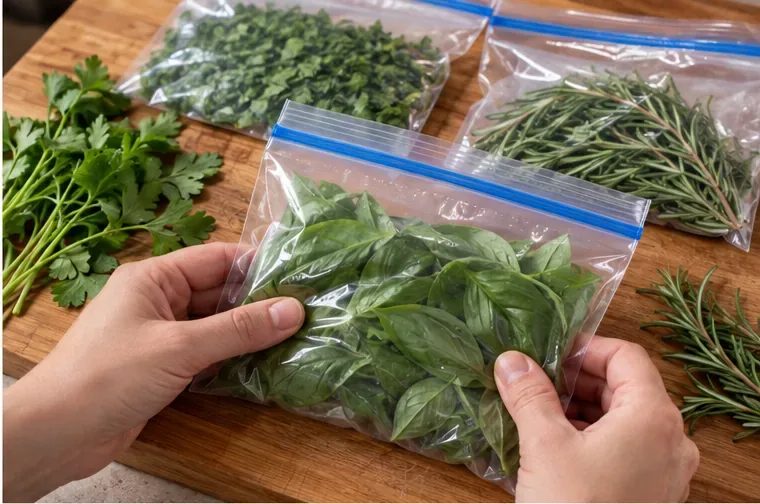
If you want to decide later whether the herbs will go into soup, pasta, sauce, or another cooked dish, a simple freezer-bag method is hard to beat. Arrange a small quantity of dry sprigs or leaves in freezer wrap or a freezer-safe bag, press out excess air without crushing the herbs, seal, label, and freeze.
NCHFP recommends wrapping a few sprigs or leaves, placing them in a freezer bag, sealing, and freezing. The limitation is important: once thawed, the herbs are normally limp, so this method is about retaining flavor for cooking rather than recreating fresh leaves. If you can use the herbs directly from frozen, you avoid an unnecessary thawing cycle and can chop or crumble them as needed.
Freezer packaging should resist moisture vapor, seal well, and protect food from off-odors. Those are among the characteristics NCHFP lists for proper freezer containers and wraps. Thin sandwich bags that leak air are a poorer choice for longer storage than packaging designed for the freezer.
Small, well-sealed freezer bags make it easier to remove only the amount of herbs needed for a cooked dish while limiting air exposure.
Step 3: Use water cubes when the recipe can absorb extra liquid
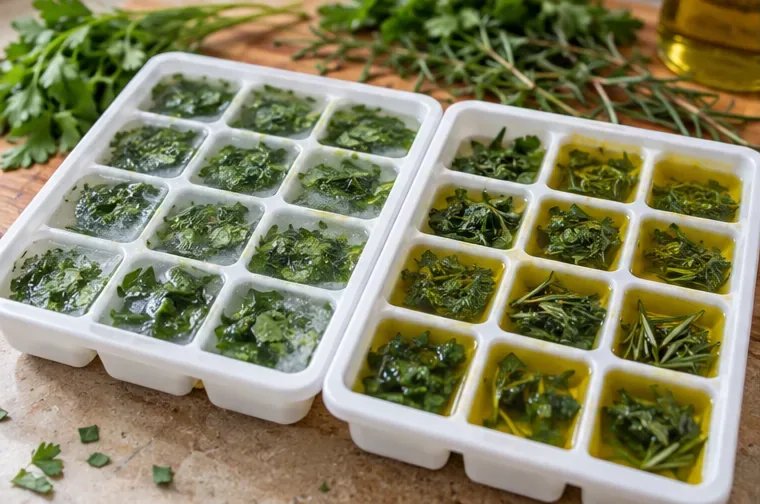
Water cubes are convenient for soups, stews, beans, braises, and sauces where a small amount of water is harmless. Strip leaves from tough stems if appropriate, chop the herbs roughly as you normally would for cooking, and portion them into an ice cube tray. Penn State Extension recommends filling the tray about halfway with water, adding the herbs, pushing them under the water as much as practical, freezing, then adding more water after the first freeze to cover the herbs before freezing solid.
Once solid, transfer the cubes to a labeled freezer bag or freezer container. This frees the tray for reuse and gives the cubes an extra barrier against drying and freezer odors. Strong-smelling herbs may need particularly good packaging so their aroma does not migrate to neighboring foods.
The trade-off is dilution. A water cube is perfect in a pot of lentil soup but awkward in scrambled eggs, a pan sauce that needs quick reduction, or a dish where a few tablespoons of added water would affect texture. Choose water cubes because they match the recipe, not because cubes are automatically better.
Choose oil when the herb is headed for a savory cooked dish
Oil is useful when you expect to add the herb to a skillet, sauce, stew, or similar preparation. Penn State Extension notes that herbs frozen in oil can maintain color better than herbs frozen individually and specifically calls the method useful for basil. A neutral oil keeps the herb flavor dominant; olive oil makes sense when its flavor belongs in the final dish.
For a practical home batch, chop the herbs and combine them with enough oil to coat and suspend the leaves, then portion into a tray or spread in a thin layer inside a zipper-style freezer bag. Penn State's tested guidance describes both cube and flat-bag approaches and provides a formula of roughly 1/3 to 1/2 cup oil for 2 cups chopped herbs for one method. A flat bag can be especially convenient because you can break or scrape off a small amount instead of committing to a full cube.
Food-safety boundary: herb-and-oil mixtures are not a room-temperature storage method. Penn State explicitly says oil should be added to herbs only when the mixture will be frozen and warns against storing herbs in oil at room temperature. Keep the mixture frozen as intended and handle thawed portions like other perishable foods.
Water cubes suit soups and braises, while oil portions are better matched to sautés and savory sauces; choose the liquid according to the final recipe.
Step 4: Cook with frozen herbs instead of expecting fresh-garnish texture
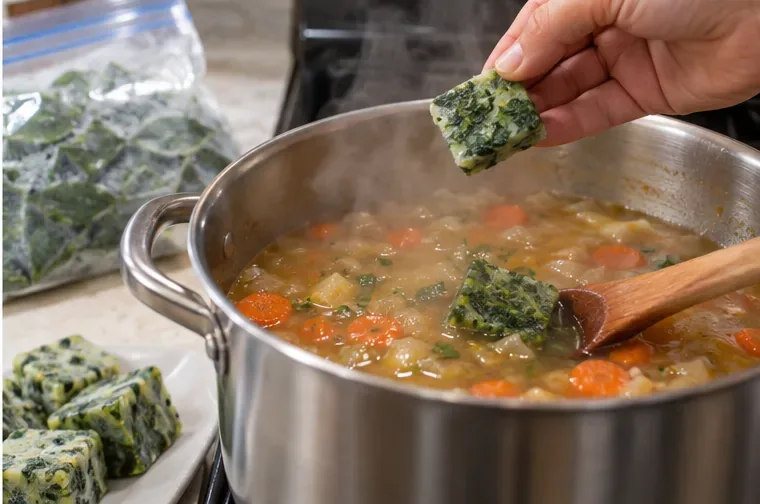
The most reliable way to preserve the eating experience is to use frozen herbs where texture is not the main attraction. Add a water cube directly to soup or stew. Add an oil cube to a pan where you would otherwise start with oil and aromatics. Crumble frozen thyme or rosemary into a braise. Stir chopped frozen parsley or dill into a hot sauce near the end of cooking if you want more aroma.
For delicate herbs such as basil, cilantro, parsley, dill, or mint, do not judge success by whether a thawed leaf looks salad-fresh. Freezing damages cell structure, so a limp leaf can still be useful and aromatic in a cooked dish. If appearance and crispness matter—Caprese salad, a raw herb garnish, fresh cilantro on tacos—fresh herbs are still the better choice.
Using frozen herb portions directly in hot cooked dishes avoids asking thawed leaves to perform like a fresh garnish.
How to protect aroma once the herbs are frozen
Freeze promptly. Do not let herbs sit in the refrigerator until they are already tired and yellowing. Freshness at the time of freezing matters.
Keep portions small. Small, thin packages freeze faster than a thick mass and let you remove only what you need.
Limit air. Press excess air from freezer bags and use containers that seal tightly. Poor wrapping encourages surface dehydration, commonly called freezer burn.
Keep the freezer at 0°F (-18°C) or below. Use an appliance thermometer if the freezer's built-in display is uncertain.
Label the herb and date. Parsley, cilantro, and other chopped green herbs can be hard to distinguish once frozen.
Avoid repeated thawing. Portion herbs before freezing so the main package can stay cold and sealed.
Should you blanch herbs first?
Most household herb-freezing guidance does not require blanching for the simple sprig, bag, water-cube, or oil methods described here. Blanching is a standard quality-preservation step for many vegetables, but tender culinary herbs are typically handled differently. For the herbs covered by NCHFP's fresh-herb instructions, the recommended preparation is washing, draining, drying, wrapping, bagging, sealing, and freezing.
If you are preserving a specialty product rather than plain herbs—for example pesto, a cooked herb sauce, or a garlic-and-oil mixture—follow a recipe or preservation method written for that specific product rather than assuming the plain-herb method applies.
Which herbs are most worth freezing?
Freezing is particularly useful when your priority is cooked flavor rather than dry-herb shelf stability. Basil is a strong candidate for oil freezing because color and aroma matter and the thawed texture was unlikely to be suitable for garnish anyway. Parsley, dill, cilantro, chives, mint, rosemary, thyme, oregano, and sage can all be useful from the freezer in the right cooked application, though their textures and flavor intensity do not change identically.
Woody herbs such as rosemary and thyme are often convenient as sprigs or loose leaves because their structure is sturdier and they are commonly cooked. Tender leafy herbs gain more from cube or chopped-pack methods because freezing already removes much of the fresh-leaf textural advantage.
When drying may be the better preservation method
Freezing is not automatically the best way to save every surplus herb. Drying uses no freezer space, stores compactly, and can be excellent for herbs whose dried flavor works well in your cooking. NCHFP describes drying as the easiest way to preserve herbs and advises protecting herbs from excessive heat and sunlight because flavor and color can be lost.
Choose freezing when you value a greener, fresher-style flavor and routinely cook dishes that can accept frozen leaves, water cubes, or oil portions. Choose drying when pantry storage, portability, and long-term convenience matter more. For many kitchens, the practical answer is to split the harvest: freeze some basil, parsley, or dill for cooked dishes and dry rosemary, thyme, oregano, or sage for seasoning.
A quick decision checklist
If you need fresh-looking leaves for garnish, do not rely on freezing; buy or harvest fresh.
If you need maximum flexibility, freeze dry sprigs or leaves in small freezer bags.
If you mostly make soups and stews, freeze chopped herbs in water cubes.
If you mostly make sautés, pasta sauces, and savory skillet dishes, consider oil cubes or a thin oil-and-herb freezer bag.
If freezer space is tight and you like the flavor of dried herbs, drying may be the better trade-off.
For freezer temperature and freezing-quality principles, see USDA Food Safety and Inspection Service freezing guidance and the USDA freezer-temperature knowledge article. These sources support a 0°F (-18°C) freezer target and explain why fast freezing and good packaging help quality. Exact flavor retention varies by herb variety, harvest condition, package, freezer performance, and storage time, so no home method can guarantee fresh-picked texture or aroma after freezing.