Home
» Crafts
»
Which Glue Works Best for Paper, Fabric, Wood, and Plastic Crafts?
Which Glue Works Best for Paper, Fabric, Wood, and Plastic Crafts?
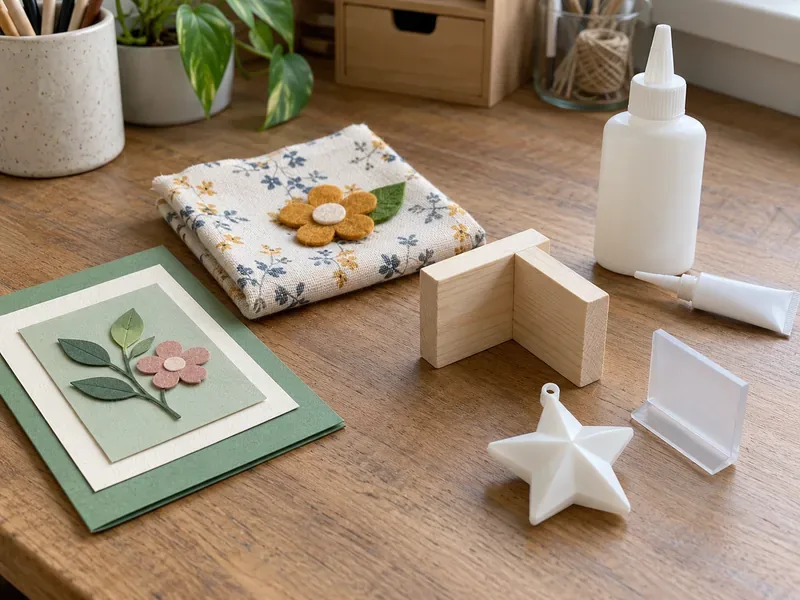
You finish a paper collage, fabric patch, small wooden ornament, and plastic decoration with the same bottle of glue—then one piece wrinkles, another peels, and the plastic part slides off. The problem is usually a mismatch between adhesive and surface. Paper and unfinished wood are porous; fabric needs a bond that can bend; and “plastic” covers materials that do not all accept the same glue.
For most crafts, choose a washable school glue or glue stick for paper, a fabric glue for cloth that must flex, a PVA wood glue for wood-to-wood joints, and a plastic-specific adhesive after identifying the plastic. A thick all-purpose tacky glue can cover several porous craft materials, but it is not a universal answer for washable clothing or every plastic. Test a hidden scrap, use a thin controlled layer, and follow the product label for cure time before judging the bond.
Paper, cloth, wood, and plastic craft pieces call for different adhesive properties.
Start with the material and the job
Before reaching for a bottle, ask two questions: What are the surfaces made of, and what must the finished piece withstand? A flat paper decoration kept indoors has different needs from a fabric patch that will be washed or a plastic ornament that will be handled. Also consider whether the joint must stay flexible, whether a wet adhesive could mark the surface, and whether you can clamp or hold the pieces while the glue cures.
Craft material or joint
Good first choice
Check before you use it
Paper, cardstock, cardboard
Glue stick for light paper; washable school glue or tacky glue for heavier layers
Too much wet glue can buckle thin paper; test on a matching scrap
Fabric or felt
Fabric glue for a flexible fabric-to-fabric bond
Confirm the fabric types, washability, and cure time on the label
Unfinished wood to wood
PVA wood glue
Keep the joint fitted and held together as directed; it is not meant for every surface
Plastic
An adhesive explicitly rated for the identified plastic
Ordinary super glue may not bond PE or PP; verify the plastic and product instructions
Which glue works best for paper?
For a paper chain, school project, or light collage, a glue stick is often the neatest choice because it puts down a controlled layer without soaking the sheet. Washable liquid school glue is useful for cardboard, heavier paper, and small porous embellishments. For dimensional paper crafts or pieces that need a thicker adhesive, tacky glue offers more body; Aleene’s says its Original Tacky Glue is intended for paper products and gives directions for applying a thin coat to paper and other porous materials.
The trade-off is moisture. A generous puddle of liquid glue can make thin paper ripple, and excess may squeeze out at the edges. Try the least wet option that gives enough coverage: use a stick for a broad, flat paper layer, or spread a small amount of liquid glue thinly with a scrap applicator. Press the piece between clean sheets or under a flat weight if the product directions allow it. Elmer’s identifies its washable school glue for paper, wood, and cloth, but that broad material list does not mean it is the best option for every project or a wash-resistant finish. See Elmer’s School Glue materials information.
What should you use on fabric?
Choose fabric glue when the cloth must remain flexible after drying, especially for a hem, felt detail, ribbon, or a small embellishment. A product described as “all-purpose” or “tacky” may attach nonwashable fabric for a display craft, but that does not automatically make the result suitable for clothing, frequent handling, or laundering. Read the specific label for fabric compatibility and whether the cured bond can be washed or ironed.
For example, Gorilla Fabric Glue’s manufacturer instructions describe a flexible bond for materials including cotton, denim, polyester, and felt. They call for a scrap test, a minimum 24-hour full cure, and waiting at least three days before washing or ironing. Those times are for that named product, not a rule for every fabric glue. For your project: test on a matching offcut, apply the amount and method on the label, and do not wash the item until the product’s stated cure period has passed.
When is wood glue the right choice?
For two pieces of unfinished wood, a standard PVA wood glue is usually a better fit than school glue or a general craft adhesive. Wood glue is designed for porous wood surfaces and creates a joint that can be held under pressure while it sets. Titebond Original Wood Glue’s product page lists wood, hardboard, particleboard, leather, cloth, and other porous materials as suitable surfaces, and notes that it cleans up with water.
That does not make wood glue the right choice for every object that happens to contain wood. A painted, sealed, oily, or very small surface may need preparation or a different product; follow the manufacturer’s surface instructions. Fit the wood pieces closely, spread glue as directed, and clamp or press the joint for the stated time. Wipe away squeeze-out while it is still manageable, taking care not to smear it across a visible finish. Do not load, sand, or paint the joint until the label’s cure guidance says it is ready.
Why is plastic the hardest material to choose for?
Plastic is not one surface. A glue that works on a rigid acrylic piece may fail on a flexible container or a low-surface-energy plastic. Many ordinary cyanoacrylate “super glues” explicitly exclude polyethylene (PE) and polypropylene (PP). Gorilla’s product information warns against using its Super Glue on PE and PP; Loctite lists the same plastics among materials its standard super glue does not bond. Do not assume a glue is plastic-safe just because the label says it bonds “plastic.”
Look for a recycling or resin mark on the object, check the adhesive maker’s compatibility list, and use a specialty system if the product specifically names that plastic. For instance, Loctite’s Plastics Bonding System is a two-part product with an activator that the manufacturer says is designed for PE, PP, and PTFE. That is a product-specific claim, not permission to use any super glue on those plastics. When the resin is unknown or the piece is valuable, test an inconspicuous area or choose a mechanical fastener instead of guessing.
How can you avoid a failed or messy bond?
Clean and dry the surfaces. Dust, oil, loose fibers, and moisture can interfere with adhesion. Use only cleaning methods that will not damage the material.
Use less than you think you need. Extra glue can squeeze out, show through paper, or slow drying. Follow the package directions for coverage.
Hold the parts in position. Use a gentle weight, clip, or clamp only if it will not dent or distort the project and the glue instructions allow it.
Respect set time and cure time. A surface that feels dry may not have reached full bond strength. Product times vary with formula, amount, temperature, humidity, and materials.
Keep stronger adhesives for the right job. Super glue and two-part products can bond skin or irritate eyes. Keep them away from children, work with the ventilation and protective measures on the label, and store them safely.
Check the result before calling the project finished
After the full cure period on the package, inspect the edge for lifting, gaps, paper ripples, fabric stiffness, or glue that has spread onto a visible area. Test a hidden edge with gentle pressure; do not yank a fresh joint to see whether it holds. Flex fabric only if its glue is rated to remain flexible, and wash only if the product specifically allows it. For plastic, check the bond on a scrap of the same item before relying on it. If the test peels away cleanly, the surfaces may be incompatible or need a different preparation or adhesive.
In short: use a glue stick or thin layer of school glue for paper, flexible fabric glue for cloth, wood glue for fitted wood-to-wood joints, and a plastic-specific product for identified plastics. The best craft glue is the one whose label matches both the material and the finished use—not simply the strongest glue in the drawer.
Sources and product guidance checked September 30, 2026