Home
» Crafts
»
What Can You Use Instead of Glitter for a Lower-Mess Sparkle?
What Can You Use Instead of Glitter for a Lower-Mess Sparkle?
For a lower-mess sparkle effect, use a reflective material that stays attached to the project: metallic paper for crisp highlights, a metallic marker for controlled lines, pearlescent paint for a wider sheen, or ribbon for a soft, dimensional glint. These options avoid scattering loose glitter, though each has its own cleanup or durability trade-off.
Illustrative scenario: Maya is making folded place cards for a small winter dinner. She wants a little shine on each card, but does not want loose particles on the table or stuck to guests’ clothes. Maya is a fictional example, not a real person or a report of a tested craft project. The comparisons below show how she could choose an approach based on the finish she wants.
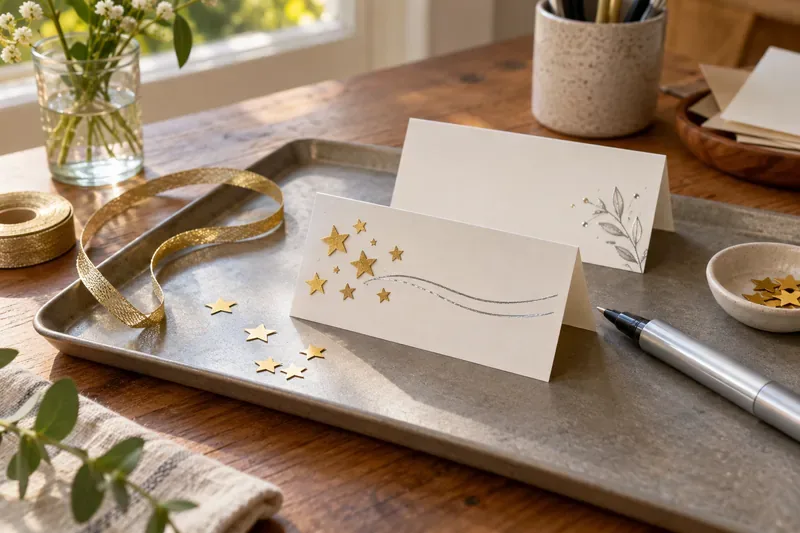
Metallic paper stars, a marker, and ribbon offer attached sparkle accents for folded place cards.
Which substitute should you choose first?
Start with the surface and the kind of sparkle you want. If Maya wants a few sharp points of light on flat cardstock, small foil-paper shapes are the simplest fit. If she wants lettering or thin lines, a metallic marker offers more control. If she wants a broad, even sheen, paint may cover more area, but it introduces a wet step and drying time. A narrow ribbon adds shine without coating the card at all.
Alternative
Look
Best for
Main trade-off
Metallic or foil paper
Bright, crisp reflections
Cards, tags, banners, flat collage shapes
Works best on flat surfaces; cutting leaves paper scraps
Metallic marker or gel pen
Fine lines, lettering, small accents
Names, borders, stars, drawn patterns
Less textured than glitter; performance varies by paper and product
Pearlescent or metallic paint
Smooth sheen across a larger area
Paper, dry clay, or other surfaces named on the product label
Needs a brush or sponge, a protected work area, and drying time
Adhesive foil shapes or metallic tape
Clean-edged highlights with little setup
Small accents on compatible smooth surfaces
Adhesion and residue depend on the surface; test a hidden spot first
Metallic ribbon, cord, or fabric
Soft, dimensional shimmer
Gift wrap, ornaments, clothing details, table décor
It must be tied, stitched, or secured; it cannot create a fine all-over sparkle
What works best for paper crafts?
Metallic cardstock, foil paper, or pre-cut metallic shapes give Maya a reflective detail without loose particles. She can cut stars or narrow strips, then attach them with a small amount of glue or double-sided tape suited to the paper. The shine comes from the sheet itself, so it will not look exactly like tiny glitter flecks; it gives broader, cleaner flashes when it catches the light.
For words, borders, or a drawn pattern, a metallic marker or gel pen keeps the shiny area where the tip touches. A manufacturer’s craft example uses a silver metallic marker to draw lines on cardstock, which is one practical way to add controlled highlights. Try the pen on a scrap first: the color can look different on dark and light paper, and ink may feather, skip, or take time to dry depending on the surface and product.
Adhesive foil shapes are useful when a project needs repeated accents and you want to avoid spreading wet glue. They are less forgiving if repositioning matters, and textured paper may not hold an adhesive as well as a smooth surface. Maya could test one star on a spare card before decorating the whole set.
When is paint or fabric a better choice?
Metallic or pearlescent paint is a better match when the goal is an even sheen rather than separate points of sparkle. A thin layer applied with a brush or sponge can look subtle; several coats may appear more opaque, but they also add moisture and drying time. Follow the paint label for suitable surfaces and cleanup. If the item will be handled, check whether the finished paint needs a compatible sealer; do not assume that every paint is permanent or washable.
For Maya’s place cards, painting every card would take more setup than adding a few paper stars. If she were decorating a dry clay ornament or a broad paper panel instead, paint might cover the shape more evenly. Material makers commonly distinguish among painting, marker, and embellishment methods for different surfaces; for example, Crayola’s air-dry-clay guidance recommends painting fully dry pieces and gives separate marker advice. That guidance applies to the named clay product, so check the instructions for the material you actually have.
Ribbon and metallic fabric work when you want shine with movement or texture. A strand tied around a card, wrapped around a gift, or stitched onto fabric stays in one piece and can often be removed more easily than glued-on decoration. It creates a glint rather than a dusting effect, and loose ends may snag or come untied. For a surface that should stay undecorated after an event, choose a tied-on accent instead of permanent adhesive.
How do you keep the substitute low-mess?
“Lower mess” depends on how you apply the material. Paper shapes do not scatter like fine particles, but cutting creates scraps. Markers avoid glue and loose pieces, but can mark a table or stain fabric. Paint avoids airborne flecks while wet, yet spills and brush cleanup can create a different kind of mess. No option is automatically mess-free.
Work over a shallow tray, scrap paper, or another surface that can be gathered and cleared afterward.
Choose pre-cut foil shapes if you need only a few accents; do not shake loose decorative pieces over a project.
Use one controlled application method at a time, and let wet paint or ink dry in a protected area.
Test markers, paint, and adhesive on a hidden or spare piece of the same material.
For a temporary decoration, prefer a tied-on ribbon or removable paper accent; for a durable detail, use an adhesive or finish intended for that surface.
For the fictional place-card project, a practical low-mess combination would be a metallic marker for the names and a few foil-paper stars placed on a tray and attached with small dots of adhesive. If Maya wanted more shine without adding more materials, she could use metallic paper for the card itself and skip the extra accents.
Are craft markers and paints safe for skin or around children?
Use art products for the purpose stated on their labels. Craft paint and markers are not automatically cosmetics: ACMI notes that products intended for the body, such as face paints, fall under a different FDA regulatory framework. Do not use a craft product on skin or near eyes just because it is labeled “nontoxic.” Choose a cosmetic product specifically labeled for that use.
If children will help, check age guidance and read the full label. ACMI explains that its AP Seal identifies art materials evaluated by a board-certified toxicologist as non-injurious when used as intended; its CL Seal carries cautionary labeling and should not be given to children in sixth grade or younger. The seal does not mean a material is safe for every use, surface, or person. Follow product directions, keep small pieces away from young children and pets, and supervise cutting or adhesive use as appropriate.
What is the best glitter alternative for Maya’s cards?
For a few bright, tidy accents on flat place cards, choose metallic paper shapes or a marker. Use paint when a broad shimmer matters more than quick cleanup, and use ribbon when the shine should be dimensional or removable. These are practical differences between material formats, not the results of a controlled comparison; the finish and cleanup depend on the exact product, surface, and how it is applied.
The central choice is simple: replace loose sparkle with sparkle that is printed, drawn, painted, attached, or woven into another material. Test the method on a scrap, follow the product directions, and match the finish to the surface. That gives you more control over where the shine lands—and makes cleanup easier to plan.