Providing your dog with at least some training is the best and most loving thing you can do for him. Training your dog ensures that he’s safe and welcome everywhere he goes and that he’s easy to live with. When beginning obedience training, you need to keep in mind a few do’s and don’ts, and you should start with a few basic exercises, including sitting and laying down on command. Training him to respond to the Come and Sit-Stay commands also is extremely helpful.

©Melounix/Shutterstock.com
The Do’s and Don’ts of Dog Training
Yes, dog training is based on common sense. However, you do need to keep in mind a few specific guidelines — the do’s and don’ts — to make sure that you’re successful and fostering a healthy relationship with your dog. The following sections are here to help get you started.
Do’s
- Do be nice to your dog every time he comes to you (even if he’s just coming back from an unexpected romp around the neighborhood).
- Do get into the habit of giving a command only once. If your dog doesn’t respond to a command you already taught him, reinforce the command by helping him respond correctly.
- Do use your dog’s name to get his attention and then tell him what you want him to do.
- Do eliminate the word “no” from your training vocabulary; it’s used too often and meaningless.
- Do use a normal tone of voice when you give a command. Being loud doesn’t help him understand.
- Do be consistent in your actions and expectations.
- Do provide an outlet for your dog’s energies.
- Do keep your dog mentally stimulated by training him.
- Do understand that your dog is a social animal. Train him so he can be a part of the family.
- Do socialize your dog with people and other dogs.
- Do become your dog’s teacher.
- Do make learning fun for your dog.
- Do consistently reward with praise the correct behaviors.
- Do spend plenty of time with your dog and give him lots of exercise.
- Do keep trying, and your dog will reward you by learning.
- Do get outside help if you get stuck.
Don’ts
- Don’t do anything your dog perceives as unpleasant when he comes to you.
- Don’t nag your dog by repeating commands; nagging teaches him to ignore you.
- Don’t use your dog’s name and then expect him to read your mind as to what you want.
- Don’t expect your dog to know what the word “no” means.
- Don’t yell at your dog. He’s not deaf. Raising your voice doesn’t improve his understanding.
- Don’t confuse your dog with unrealistic expectations.
- Don’t try to suppress behaviors that need an outlet.
- Don’t let your dog stagnate.
- Don’t lock up your dog or put him out because you haven’t trained him to behave.
- Don’t isolate your dog — he’s a social animal.
- Don’t expect your dog to obey a command you haven’t taught him.
- Don’t get too serious in your training; keep things fun.
- Don’t reward undesired behaviors.
- Don’t make your dog neurotic by neglecting him.
- Don’t give up when the going gets tough; keep trying.
- Don’t blame the dog; you are his teacher.
Control Your Dog with the Sit and Down Commands
When you think of dog training or obedience, the first two commands that probably pop into your head are the Sit and the Down commands. These commands are essential to making a well-behaved dog. Practice a 30-minute Down and a 10-minute Sit, on alternate days, for four weeks. See the following sections for details.
When giving commands to your dog during training, be sure to give them in a calm, yet upbeat tone of voice. Don’t pose commands as questions; otherwise, Buddy won’t obey. And be sure to use only one command at a time and say it only once. If he doesn’t respond, show him exactly what you expect from him and then praising him for his success even though you helped.
Sit on command
The following steps show you one way of teaching your dog the Sit command. Start off teaching him to do so using a treat, and then you add the command. Here’s how to do it:
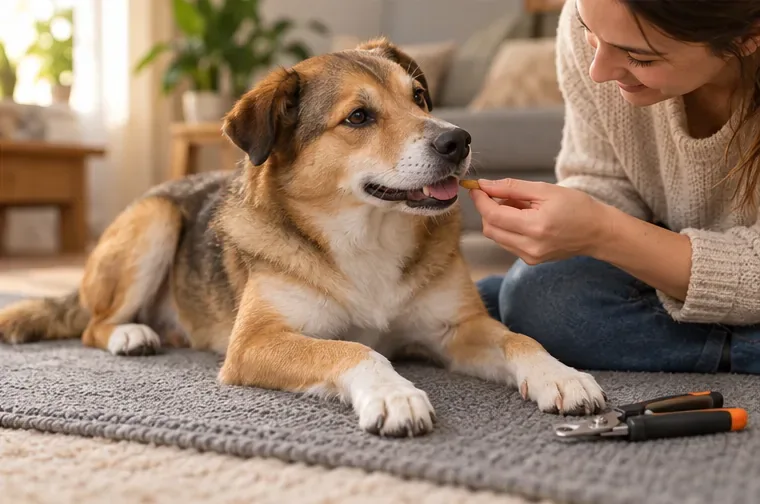
Hold the treat slightly in front of your dog’s head, say “Sit” and bring your hand slightly above and over his eyes.
Give him the treat when he sits.
For the next attempt, use a treat in one hand, and apply some upward pressure on the collar with the other as you say “Sit.”
Give lots of praise when the dog sits.
When he gets the hang of sitting, you can work on commanding him to sit; without touching your dog or showing him a treat, say “Sit.”
When he responds correctly, reward him with a treat. If he doesn’t respond correctly, review Step 2.
Down on command
When you’re ready to teach your dog the Down command, one way of teaching him to lie down is with a treat, and then you introduce pressure on his collar as you command. Here’s what to do:
With your dog sitting at your left side, show him a treat, held in the right hand, say “Down,” and then lower the treat to the ground between his feet and slowly slide it forward so he has to lie down to get it.
When he’s in the Down position, give him the treat.
For the next attempt, put the treat in your right hand, and then put your left hand through his collar under his chin and say “Down.”
Lower the treat and apply slight downward pressure toward the dog’s chest using the collar. Give your dog the treat and lots of praise when he lies down.
When he’s familiar with the Down position, you’re ready to work on commanding him to lie down.
Without touching your dog or showing him a treat, say “Down.”
When he responds correctly, reward him with a treat. If he doesn’t respond correctly, review Step 2.
Use the Recall Game to Get Your Dog to Come When Called
If you’re interested in training your dog to come to you when he’s called, one way to teach him is to play the Recall Game. This training game is played with two people, one hungry dog, a 6-foot leash, and plenty of small treats. Practice the Recall Game on and off leash inside, on and off leash outside in a confined area, and then ultimately on and off leash with distractions when your dog is ready. Be sure you can touch your dog’s collar every time he comes to you and before you give him a treat.
Here are the steps to follow when playing the Recall Game:
Find a partner and sit on the floor 6 feet apart, facing each other, and ask your partner to gently restrain the dog while you hold the handle of the leash.
Call your dog by saying “Buddy, Come,” and use the leash to guide him to you as your partner lets go of him.
When Buddy comes to you, put your finger through his collar, give him a treat, and praise him enthusiastically.
Hold onto Buddy’s collar and pass the handle of the leash to your partner, who says, “Buddy, Come,” guides the dog in, puts his finger through the collar, gives him a treat, and praises the dog.
Work through these steps until your dog responds on his own to being called and no longer needs to be guided to you with the leash. At that point, you can start increasing the distance between you and your partner (up to 12 feet). You also can begin playing the game from room to room in your house. Make sure Buddy responds well inside before you take him outside. Each time you change location, start the Recall Game on leash — get the correct response before taking the leash off. If Buddy doesn’t respond, go back and put him on leash.