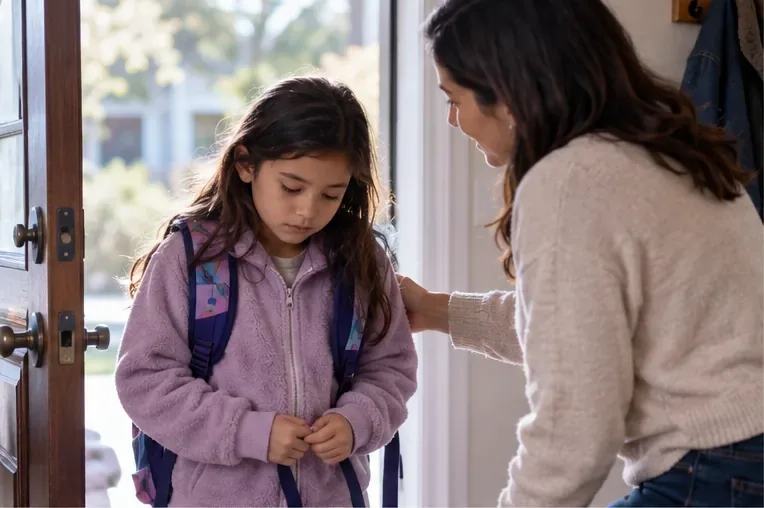
How to Teach Chores Without Redoing Every Task for Your Child

Teach kids to do chores with fewer reminders: set a clear finish line, model one task, step back, and correct only what is unsafe or unfinished.

Both boys and girls have breast tissue. Normally, breast development occurs as soon as a baby is born, then continues into puberty. The timing of when the breast will develop varies from person to person, and some girls may develop after teen.
Below is an overview of the abnormal breast growth that can occur in children.
Both boys and girls have small breast tissue within the first few weeks of life. These nipples will become real breast tissue as the baby matures. After birth, breast tissue becomes more apparent in the baby because of the effects of estrogen from the mother. When estrogen levels drop, breast tissue is no longer visible.
Some babies have a discharge and redness around the nipples. This usually goes away on its own. Fluid in a baby's nipple is one of the reasons why a baby may stop breastfeeding. At that time, please take your child to the doctor right away.
One of the most common breast abnormalities is the excess nipple, which is commonly found in the armpits or on the abdomen in both boys and girls. This extra tissue is called polythelia. If it is uncomfortable, the doctor will remove it.
Breast enlargement is the presence of more breast tissue in men that make their breasts look like a developing female breast (called gynecomastia). The breast can be about the size of a slightly raised breast to female breast with round and raised nipples.
About half of all boys who reach puberty will experience protruding breast tissue around the nipple. Most of these cases will decrease in size within 2 to 3 years. If it doesn't subside and the baby is healthy, consider having your child remove it with surgery.
Macromastia is a term used to describe a girl's breast that has become too large for the rest of the body. Large breasts can put teenage girls under not only emotional stress, but also physical impact. For example, large breasts can contribute to upper back pain, tingling arms and skin irritation. Socially, children are said to be adults even though they are teenagers, and they may have limited physical activity. Initial treatment includes physical therapy, skin care, wearing the right bras and pain relievers if needed.
Once breast size causes other problems or affects routine activities, surgery may be considered. Usually, the size of the breast stops changing 2 to 3 years after the first period.
Breast reduction surgery, as the name implies, is usually done with anesthesia. After surgery, limit activity for 4 to 6 weeks, but usually girls can return to school the following week.
Up to 25% of teenage girls have abnormal breast growth with uneven bilateral development, and many adult women have one breast larger than the other. Sometimes the reason for this condition is because they have a different shape and development. Sometimes the cause is the presence of a benign tumor called a fibroadenoma on one breast, when the breast is removed, it will return to normal size.
In some cases, balancing the breasts may involve enlargement of a small breast, reduction in size of a large breast, or a combination of the two. Using a bras with one-sided padding can partly solve the problem while parents and baby are wondering whether or not to see a doctor.
One of the other abnormal breast growth in children is a breast tumor in children. However, do not worry too much because breast cancer is extremely rare in people under 20 years of age; Approximately less than 0.1% of breast cancers occur in children or teenagers. An ultrasound can help determine if the tumor is a fibroid or a fluid-filled cyst that can be pulled out.
If your baby has a lump in the breast, see a doctor. Breast surgery in girls should be performed with caution because of the risk of future breast development.
Mom, please teach your daughter how to self-check the breast when baby's breasts are starting to develop and menstruating. Children should keep this habit for life.
If a girl has no developing breast tissue by age 13, her breast development is considered delayed. Although rare, breast buds may not persist because a deformation in the chest wall or underlying pectoral muscle has not grown normally. Girls with a chronic illness like Crohn's disease , Turner syndrome , or an eating disorder can also prevent the young breast buds from developing by age 13.
aFamilyToday Health hopes that the above information about abnormal breast growth helps parents better understand the child's puberty process and detect abnormalities, if any, from the very beginning.
Teach kids to do chores with fewer reminders: set a clear finish line, model one task, step back, and correct only what is unsafe or unfinished.
Learn why toilet-trained children may start having pee or poop accidents again, what patterns to track, how to respond calmly, and when to call the pediatrician.
A child may repeat a reassurance question to process information, seek connection, or manage worry. Learn how to respond and when persistent anxiety needs support.
Learn how to set screen-time boundaries with predictable routines, warnings, calm follow-through, and better transitions—without turning every device handoff into a fight.
Teach children to handle losing without shame or explosive anger by validating feelings, setting behavior limits, modeling recovery, and practicing at the right difficulty.
A calm, practical plan for after-school meltdowns: reduce overload, keep limits clear, track patterns, coordinate with school, and know when to seek help.
Learn how to respond when a child feels unwanted, ask supportive questions, recognize bullying or ongoing distress, and know when to seek extra help.
Learn how to set up a shared bedroom for siblings with different bedtimes, from planning around age-based sleep needs to creating separate sleep spaces and quiet routines.
Compare full-day, gradual, and temporary at-home return plans, plus health checks and school supports that can help a child reenter safely.
Learn when a child can try to solve a friendship problem, when adults should step in, and how to tell whether support is helping or needs to change.