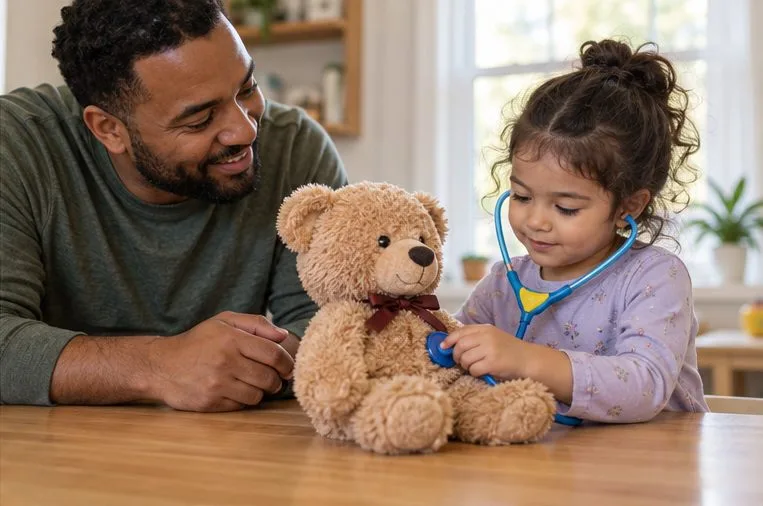
The path to perfect communication with children is endless, and not all parents face the same problem. Here are a few examples you can check out for now or for the next few months:
1. Commenting continuously
Always talk about what you are doing, at least when you are with your baby. Describe what you do like telling a story like: "I am going to change your diaper… first put your shirt over your head… now you have to put the button on." While in the kitchen, describe how to wash the dishes or how to season the dipping sauce. While bathing your baby, you can explain how to use soap for bathing, such as a shampoo to make hair shiny and cleaner. Even if your baby does not understand what you say, it is okay, it is important that through such descriptions will help you talk to your child more and help him listen to you more and he will gradually understand the meaning. what you say.
2. Ask questions
Don't wait until your child answers before you start asking questions. Think of yourself as a reporter and your child as the interviewee. The question can be diversified like: "Do you want to wear this red pants or a blue bib?", "Isn't the sky very blue today?" "Should I buy green beans or broccoli for dinner?" Pause for a moment to wait for your baby to respond, and then “set” an answer like, “Broccoli? That sounds good, son? "
3. Relax in baby's talk practice
Research suggests that young children learn to talk earlier when parents and babies talk to each other instead of just having their parents talking. Give your baby the opportunity to make their own sounds, even if it's just a giggle, and always take the time to wait for your child's response when you speak or comment on something.
4. Simplification
Although for the time being, your child may hear you retelling someone's story or debate the economy. However, when your baby is a little older, you can talk to your child by choosing simple phrases to talk with, you should try to use simple sentences or phrases such as: "Turn off the lights", "Goodbye. goodbye ”, etc. at this present time to talk to your child so that he / she will get used to these phrases.
5. Calling your baby very simple
Children will not be able to understand pronouns like "I" or "you" but only understand names like "daddy", "mother", or "grandmother", even "baby". Therefore, you should call yourself “Mom” or “Dad” and use your baby's name when talking, eg “Now Dad will change baby Bi's diaper.”
6. Raise your voice
Most children love to hear the high voice, but in a family the person with a high voice will be the mother. (because women's voices are higher than men's). Try to raise your voice a little while talking to your baby and see if he is interested.
7. Comfortably talk in your baby's voice
If you feel comfortable talking to your child in a baby-like, cute voice, you should try to be as good as you can. If you don't feel comfortable, that's okay.
8. Focus on the present
Though you can tell your baby everything because he won't understand much. As cognition develops over time, you need to associate your statements and stories with what your baby is seeing or experiencing in the present. Young children will have no concept of the past or the future.
9. Imitation is a way to talk to your child
Babies love to be praised and imitated. When your baby makes any sounds, imitate him. When your baby yells "A", you should also shout "A" with her. The imitation will quickly become a game that both you and your baby are interested in and will also be the foundation for your baby to imitate your language in the future.
10. "Music" turns everything
Don't worry if you don't belong to a lullaby or music; Your kids won't realize it. Your baby will love what you sing to your baby whether it's a modern song, an old high school song or a meaningless song you put into melody. The movements and gestures that help you when you sing to your baby will make them feel more excited.
11. Read aloud
Although vocabulary is meaningless to your baby at first, you should soon start reading aloud to your baby with simple rhyming stories. When you want to find a different way to communicate with your baby, try reading and sharing your love of literature with your baby.
12. Observe the baby's performance
Although they do not understand what you say, they will gradually become bored with familiar sounds. Your baby may not be interested in what you say, close his eyes and ignore it, and become irritable to let you know he doesn't want to hear anymore.
You may be interested in:
10 things you should never say to kids