How to Find a Hidden Water Leak Under a Sink: A Simple, Safe Check
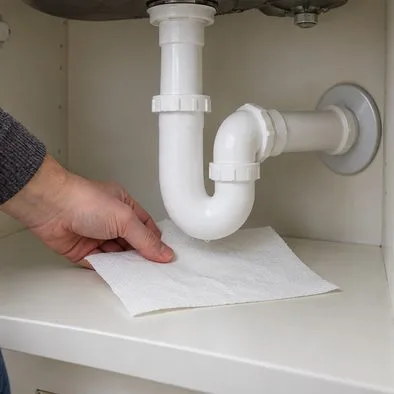
Use dry paper towels and four focused checks to find a hidden sink leak, tell supply leaks from drain leaks, and know when to call a plumber.
A deep cabinet is not automatically useful storage. The difficulty begins when one item has to be moved before you can reach another. If every trip to the back requires unloading the front, the cabinet is functioning more like a tunnel than a shelf.
Verified: pull-out storage is specifically designed to bring cabinet contents into view and within reach. IKEA describes both pantry pull-outs and full-extension trays as ways to make items easier to see and access, and its corner pull-out fitting is designed to move stored items out of hard-to-reach cabinet space. Action: judge every organizing idea by one question: can you retrieve a back item without removing several front items first?
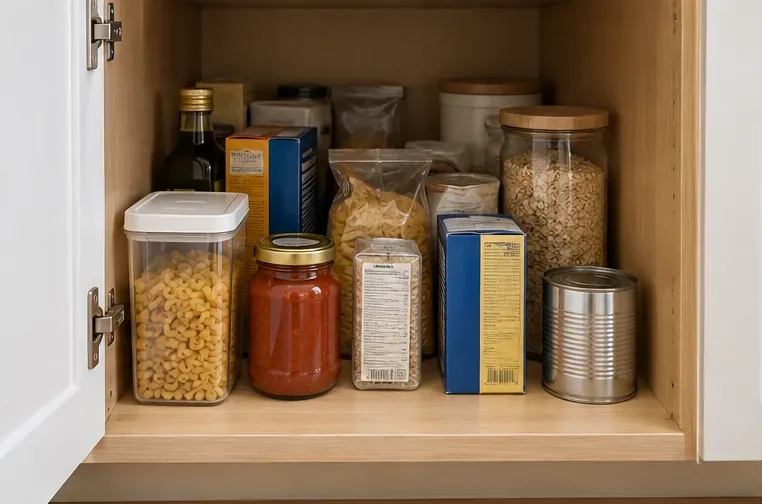
Before buying bins, turntables, or sliding hardware, measure the interior width, depth, and height. Then check the door swing, hinge intrusion, face-frame lip, plumbing, shelf pins, and any trim that narrows the opening. A container that fits the shelf may still fail if it cannot pass through the doorway or clear the hinges.
Context-dependent: there is no universal “best” bin depth or pull-out size because cabinet construction varies. A frameless cabinet may offer a wider opening than a face-frame cabinet with the same nominal width. Action: write down two sets of dimensions: the shelf cavity and the narrowest opening through which an organizer must move.
For most renters and anyone who wants a low-cost fix, handled bins are the simplest way to make deep shelves behave more like drawers. Group items by task or type—such as baking, breakfast, snacks, sauces, or back-stock—and keep each group in a bin you can pull out as one unit.
Common misunderstanding: “Clear containers solve deep-cabinet access.” Transparency helps you identify contents, but it does not remove the physical obstruction of a front row. A solid handled bin may be more useful than a clear box if the whole category can slide toward you at once. Action: choose containers primarily for grip, clearance, and easy removal; treat transparency as a secondary benefit.
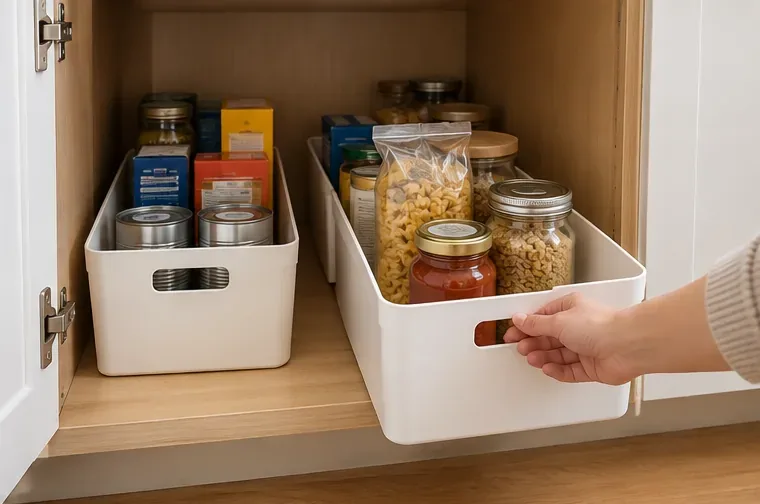
Keep each bin light enough to pull out comfortably with one hand or two hands without twisting. Heavy glass jars, large cans, cast-iron cookware, or appliances may be better on a dedicated pull-out rated for the load. Manufacturer load limits differ by product, so do not assume a decorative plastic bin or light-duty rail is suitable for dense pantry goods.
Unknown until you check: the safe working load of your existing shelf and any add-on organizer. Action: read the cabinet or organizer documentation when available, and avoid concentrating excessive weight at the front edge of a shelf.
A turntable, often called a lazy Susan, can work well for oils, condiments, jars, supplements, or cleaning bottles. Instead of reaching behind the first row, you rotate the tray until the item comes forward.
Verified: rotating and pull-out corner organizers are sold specifically to improve visibility and reach in deep or awkward cabinet spaces. Action: use a turntable when the items are relatively small, upright, and stable enough to rotate without tipping.
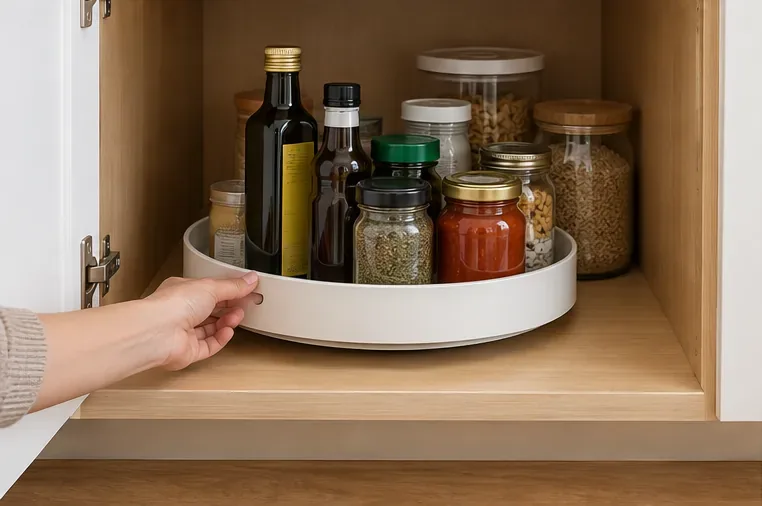
Context-dependent: a round tray can waste some rectangular shelf area, and tall items may hit the cabinet above if vertical clearance is tight. A turntable also needs enough side clearance to rotate without rubbing the walls. Action: test the rotation path with a cardboard circle cut to the organizer’s diameter before buying one.
It is reasonable to reserve the deepest zone for infrequently used items, but only if the front storage can move as a unit. For example, a front bin of daily snacks can pull out to reveal a back bin of holiday baking supplies. The back is still reachable because the front zone has one simple movement.
Common misunderstanding: “Rarely used means it can be buried.” Buried storage becomes forgotten storage, and duplicate purchases are more likely when you cannot see what you own. Action: label the front edge or handle of every back-zone bin with a short category name.
If you open the cabinet frequently, a mechanical pull-out can be the most direct way to solve depth. Full-extension drawers, trays, and pantry fittings bring items toward the cabinet opening. IKEA’s current U.S. product information, checked in September 2026, describes pull-out pantry baskets that move into view and full-extension storage that allows access to the contents.
Verified: purpose-built pull-outs can improve access to the rear of a deep cabinet. Action: consider a hardware upgrade when the cabinet stores frequently used food, cookware, small appliances, or cleaning supplies and repeated lifting of bins would be inconvenient.
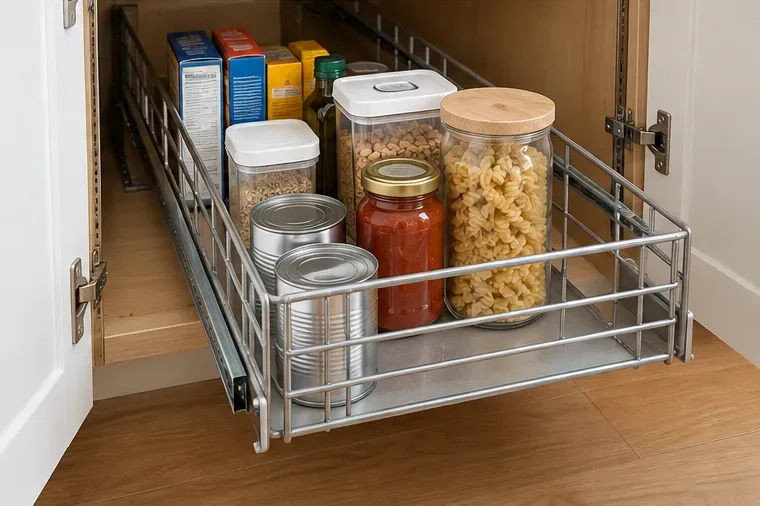
A pull-out costs more than bins, takes installation work, occupies some space with rails and frames, and must clear hinges or doors. Some systems are designed only for particular cabinet series or dimensions. Heavy storage also makes load ratings important.
Context-dependent: “pull-outs are always best” is too broad. They are strongest when convenience matters more than maximum raw cubic volume, and when the cabinet can accept the hardware. Action: compare the organizer’s required opening, depth, mounting method, and load rating with your measurements before ordering.
Tiered risers can make short cans, jars, or spices easier to see. They work especially well when you can reach across the full shelf without another object blocking your hand.
Common misunderstanding: adding vertical levels automatically fixes a deep shelf. Risers improve sight lines, but they can create a second obstacle if the front tier still blocks the rear tier. Action: use risers for shallow groups or combine them with a removable bin or turntable rather than filling the entire depth with fixed tiers.
| Storage method | Best for | Main trade-off | Check before using |
|---|---|---|---|
| Handled bins | Renters, pantry groups, low-cost upgrades | You must pull out the whole bin | Opening width, handle clearance, loaded weight |
| Turntable | Bottles, jars, condiments, small containers | Some rectangular space may be unused | Diameter, rotation clearance, item height |
| Shelf riser | Short cans or jars that need better visibility | Does not remove a blocked front row | Reach depth and vertical clearance |
| Full-extension pull-out | Daily-use deep cabinets | Higher cost and installation complexity | Cabinet fit, hinge clearance, mounting, load rating |
Once the hardware or containers are chosen, give each depth zone a purpose. Keep daily items in the easiest-to-reach moving zone. Put weekly or backup items behind them. Reserve the highest or deepest positions for lightweight, infrequent items rather than heavy things you must lift from an awkward reach.
Context-dependent: the correct arrangement depends on the user. A shorter person, someone with limited shoulder mobility, or a household with children may need different shelf heights and item placement. Action: organize for the person who uses the cabinet most often, not for a generic diagram.
Organization should be tested like a workflow. Choose three items from the back of the cabinet and retrieve them one at a time. If each takes one simple movement—pull a bin, rotate a tray, or extend a drawer—the system is working. If you still have to unload unrelated items, reorganize the zones.
Also test replacement: after using an item, can you put it back without rearranging the shelf? A cabinet that is easy to empty but difficult to reset will not stay organized for long.
Action: repeat the retrieval test after a week. If family members leave items in front instead of returning them to a bin or pull-out, reduce the number of categories or make the labels simpler.
The most reliable principle is simple: do not organize a deep cabinet as a fixed front row plus a hidden back row. Make the front move, make the storage rotate, or make the shelf extend. That keeps depth useful without turning the back of the cabinet into long-term storage you rarely reach.
Product specifications and access claims were checked against current manufacturer documentation in September 2026. See IKEA UTRUSTA pull-out pantry organizer, IKEA UTRUSTA corner base cabinet pull-out fitting, and IKEA KOMPLEMENT pull-out tray. Product dimensions, load limits, and compatibility can change, so verify the exact current specification for the organizer you plan to install.
Use dry paper towels and four focused checks to find a hidden sink leak, tell supply leaks from drain leaks, and know when to call a plumber.
Bathroom mirror streaks often come from residue, dirty cloths, excess cleaner, or dried water. Find the likely cause and a gentle way to fix it.
Reduce overnight window condensation by controlling indoor moisture, improving airflow, monitoring humidity, and knowing when the window itself needs attention.
Reduce cooking and kitchen odors without fragrance by improving ventilation, cleaning grease and food residue, managing waste, and finding persistent odor sources.
Learn why ceiling fans wobble, which warning signs mean turn it off, and what you can safely check before calling an electrician.
Learn why indoor plant leaves turn brown at the edges, how to read clues about watering, humidity, salts, and light, and when to seek expert help.
Keep stored clothes dry without mothballs: measure closet humidity, reduce moisture at the source, dry garments fully, choose suitable storage, and inspect for mold.
Musty towels often point to lingering moisture, washer residue, or slow drying. Learn how a hypothetical laundry example helps narrow the cause and what to change first.
Keep balcony plants hydrated during a short trip with a plan based on pot size, plant needs, sun, and wind. Compare wicks, self-watering pots, and plant sitters.
Move a heavy houseplant safely without scratching hardwood, denting flooring, spilling soil, or straining your back. Use a protected path, a dolly, and a controlled team lift.