How to Find a Hidden Water Leak Under a Sink: A Simple, Safe Check
Use dry paper towels and four focused checks to find a hidden sink leak, tell supply leaks from drain leaks, and know when to call a plumber.
The easiest reliable way to find a hidden leak under a sink is to dry the cabinet, place dry paper towels beneath likely drip points, and test one water-use condition at a time. The first towel that becomes wet helps locate the source, while the condition that makes it wet—faucet off, faucet running, sink draining, or an appliance running—helps narrow down what to inspect. A quick look alone can miss a slow leak because water may travel along a hose or cabinet surface before it drips.
This is a localization check, not a repair or a guarantee that every concealed leak will be found. If water is spreading quickly, the cabinet floor is soft or swollen, or water is near electrical equipment, stop testing and get qualified help. If an active pressurized leak is present and the shutoff valves turn easily, close the appropriate valves; do not force a stuck valve.
Remove stored items, cleaning bottles, and drawer liners so they cannot hide moisture or wick it away from the source. Dry the cabinet floor, the underside of the sink, and any visible pipes with a towel. Use a flashlight and look for mineral deposits, rust, water tracks, darkened wood, or droplets. These clues point to an area, but an old stain does not prove that a leak is still active.
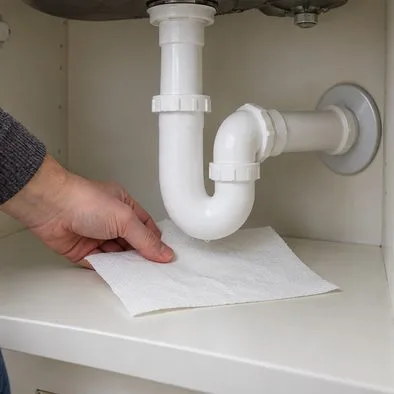
Lay dry white paper towels or plain newspaper under the plumbing, with separate small pieces beneath the shutoff valves, supply hoses, drain assembly, and garbage disposal if present. Keep paper away from hot surfaces and moving disposal parts. Check that the paper is dry before each test. A fresh wet spot is more useful than a damp area that was already there.
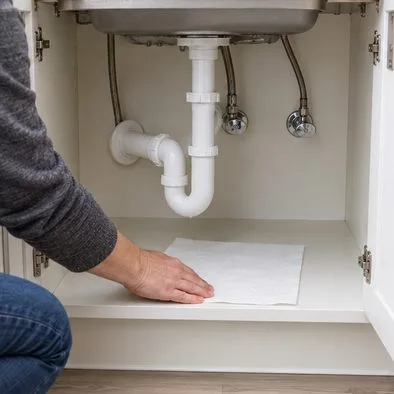
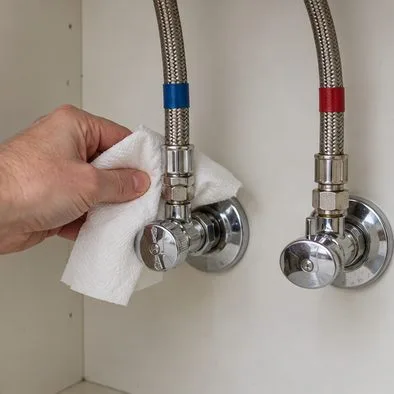
Leave the faucet unused for several minutes and inspect the towels. Lightly touch a fresh, dry tissue to each visible connection: the hot and cold shutoff valves, the supply hoses, and the points where the hoses connect to the faucet. Do not pull on a hose or tighten a fitting just to see what happens. If a tissue becomes wet while the faucet has not been used, the leak may be on a pressurized supply line, a valve, or a connection. A continuous leak deserves prompt attention because it can continue even when the sink is idle.
Manufacturers advise checking the home shutoff valves and supply lines when a faucet-base leak is continuous. If a valve itself is wet, or you cannot tell whether the water comes from the valve, line, or faucet connection, close the local valve only if it operates normally and arrange a plumber’s inspection.
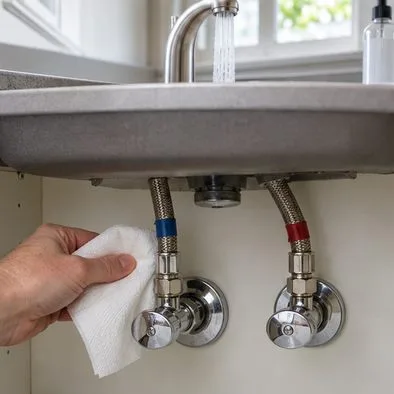
After replacing any wet paper with dry pieces, run the faucet briefly. Check around the faucet hoses, sprayer hose connections, and the underside of the faucet base. If the water appears only while the faucet is running or just afterward, the trigger is useful evidence: a faucet hose or its connection may be leaking under flow, or water may be escaping around the faucet and running down into the cabinet. Dry the area again and repeat once to confirm the same spot becomes wet under the same condition.
Do not assume that water near the faucet base proves the faucet itself is defective. Water can move along a hose or the sink underside. Follow the wet trail upward to the highest point you can see. If the leak is intermittent or hidden behind the sink, a plumber may need to inspect it from a better angle.
Replace the towels and run water into the basin, then stop and inspect the drain piping. If there is no leak, fill the basin partway, release the water, and check again as it drains. Look at the sink drain flange, tailpiece, slip-joint connections, P-trap, and the pipe entering the wall. A joint that becomes wet only while water is draining points toward the drain path, though water can still travel down from a higher fitting. Trace the moisture upward rather than tightening every connection at once.
If the sink has a garbage disposal, inspect its sink mounting area, dishwasher inlet, and discharge connection during the relevant test. A leak at the disposal’s bottom may be water dripping from above; water emerging through the disposal body can indicate internal failure. Do not put a hand inside the disposal. Follow the manufacturer’s support guidance for the specific model, and call a plumber if the source is unclear.
A dishwasher drain hose may leak only while the dishwasher pumps water, and a water filter or pull-out sprayer can have connections that do not leak during a basic faucet-off test. If the first three passes stay dry, place fresh towels and check during a dishwasher drain cycle or after using the filter or sprayer. Also inspect the seam where the sink meets the counter: water spilled on the counter can run behind the basin and appear underneath without a pipe leak.
For a slow or intermittent leak, leave a clean, dry piece of paper under the suspected area and inspect it later, including after normal sink or appliance use. A dry towel after one short test does not rule out a leak that happens only during a full dishwasher cycle or occasionally. Avoid leaving absorbent material in place where it could stay wet unnoticed; check it at least daily and remove it if it becomes damp.
| What you observe | What it can suggest | Useful next step |
|---|---|---|
| Water returns while the faucet is off | Supply valve, supply line, or a continuously leaking connection | Use the local shutoff if safe and arrange prompt plumbing service |
| Water appears while the faucet runs | Faucet hose, sprayer connection, or water tracking from the faucet area | Dry and repeat once; trace the wet path upward |
| Water appears while the basin drains | Drain flange, tailpiece, trap, disposal, or drain connection | Inspect each drain joint and note the first wet point |
| Only an appliance cycle triggers moisture | Dishwasher hose or a nearby appliance connection | Check during the matching cycle; stop if water is spreading |
These patterns are clues, not proof of a particular failed part. Some leaks are hidden inside a cabinet wall, behind a dishwasher, or under flooring; a dry visible connection cannot rule those out. A moisture alarm under the sink can provide an early warning of future water, but it does not locate or repair a leak. For broader leak monitoring, the U.S. Environmental Protection Agency’s overview of leak detection devices explains the difference between local moisture sensors and systems that monitor water flow.
Shut off water if a supply leak is active and the valve can be closed without force. Get prompt professional help if water is flowing steadily, a shutoff valve will not operate, the leak is inside a wall or cabinet, the wood is soft or swollen, or repeated testing cannot identify the first wet point. If water is close to an outlet, disposal wiring, or another electrical component, do not touch wet equipment or reach into the cabinet to continue testing; contact a qualified professional. For a small contained leak, dry the cabinet and nearby items promptly, then keep checking until the area stays dry under the conditions that previously triggered the leak.
The timing clues above follow the manufacturer’s troubleshooting guidance for kitchen faucet leaks under the sink and bathroom faucet leaks under the sink. For local shutoff operation, see Moen’s instructions on turning off faucet water supply. Disposal leak locations and cases that need service are described in InSinkErator’s garbage disposal leak guide. These sources cannot determine what is leaking in a particular home; the checks here help locate visible moisture, and repair decisions depend on the fixture and plumbing condition.
Use dry paper towels and four focused checks to find a hidden sink leak, tell supply leaks from drain leaks, and know when to call a plumber.
Bathroom mirror streaks often come from residue, dirty cloths, excess cleaner, or dried water. Find the likely cause and a gentle way to fix it.
Reduce overnight window condensation by controlling indoor moisture, improving airflow, monitoring humidity, and knowing when the window itself needs attention.
Reduce cooking and kitchen odors without fragrance by improving ventilation, cleaning grease and food residue, managing waste, and finding persistent odor sources.
Learn why ceiling fans wobble, which warning signs mean turn it off, and what you can safely check before calling an electrician.
Learn why indoor plant leaves turn brown at the edges, how to read clues about watering, humidity, salts, and light, and when to seek expert help.
Keep stored clothes dry without mothballs: measure closet humidity, reduce moisture at the source, dry garments fully, choose suitable storage, and inspect for mold.
Musty towels often point to lingering moisture, washer residue, or slow drying. Learn how a hypothetical laundry example helps narrow the cause and what to change first.
Keep balcony plants hydrated during a short trip with a plan based on pot size, plant needs, sun, and wind. Compare wicks, self-watering pots, and plant sitters.
Move a heavy houseplant safely without scratching hardwood, denting flooring, spilling soil, or straining your back. Use a protected path, a dolly, and a controlled team lift.