The study of a baby's cognitive ability when talking to a parent was conducted by two psychologists from New York University and Northwestern University in the US. Research is a narrative overview that narrates how choosing evidence regarding the effects of contact and conversation with a baby on a baby's speech ability during the early years of life Psychologists believe that contacting and talking with babies not only develops speech and language skills well, but also affects their cognitive ability and socio-emotional capacity.
How does talking to babies help develop their cognitive abilities?
Researchers have long thought that it was often thought that giving babies to hear voices was primarily beneficial for their language development. However, new evidence suggests that the benefits of this practice go beyond just developing a child's language.
Psychologists believe that, from the first few months of a baby's life, listening to voices promotes basic cognitive development of children, including:
Learning by imitation is the ability to imitate images and words, such as “ma-ma-ma”;
Forming the ability to classify objects is the ability to catalog similar objects to other objects, such as being able to distinguish between a white vehicle and a white chicken;
Recognize who is talking to the baby;
Gain more knowledge about social interaction;
Develop social awareness such as the ability to interpret, recognize, and respond to the feelings and emotions of others.
The authors also emphasized that human voices are especially beneficial for baby's development compared to other sounds, such as laughter or sneezing. Psychologists think that nerve cells respond in different ways to human speech compared to other sounds, and how voice activates certain areas of the brain. The researchers then went deeper into more complex models of how children learn more difficult language rules and features as they grow, such as recognizing sequences of sounds over and over again. different details.
The authors are currently working on a number of experiments that aim to discover mechanisms that help babies categorize different subjects. Children between the ages of three and 12 months are shown different subjects (such as a variety of animals) and are divided into two groups, one group viewing pictures and listening to their voice. people and the other group heard the sounds of those objects. The results of the experiment showed that children who listened to other people's voices were better able to categorize subjects than babies who saw pictures and listened only to the sounds of animals.
This study also analyzes the mechanisms that allow infants to identify “potential communication partners”. Children develop their awareness of treating people and things differently (eg smiling and making sounds when meeting others). Children also develop an awareness that voice conveys information and the speaker's intentions, even when they cannot understand what those messages are.
Unexpected conclusions from research
“Before they start learning to speak, they can hear the voices of others,” the authors conclude. We believe that even before children can understand the meaning of surrounding words, listening to the voices of others changes their core cognitive abilities. When they begin to listen to others talk, children randomly form a natural self-learning mechanism about objects, events and people in their world ”.
The study authors also argue that more research is needed regarding the issue of whether or not other categories of cognitive processes and social capacity are influenced by human voice, mechanisms are hidden under these processes of influence.
However, this is an interesting study that goes against an inherent belief that talking with infants only helps children develop language and learn to speak. The results of the study present new evidence that the benefits of talking to your baby may go far beyond. Researchers suggest that talking to babies can help children develop cognitive abilities, such as cognitive tests accompanying human voices helping children better categorize subjects. In addition, talking with your baby can help improve a child's social capacity, such as recognizing who is talking to him, recognizing someone else's words, and how the voice conveys thoughts and the intention of the speaker.
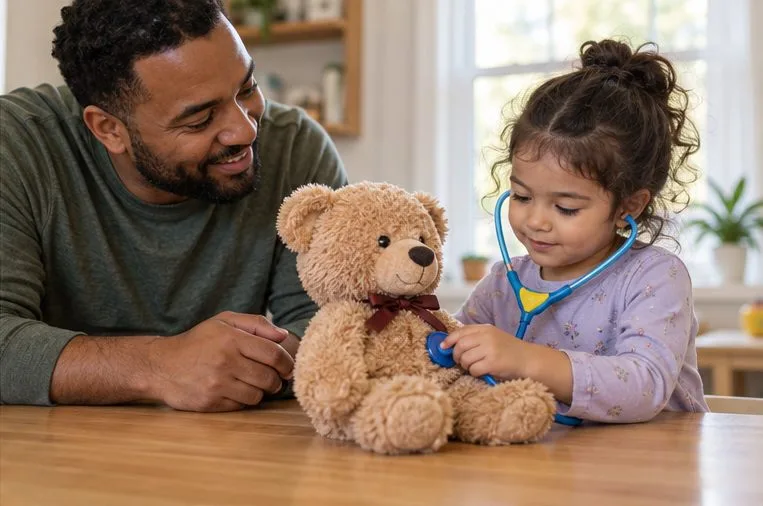
Regular communication with your baby is very beneficial, it helps your baby develop speech awareness and strengthens the connection between you and your baby. There is also evidence that babies are born in a “low voice” environment, where babies are not exposed regularly to spoken language, which can slow down their development. Therefore, hold your baby and talk to him often, you will be amazed at his ability to "understand"!