Keep a freezer-rated appliance thermometer in a spot you can read in one glance when power returns: near the center of the freezer, on the middle shelf, with its face toward the opening and not hidden behind food. Set it up before an outage, then leave the freezer door closed while the power is off. The steps below help you get a useful reading without searching through packages or disturbing the food.
This guide uses current U.S. FoodSafety.gov and USDA guidance for household freezers. A freezer thermometer helps you assess the compartment; it does not replace checking food-specific guidance after a long outage.
Prerequisites
| Item | Purpose |
|---|---|
| A freezer-rated appliance thermometer that reads at least 0°F (−18°C), with a dial or display you can read quickly | To monitor the freezer through normal use and an outage |
| A stable middle shelf or basket and a small label or note, if useful | To keep the thermometer in a consistent, findable position |
| Estimated setup time: 10–20 minutes, plus any settling time required by the thermometer instructions. Difficulty: Easy. | Check your appliance and thermometer manuals for model-specific placement and settling instructions. |
Five steps to place a freezer thermometer
Step 1: Choose an appliance thermometer made for freezer temperatures
Use a refrigerator/freezer appliance thermometer with a scale that includes 0°F (−18°C) and warmer temperatures. A cooking thermometer may not be designed to stay in a freezer, and an instant-read food thermometer is meant to measure an individual food when you insert it. Check the package or manufacturer instructions to confirm the thermometer can remain in freezing conditions and can be read at the temperature range you need.
A simple dial is easy to see without batteries. A digital model can also work if its sensor is freezer-rated and its display remains readable when cold. If it uses a separate display or alarm, check the instructions for where the sensor goes and whether readings continue during a power failure. Do not assume a freezer’s control-panel setting is its actual temperature; use a thermometer for an independent reading.
Step 2: Pick a middle-shelf location near the center
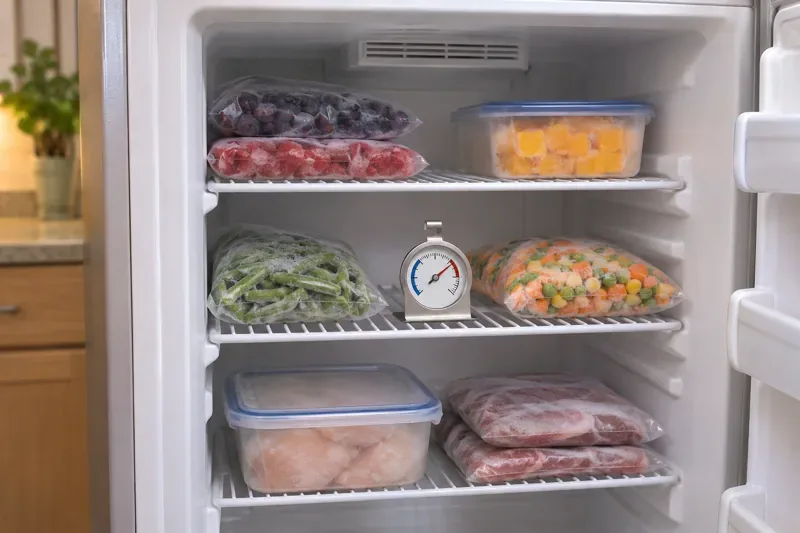
On an upright freezer, choose the middle shelf, as close to the center of the compartment as practical. On a chest freezer, choose a central spot among the stored packages. Leave enough room to see and reach the thermometer immediately when you open the lid or door. Aim its face toward the opening; do not bury it behind bags or place it in a door bin where it is easier to overlook.
For a reading closer to the temperature of stored food, follow your thermometer or freezer manufacturer’s directions. GE Appliances advises placing a thermometer between packages that have been frozen for more than 24 hours, on the middle shelf or near the middle of the appliance, when measuring freezer temperature. Air temperature can fluctuate when the door is opened. This makes a stable central position a useful compromise between a representative reading and quick access. See GE Appliances’ freezer temperature measurement instructions.
Step 3: Secure it so it stays visible and in place
Use the stand, hook, clip, or shelf position intended by the thermometer’s manufacturer. Place the dial or display upright and visible from the doorway. Do not wedge it where a package can knock it down, cover its scale, or block a vent. Keep it away from the door gasket and from direct contact with a cooling plate or wall unless the product instructions specifically call for that position.
Arrange food around the thermometer without leaving it loose on top of a sliding bag. If the shelf is crowded, reserve a small gap at the front of the middle shelf and put the thermometer just behind that edge, still within the central part of the compartment. A small label on the shelf can remind household members to return it to the same position after cleaning or reorganizing.
Step 4: Check a normal reading and make a quick-find plan
After installation, allow the period stated in the thermometer’s instructions before using the reading as a baseline. Write down the date and the normal reading, and confirm that the thermometer face is easy to find with the door open. For U.S. home food storage, USDA and FoodSafety.gov recommend keeping the freezer at 0°F (−18°C) or below. The appliance setting and actual measured temperature may differ, so adjust the control only as directed in your freezer manual.
Tell other household members where the thermometer is. If possible, take a quick reference photo of its normal location so no one needs to search during an outage. Do not move it to a door shelf for convenience; consistent placement makes readings easier to interpret over time. USDA advises keeping an appliance thermometer in the freezer so it can help assess food after power returns. Read USDA FSIS guidance on preparing for a power outage.
Step 5: Leave the door shut during an outage and read it once power returns
When the power goes out, keep the freezer door or lid closed as much as possible. The thermometer stays in its usual position so you can find it quickly after power returns; repeatedly opening the door to check it can let cold air escape. A basic dial shows the temperature when you read it, but it does not preserve the highest temperature reached while nobody was checking. If you want an outage history, choose a freezer-rated model with maximum-temperature memory or an alarm, and confirm in its instructions that the sensor and memory continue working during a power failure. When power returns, open the freezer, find the thermometer immediately, and note the reading before moving food. Record the outage’s approximate start and end times and whether the door stayed closed.
FoodSafety.gov says a full freezer can hold a safe temperature for about 48 hours, or 24 hours if it is half full, when kept closed; these are approximate time guides, not a guarantee. Its outage guidance says food may be refrozen if it still has ice crystals or is at 40°F (4°C) or below, though quality can decline. Follow the food-specific chart when food has thawed or the reading is above that threshold, and never taste food to decide if it is safe. Check FoodSafety.gov’s current power-outage food chart.
Household example
Suppose an upright freezer has three main shelves. Put a freezer-rated dial thermometer on the middle shelf, centered between frozen packages, with its face aimed toward the door and a few inches of clear space in front. Note the usual reading after the manufacturer’s recommended settling period. During an outage, keep the door shut. When power returns, open it once, read the dial, and log the time and temperature. This routine makes the thermometer easy to find while keeping it near stored food, rather than relying on memory about where it was placed.
Troubleshooting
- The display is blocked or hard to read: Reposition the thermometer on the same middle shelf with the face toward the opening. Keep it near the central zone, not in the door. Confirm its markings can be read in dim light before an outage.
- The reading looks normal after power returns, but the outage lasted a long time: A basic dial does not show the highest temperature reached earlier. Use the outage duration and FoodSafety.gov’s food-specific chart; do not assume a current low reading proves every item stayed frozen.
- The reading changes whenever the door opens: That can happen because air temperature fluctuates. Keep the thermometer in a stable position near frozen packages, minimize door openings, and use the manufacturer’s directions for checking temperature. Do not mistake a brief air change for the temperature of every food item.
- The thermometer falls or gets buried: Use its built-in stand or hanger on a stable shelf, then reorganize packages so the display remains visible. If the freezer is too full to keep it in place, choose a less crowded middle-shelf area rather than a door bin.
Frequently asked questions
Should a freezer thermometer go near the door or in the middle?
Keep it in the middle area of the freezer, ideally on the middle shelf or among stored packages, and orient the display so you can see it when opening the door. Avoid door bins because they are easy to disturb and may not represent the central storage area. Follow your appliance and thermometer instructions if they specify a location.
What temperature should a home freezer read?
For U.S. household guidance, USDA recommends 0°F (−18°C) or below for freezer storage. After an outage, food-safety decisions use additional time, temperature, and food-specific criteria; the normal storage target should not be treated as the only outage threshold.
Can I tell whether every food is safe from one freezer thermometer?
No. The thermometer provides a useful reading for the appliance, but foods can differ in size, location, and thawing. Use FoodSafety.gov’s frozen-food outage chart, consider whether food still has ice crystals, and never taste it to test safety. When guidance says to discard an item, follow it.