Like all other skills, baby food chewing and swallowing skills are gradually accumulated over time. From the very first days of feeding your baby, you should pay attention to helping your baby to chew and swallow fluently by choosing foods with the right texture.
Experience the texture of the food
Most babies begin to get used to weaning foods at 6 months. When you put food in your baby's mouth, your baby will feel the food's flavor, size, texture, shape and temperature. Oral activities will give your baby the first experience of foods of a certain coarse texture and require more active tongue. Mothers who choose to feed their baby with the self-directed method will see this experience most clearly.

The weaning process is not just about introducing solid foods, but also about exploring different food textures.
We often see older babies doing the chewing motion to crush large chunks of food into flakes and swallow it easily. But this is not all that your baby needs to chew food. You may not realize that babies need to know how to gather all the food scraps in their mouths to swallow. If your baby does not know this step, there is no point in chewing food. To encourage your baby during solids-feeding, choose foods with suitable textures, not too soft, not too hard or too big, too smooth for each baby's age.
When can my baby eat raw foods?
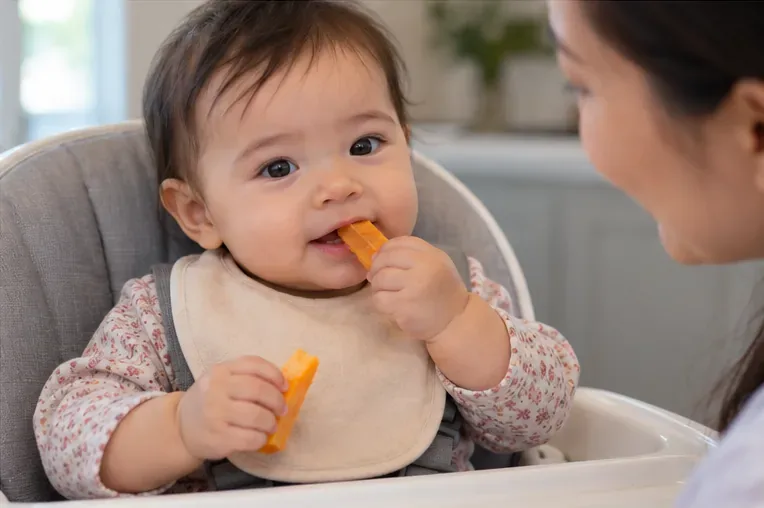
Usually, babies will be ready to offer raw, pelleted or small food in about 8 months. When introducing solids at this stage , you need to note that the baby is able to sit firmly. This is a good position for chewing and swallowing food. The sitting still is also a sign to parents that they are ready to try new skills. The skills of mouth and jaw after a period of weaning practice are also skillful enough to handle larger food pieces than before, allowing babies to eat more proficiently.
![Feeding your baby: The secret to choosing foods to practice chewing]()
Offer your baby snacks with a varied menu to familiarize them with different food textures
When starting to introduce solids, you only give your baby smooth, thin foods, at this stage you can change to lumpy, denser foods. The increase in pigmentation over time will help babies to be more aware of the food texture and stimulate the movement of the jaw and tongue to coordinate chewing - swallowing. However, at this time, your baby should only eat soft foods that can be crushed by hand. This not only helps to limit accidents and choking, but also helps children eat easily and eat more.
Develop chewing - swallowing skills
When babies begin to enter the toddler stage, their ability to combine chewing and swallowing food will develop more than before. Babies can bring food from the middle to the sides of the tongue, chew and bring back the middle of the tongue easily. If the baby feels not ready to swallow, the food will be sent back to the sides of the tongue to continue chewing. When you are 2 or 3 years old, your baby can move food from one side to the other easily and can naturally chew and stir food in the mouth at the same time. In the eyes of adults, all these activities are simply "chewing" only. With this developmental schedule, you only need to gradually increase the hardness and coarse of the food from the age of 8 months. Start with vegetables and expand your baby's menu with meats, fish… until they can eat the same foods as adults.