Home
» Babies
»
How to Encourage Tummy Time When Your Baby Cries: Gentle Options That Work
How to Encourage Tummy Time When Your Baby Cries: Gentle Options That Work
If your baby cries the moment you place them on their stomach, you do not have to choose between forcing a long session and skipping the position entirely. Start with a version that feels easier, keep each try brief, and respond when your baby needs a break. Tummy time is for awake, supervised play; it is not a sleep position.
Many babies protest at first because lifting the head and pushing against gravity are hard work, and the floor can feel less reassuring than being held. Crying does not by itself tell you why your baby is upset or signal a developmental problem. Check basic needs, try a calmer moment, and make the position more comfortable. If crying seems painful, happens every time despite adjustments, or comes with other concerns, ask your baby’s clinician for individual guidance.
Choose the starting position that fits your baby
There is no single best starting point for every family. The practical trade-off is usually between how much support the position gives, how easy it is to supervise, and how well the baby tolerates it. All tummy time must be supervised, and a caregiver should be fully awake for chest-to-chest practice.
Option
Often useful when
Trade-off and safety check
Chest-to-chest
Your baby settles more easily with your voice and closeness.
Gentler and more face-to-face, but your upper body must be securely reclined and you must stay fully awake. Move to a safe sleep space if you feel sleepy.
Across your lap
The floor position triggers immediate fussing, or you want a small first step.
Easy to soothe and support, but keep a hand on the baby and their face clear. Sit securely on the floor rather than balancing the baby on a raised surface.
Firm floor mat
Your baby is alert and ready to practice lifting and turning the head.
Offers room to move and is a practical everyday option, but can feel demanding at first. Get down face-to-face and keep the area clear.
Floor mat with a small rolled towel
Your baby needs a little help getting the arms forward under the shoulders.
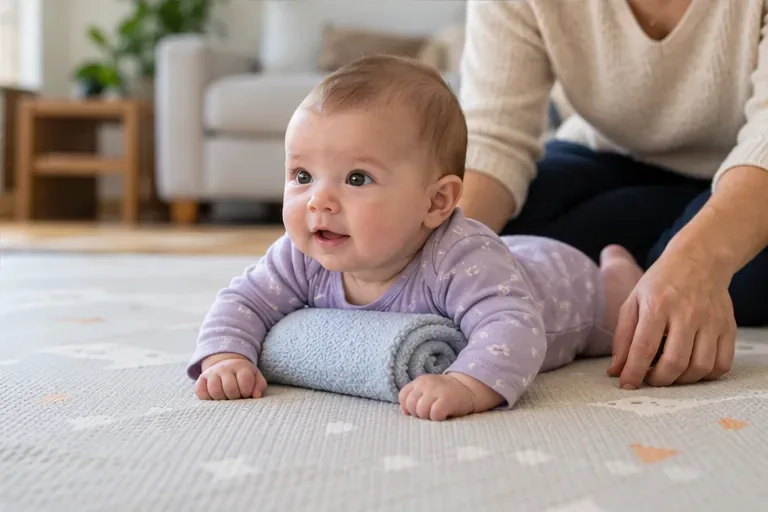
May make the position easier for some babies, but it is an optional aid, not a required product. Keep the towel below the upper chest, away from the face, and remove it when play ends.
An awake baby practices tummy time on a fully awake caregiver’s chest as they look at each other.
Make the first attempts short and well timed
Try tummy time when your baby is calm and alert, such as after waking or after a diaper change. Avoid starting when the baby is very hungry, overtired, already crying hard, or immediately after a full feed if lying on the stomach seems uncomfortable. There is no need to use a timer as a test of success: a brief, calm attempt is a useful start.
Meet the immediate need first. Check whether your baby needs a feed, burp, diaper change, sleep, or a few minutes of cuddling. If they are already upset, settle them before trying again.
Start with the easiest position. Place your awake baby tummy-down on your chest while you recline securely, or across your thighs while seated on the floor. Keep the baby’s head turned to one side and the nose and mouth unobstructed.
Stay close and make it social. Bring your face near your baby’s eye level, talk or sing, and let them look at you. A familiar voice and face may make the brief effort more engaging. A toy at eye level can help when your baby is ready.
End the try when distress builds. Pick your baby up, comfort them, and try another short opportunity later. The goal is repeated, manageable practice, not leaving a distressed baby to cry through a long session.
The American Academy of Pediatrics’ parent guidance suggests beginning with short periods—about 3 to 5 minutes, two or three times a day—and gradually building toward a total of 15 to 30 minutes a day by around 7 weeks. These are gradual targets, not a reason to push through intense crying. Babies vary; ask your pediatrician what is appropriate if your child was premature or has a medical condition.
An awake baby lies tummy-down across a seated caregiver’s thighs, with the caregiver’s hand supporting the baby.
What can you change if your baby still cries?
Change the surface or angle
If the floor is the hardest part, return to chest or lap practice for a while, then try the floor again when your baby is calm. On the floor, use a firm, flat play mat. A small, tightly rolled towel under the upper chest and arms is one option mentioned in NHS guidance; it is not needed for every baby. Keep it away from the face, supervise closely, and do not use pillows, wedges, loungers, or inclined products as a place for sleep.
Make the session easier to look at
Get down at your baby’s level, use your voice, or place a simple toy where the baby can see it without straining. A clean, baby-safe mirror can also provide something interesting to look at. Keep objects out of the immediate breathing space and do not leave your baby alone, even briefly.
Use more than one short opportunity
Instead of aiming for one long session, offer small bouts across the day and stop before your baby becomes very distressed. The time spent tummy-down on a caregiver’s chest or lap can be a helpful bridge to floor play, as long as the baby is awake and continuously watched. If you need to set the baby down, place them on their back in a safe sleep space if they might fall asleep.
An awake baby practices tummy time on a firm floor mat while a caregiver lies face-to-face nearby.
How the options compare in everyday use
For a baby who calms with closeness, chest-to-chest usually offers the most connection with the least change in routine. Across-the-lap practice is a convenient alternative when the baby dislikes the floor, though the adult needs to keep a hand on the baby and avoid distractions. Floor play gives the baby room to move and makes it easier to try looking toward a toy or caregiver, but may take gradual familiarization. A rolled towel can offer modest support on the floor, but adds another item to position and monitor.
Choose based on your baby’s response and your ability to supervise safely. You can switch positions from one opportunity to the next; you do not need to buy special gear or make every session look the same. If your baby briefly fusses but settles when you engage them, try another short attempt. If the crying escalates, comfort them and pause.
An awake baby lies on a firm play mat with a small rolled towel under the upper chest while an adult supervises nearby.
Keep awake play separate from sleep
Place babies on their backs for every sleep, including naps. Tummy time is only for awake play with an attentive adult. Chest-to-chest practice is not safe if the adult may fall asleep; move the baby to a separate, firm, flat, empty sleep space if you feel drowsy or the baby falls asleep. Do not use a tummy-time position, towel, pillow, wedge, or inclined device for sleep. The NIH Safe to Sleep® guidance explains why supervised tummy time and back sleeping serve different purposes.
When should you ask your baby’s clinician?
Contact your pediatrician if tummy time seems to cause pain rather than ordinary protest, your baby always turns or tilts the head toward one side, you notice an unusual preference or difficulty moving one side, or you are concerned about head shape or movement. A clinician can check positioning, neck movement, and development and can recommend a physical therapist if needed. If your baby was born prematurely or has reflux disease or another special health need, ask what positions and timing are right for them; AAP guidance specifically advises discussing tummy-time plans in these situations.
At the next routine visit, mention how long your baby tolerates each position, what helps them settle, whether they turn their head both ways, and any other changes you have noticed. A single tough session cannot assess development. The CDC’s 2-month milestone page includes holding the head up while on the tummy as one movement milestone and encourages parents to discuss concerns with a clinician; milestones are not a diagnosis or a substitute for an individual assessment.