Home
» Babies
»
How to Dress a Baby for Sleep Without Guessing the Room Temperature
How to Dress a Baby for Sleep Without Guessing the Room Temperature
You put your baby down in a sleeper, then wonder whether the room is cool enough for a sleep sack—or warm enough to skip it. A thermostat reading can help you notice a change, but it cannot tell you exactly what every baby should wear. Current U.S. safe-sleep guidance offers a more useful starting point: dress your baby in no more than one layer more than a comfortable adult would wear in the same room, then check your baby’s chest for signs of overheating. Keep the sleep space clear of loose blankets either way.
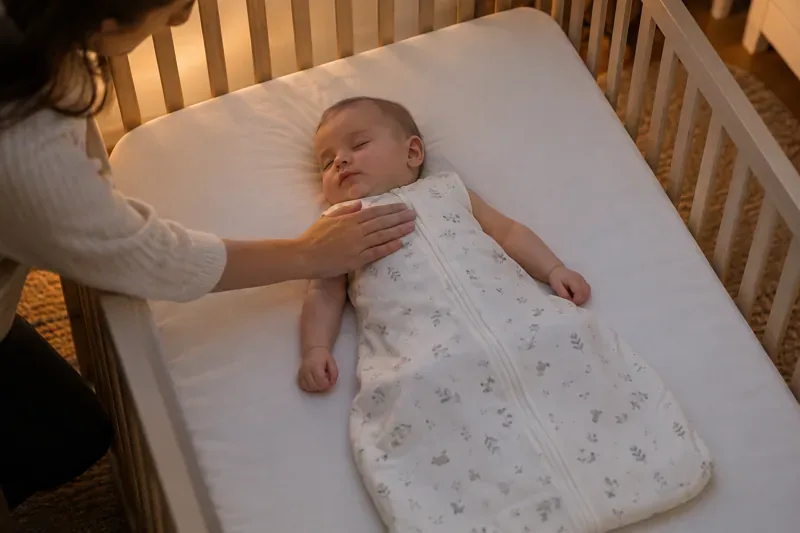
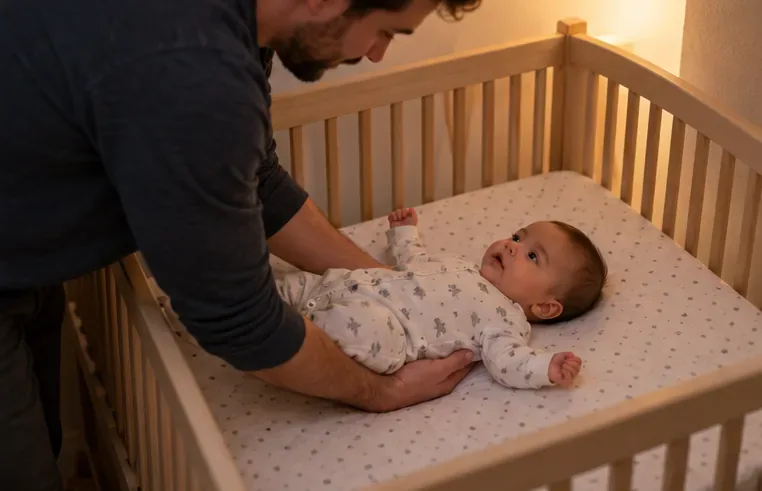
A baby lies on their back in a sleeveless sleep sack on a bare crib mattress while a caregiver checks the chest area for warmth.
What is established—and what depends on your baby
The American Academy of Pediatrics (AAP) advises keeping the room at a comfortable temperature, avoiding overheating, and generally dressing babies in no more than one extra layer compared with an adult. A correctly sized wearable blanket, often called a sleep sack, can provide warmth without adding a loose blanket to the crib. The baby’s head and face should stay uncovered. These principles are more reliable than trying to match a precise outfit to one universal thermostat number.
What counts as “one layer” depends on the clothes, the sleep sack, the room, and the baby. A thin cotton sleeper and a lightly insulated sack are not equivalent to thick fleece pajamas and a heavily insulated sack. Some sleep sacks display a TOG rating, a measure of thermal insulation. Use the specific product’s care and layering instructions as a guide, but do not treat a TOG value as a medical guarantee that your baby will feel comfortable at a particular room temperature. There is no single outfit formula that fits every home and infant.
Age and health also matter. Newborns, babies born prematurely or at low birth weight, and infants with medical conditions may need individualized advice. If your baby’s clinician or neonatal team gave you a specific plan, follow that plan rather than a general rule of thumb.
A practical way to choose sleep clothes
1. Start with the room and the adult comparison
Set the room to a temperature that feels comfortable to a lightly dressed adult. A room thermometer can show whether the temperature has shifted overnight, especially if heating or air conditioning cycles, but do not chase an exact number unless your pediatrician has advised one. The AAP’s public safe-sleep guidance does not set one exact room-temperature target for every baby and home.
Next, consider what you would comfortably wear while sitting quietly in that same room. Use that as a reference, not as proof that your baby needs exactly the same clothes. The AAP’s “one extra layer” rule is a general starting point, not a promise that every baby will respond identically. Start with a simple, breathable outfit rather than piling on clothing because the weather outside feels cold.
2. Choose one sleepwear combination
In a warm room, a single lightweight layer may be enough. In a cooler room, a lightweight sleeper plus a wearable blanket may be appropriate if the sack’s own instructions allow that combination and your baby does not show signs of overheating. Avoid stacking several thick layers under a heavily insulated sack. If you change the room conditions or switch to a warmer sleep sack, remove a clothing layer and reassess rather than adding warmth on top of warmth.
Choose a wearable blanket that fits the manufacturer’s size guidance. The neck and arm openings should not allow the baby to slip down inside, and the fabric should not cover the face. A sleep sack is not a blanket laid over the baby; it is clothing designed to be worn. Do not use a weighted sleep sack, weighted swaddle, or weighted blanket.
3. Check the baby, not just the thermostat
After dressing your baby and again if the room changes, feel the chest or upper back with your hand. A comfortably warm chest is a more useful clue than cool hands or feet; those extremities can feel cooler even when the baby is comfortable. Look for sweating, damp hair, flushed or unusually hot skin, or a chest that feels hot. NICHD’s Safe to Sleep guidance lists these as signs a baby may be too hot.
If your baby feels hot or is sweating, remove a layer, take off any indoor hat, and check again after a short time. Keep the baby’s head uncovered during sleep. If the chest feels cool and the room is also cool, add only one light layer or use an appropriate wearable blanket, then reassess. Avoid making repeated large changes based on a single touch or on cold hands and feet alone.
Common beliefs to reconsider
“There is one correct thermostat setting for every baby.”
What guidance confirms: The AAP recommends a comfortable room and warns against overheating. Its general clothing rule compares the baby’s layers with what an adult would wear in the same environment. What depends on context: Comfort varies with insulation, airflow, humidity, the baby’s health, and individual response. What is not established as a universal rule: a specific thermostat number that automatically determines the right outfit for every infant. Use the room reading as context, then check your baby’s chest and the sleepwear instructions.
“Cold hands or feet mean I should add another blanket.”
Cool hands or feet alone do not reliably show that a baby’s whole body is cold. Check the chest or upper back instead. If you think your baby needs more warmth, adjust clothing with a wearable layer; do not put a loose blanket in the crib. The AAP’s safe-sleep guidance and NICHD’s Safe to Sleep recommendations both emphasize wearable clothing over loose bedding.
“A hat or extra blanket is a harmless way to be safe.”
Indoors, a hat can contribute to overheating; once home from the hospital, babies generally should not wear one for sleep unless their medical team has instructed otherwise. Loose blankets, quilts, pillows, and other soft items should stay out of the sleep space because they can cover the face or create other hazards. Put your baby on their back on a firm, flat sleep surface with only a fitted sheet. A sleep sack can add warmth without placing a loose cover in the crib.
“Swaddling is just another way to add warmth.”
Swaddling wraps a baby’s arms and body; it is not the same as a loose sleep sack that leaves the arms free. If you swaddle, place the baby on their back and stop as soon as they show signs of trying to roll. Do not use weighted swaddles. For details, see the AAP’s swaddling guidance. When choosing warmth, an arms-free wearable blanket is a separate option, and it should fit properly.
When a general rule is not enough
Ask your pediatrician or neonatal team for an individualized plan if your baby was premature, has a condition that affects temperature regulation, is recovering from illness, or repeatedly seems too hot or too cold despite simple adjustments. If your baby is 3 months old or younger and has a rectal temperature of 100.4°F (38°C) or higher, call your pediatrician immediately; do not assume that removing clothing alone addresses the cause. The AAP explains this threshold in its fever guidance for babies. Seek prompt care for concerning symptoms such as trouble breathing, unusual difficulty waking, or persistent overheating or coolness.
A quick check before you leave the room
Layers: Is the outfit no more than one light layer beyond what a comfortable adult would wear in the same room?
Body check: Does the chest or upper back feel comfortably warm rather than hot, damp, or sweaty?
Sleep space: Is the baby on their back on a firm, flat surface, with the head uncovered and no loose bedding or weighted products?
Product fit: Does the sleep sack fit according to its label and stay clear of the baby’s face?
If those checks look right, resist adding layers just because the baby’s hands feel cool or the thermostat number seems unfamiliar. Recheck if the room changes, your baby becomes sweaty or unusually hot, or a clinician has given you different instructions. The aim is not to guess a perfect temperature; it is to use a consistent, safe starting point and respond to the baby’s actual cues.