Home
» Babies
»
How to Serve Finger Foods Safely When Your Baby Has Few Teeth
How to Serve Finger Foods Safely When Your Baby Has Few Teeth
A baby does not need a mouthful of teeth before trying finger foods. What matters more is developmental readiness, the texture and shape of the food, and close supervision. In its 2026 infant-feeding updates, the U.S. Centers for Disease Control and Prevention continues to recommend introducing foods other than breast milk or formula at about 6 months, when a baby shows readiness skills such as good head control, sitting with support, bringing objects to the mouth, and moving food back to swallow. The CDC also emphasizes that foods should be prepared to the right size, shape, and texture for the child's development.
That means the practical question is not “How many teeth does my baby have?” but “Can this food be safely mashed by the gums, handled at this stage, and swallowed without requiring hard chewing?” Babies can do a surprising amount of mashing with their gums. Still, no preparation method eliminates choking risk, so safe setup and active supervision remain essential.
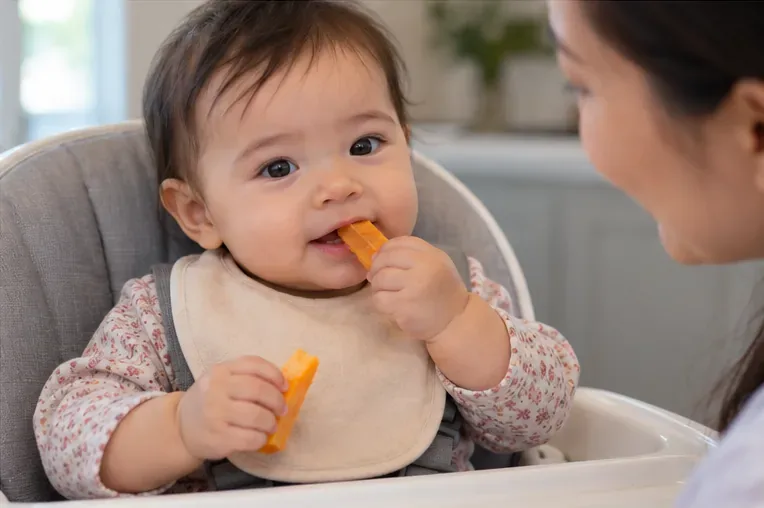
Start with posture and supervision: an upright, stable high-chair position helps make finger-food practice safer.
Start with readiness, not tooth count
Few teeth are common when babies begin complementary foods. The CDC's 2026 guidance on introducing solid foods says most babies can begin around 6 months, provided they can control the head and neck, sit alone or with support, open the mouth for food, swallow rather than push food back out, bring objects to the mouth, and move food toward the back of the tongue.
These skills matter because finger foods require coordination. A baby who is not yet ready for solids may struggle even if the food itself is soft. If your baby was born prematurely, has known swallowing problems, poor growth, a neuromuscular condition, or another medical issue that affects feeding, ask the baby's clinician for individualized advice before advancing textures.
Use the “gums can mash it” test
For a baby with few teeth, choose foods that are soft enough to squash easily between your thumb and forefinger or mash with a fork. The CDC choking-prevention guidance, reviewed March 11, 2026, advises preparing foods to a child's developmental level and avoiding small, sticky, or hard foods that are difficult to chew and swallow.
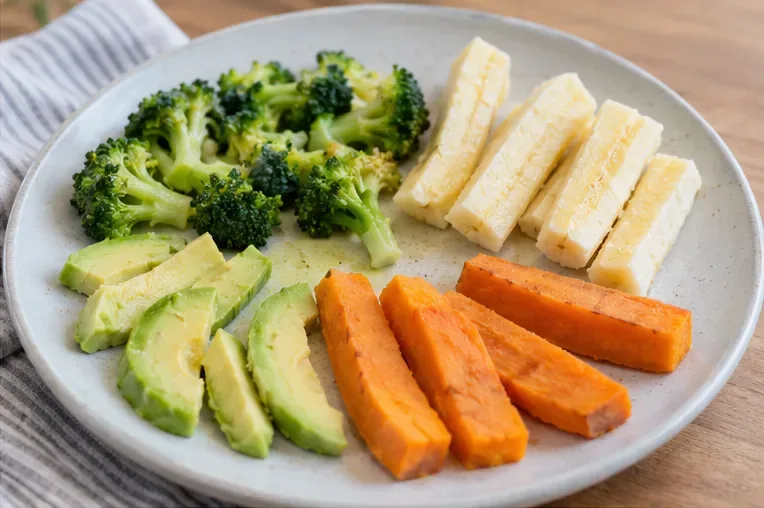
Good examples include very soft cooked vegetables, ripe avocado, soft banana, tender sweet potato, well-cooked pasta, soft scrambled egg, flaky fish with all bones removed, and tender shredded meat. The NHS guidance on first solid foods similarly recommends finger foods that break up easily in the mouth and are long enough for a baby to hold.
Choose foods that are soft enough to mash with the gums; soft-cooked vegetables, ripe avocado, and tender strips are easier to manage than hard raw foods.
Shape and size matter as much as softness
For an early self-feeder using a whole-hand grasp, larger finger-shaped pieces can be easier to hold than tiny pieces. As the baby's pincer grasp becomes more precise, smaller soft pieces can be appropriate. What should stay consistent is avoiding shapes that can plug the airway.
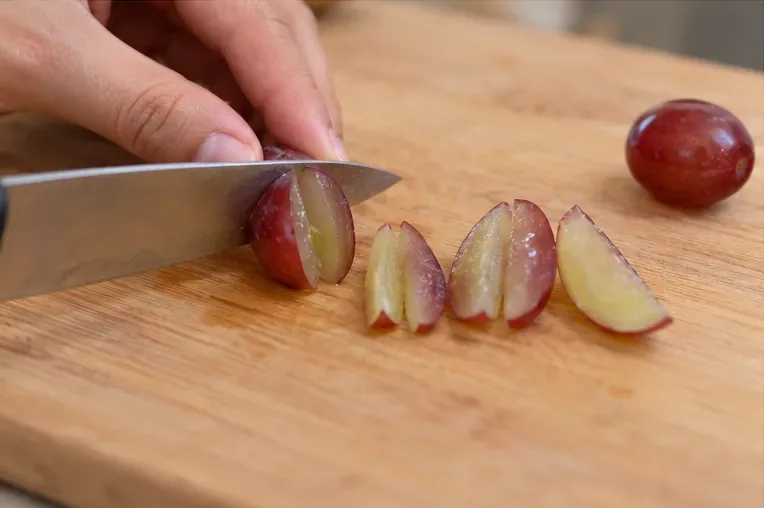
Round, firm foods deserve special attention. Whole grapes, cherry tomatoes, hot-dog rounds, hard raw carrot coins, nuts, popcorn, and chunks of hard apple are classic choking hazards. The CDC recommends cutting small spherical foods such as grapes, cherries, berries, and tomatoes into small pieces, and cutting cylindrical foods into short, thin strips rather than round slices.
Round foods such as grapes should be altered before serving; cut them into small lengthwise pieces rather than offering them whole.
A practical preparation checklist
Cook firm vegetables and fruits until they are soft enough to mash with a fork.
Remove pits, seeds, bones, tough skins, and gristle.
Shred or finely chop tougher meats instead of serving dense chunks.
Spread nut or seed butter thinly rather than offering a spoonful or sticky lump.
Quarter or finely cut small round foods such as grapes and cherry tomatoes.
Avoid hard, brittle, or sticky foods such as whole nuts, popcorn, hard candy, chewy candy, and thick globs of nut butter.
Seat the baby upright and stay within reach
Preparation alone is not enough. The CDC advises that young children sit up while eating, use a high chair or another safe eating place, and be watched at all times. Eating while crawling, walking, lying down, riding in a stroller, or moving in a car adds avoidable risk. Keep meals calm, and avoid rushing or distracting the baby while food is in the mouth.
Place only a few pieces on the tray at a time if your baby tends to stuff the mouth. Let the baby bring food to the mouth at a manageable pace. Avoid pushing pieces into the mouth or trying to “help” by placing food farther back on the tongue.
Let the baby self-feed soft pieces while seated upright, with an attentive adult close enough to respond immediately.
Gagging and choking are not the same thing
Gagging can happen while babies learn new textures. It is a protective reflex and can look dramatic. A gagging baby may cough, make noise, redden, or push food forward with the tongue. Choking is different because airflow is blocked. The American Academy of Pediatrics' HealthyChildren choking guidance lists warning signs such as inability to breathe, weak or absent crying or sound, gasping, blue color, panic, or becoming limp or unconscious.
If a baby is coughing forcefully and making sound, the airway is still moving air; stay close and watch carefully. If the baby cannot breathe, cry, or make sound, treat it as an emergency and use age-appropriate choking first aid while emergency help is being called. Parents and caregivers can reduce panic by learning infant CPR and choking first aid before an incident happens.
Do not rely on teeth to make a risky food safe
A few front teeth do not give a baby adult-style chewing ability. Even babies with several teeth can choke on the wrong texture or shape, while babies with no visible teeth may manage appropriately softened foods with their gums. Teeth therefore should not be used as the main safety test.
The more useful questions are:
Is the baby developmentally ready for solids?
Can the food be easily mashed with gums or a fork?
Has the food been cut to avoid round plugs, hard chunks, and sticky masses?
Is the baby seated upright and actively supervised?
Is the portion small enough to reduce mouth-stuffing?
Examples of safer swaps
Higher-risk form
Safer preparation for a young baby
Raw apple chunk
Cooked apple until very soft, then offer an age-appropriate soft piece
Whole grape
Cut lengthwise into small pieces
Raw carrot stick
Steam until very soft
Dense meat cube
Very tender shredded or finely chopped meat
Spoonful of peanut butter
Thinly spread nut butter or mix a small amount into another suitable food
Hard cheese cube
Soft, thin pieces appropriate for the baby's stage
When to pause and ask for medical advice
Occasional gagging during texture learning can occur, but repeated coughing, choking, wet or gurgly breathing with feeds, persistent refusal of textures, trouble swallowing, frequent vomiting with meals, or poor weight gain deserves professional review. Seek urgent help for breathing difficulty, blue color, inability to make sound, or loss of responsiveness.
Also ask your baby's clinician about texture progression if your baby has a history of prematurity, airway or heart problems, developmental delay, oral-motor difficulties, or a previous significant choking event. Individual feeding plans may differ from general guidance.
The bottom line
Babies do not need many teeth to eat finger foods safely. Softness, shape, developmental readiness, upright positioning, and supervision matter more than tooth count. Choose foods that can be mashed with gums, modify round and firm foods, avoid sticky and hard choking hazards, and stay close during every meal. As skills improve, you can gradually vary textures and sizes while keeping the same core safety principles.