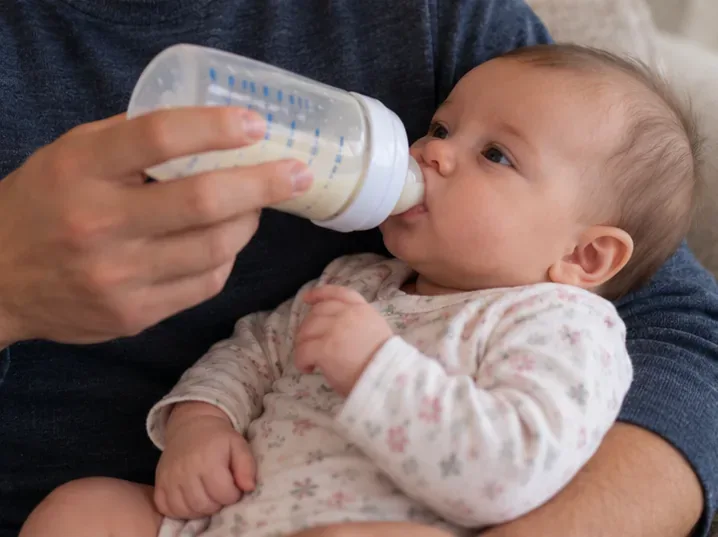
4-month-old children are almost a tiny adult with a fairly "moderate" meal, sleep, and rest schedule. Therefore, mothers do not have to pretend to wake up in the middle of the night to breastfeed. However, the mother's concern revolved around a completely different matter
To view this video please enable JavaScript, and consider upgrading to a web browser that supports HTML5 video
4-month-old baby know what to do? (QC)
By the 4th month, babies have gained twice as much weight as they were at birth and know a lot of new skills. Let's discover what a 4-month-old baby knows what to do, mom!
see more
1 / Baby's sleep
Compared to previous months, 4-month-old's sleep has begun to go into a certain “routine”, and mothers also have more rest time. Your baby can already sleep about 7-8 hours per night plus one, or two naps in the morning to "lift" the total sleep time up to 14-16 hours / day.
The main mistake in taking care of a 4-month-old baby for most mothers is trying to keep the baby awake during the day to make it easier for the baby to sleep at night, but this is completely not true mom! Despite taking a long night's sleep, 4-month-old babies still need plenty of sleep during the day. So, instead of "seducing" the baby to stay awake, mothers should arrange for the baby to be able to sleep well both night and day.

Besides sleeping time at night, babies still need daytime sleep, mom!
2 / Is 4-month-old baby ready to eat?
Most pediatric experts believe that the best time to start solids is when babies are 6 months old to minimize the risk of food allergies. Experts also recommend that the intestines of babies under 6 months old are not healthy enough to digest solid foods. But this is in theory. In fact, there are still many 4-month-old children who can start solids. Mom should refer to the baby's ready to weaning signs to know exactly when to start!
To ensure that your baby has a reasonable nutrition, in the nutrition for 4-month-old children, mothers should pay special attention to the following:
- Whether the baby has started to eat solids or not, milk is still the main source of nutrients and indispensable in the development of the baby in this period.
- If you give your baby solid food, you can start with flour, dilute porridge or finely ground foods. Note, you should only give your baby a small amount of food each time, and when you want to let your child try new foods, mothers should check to see if the baby has an allergy!
![Standard formula for 4 months old baby]()
5 great fruits for weaning babies It is interesting to note that most toddlers love the sweet taste. Therefore, fruit is the ideal choice for this period
3 / Child vaccination
As scheduled, 4 months old is about time for the next stage of the shots. If the first multiple vaccinations of Rotavirus, Hib, Diphtheria, Pertussis, Tetanus, and Polio vaccines are given, this is the time when the mother should take the baby to the next vaccination.
When taking the baby to the vaccination, the mother should warn the doctor if the baby has had a bad reaction in the previous vaccinations. The most important thing is that you should keep your baby comfortable during the vaccination.
4 / Safety precautions when taking care of children 4 months old
4-month-old babies have begun to be curious about the world around them, so mothers must be especially careful with the problems they may cause in their mother's absence. To avoid the dangers to the baby, the mother should eliminate all of the following risks:
Risk of falling children: Avoid leaving babies in high places because they can turn, flip and fall. When not with the baby, the mother should put the baby in the crib, or on the floor and have a safety barrier around.
Risk of hot water burns: Keep boiling water boilers, thermos bottles, or anything high in temperature out of sight. In particular, be careful of the risk that your baby may crawl, with a hot glass or a thermos bottle causing them to fall, and burn your baby.
- The risk of choking, choking : During this stage, the baby can put anything picked up into his mouth to "study". Therefore, take the time to clean up the dangers out of the reach of the mother! Marbles, small toys, urinal batteries ... are formidable "killers", so I pay special attention.
![Standard formula for 4 months old baby]()
Safe for the baby, do you know how to protect your baby from the dangers around? The older your children, the more mischievous, mechanical dancing and climbing non-stop ... Children are like that, with their curiosity and adventurous mentality, we can hardly protect them. from the hazards. And even more difficult for you to imagine the myriad dangers that appear ...
>>> See more discussions with related topics:
4-month-old baby quit breastfeeding and lack of sleep because of allergies
When you know the child is more than 4 months old