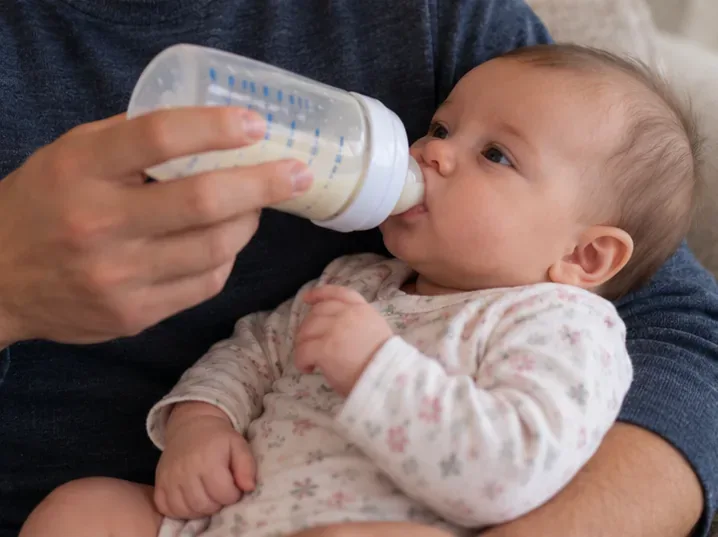
Many people think that fresh milk has absolutely no nutrients at all and does not provide enough nutrients for your baby. Actually, fresh milk also contains many vitamins and minerals that are not inferior to powdered milk. However, there are a few small notes that mothers need to pay attention to when trying to feed their babies fresh milk. Let's refer to the following!
>>> Add cow's milk to the menu for 1 year olds
>>> Children are at risk of drinking contaminated milk
When can my baby drink fresh milk?
In fresh milk, there are many viatmin and minerals , especially the protein content in fresh milk is very high, twice the protein content in breast milk. But also for this reason that pediatric specialists recommend that mothers should not give their babies fresh milk when the baby is under 12 months old.
Under 1 year old, the baby's digestive system is not yet complete and very immature. The too high protein content in raw milk will overload the baby's kidneys and stomach. In addition, the content of vitamin C and iron in fresh milk is very little, not enough to supply the baby's needs during this period. Giving a baby under 1 year old milk can make your baby lack the nutrients needed for healthy development.
For children over 1 year old, fresh milk is a very essential source of protein and calcium for babies. At that time, the baby's digestive system has also developed more completely and the baby has been provided with more vitamins and minerals from daily meals.

Depending on your baby's age, milk needs will vary
How much fresh milk should you give your baby?
For children aged 1-2 years, in addition to daily meals, mothers should give their children about 2 glasses of fresh milk, equivalent to about 200-300ml of milk, which is enough for the baby's calcium needs. Children 2-3 years old need about 300 - 400 ml of milk per day. Giving your baby more than 500ml of milk per day can lead to an excess of calcium. In addition, because of the high protein content, it will prevent your baby from wanting to eat anything else after drinking milk.
Children 4-8 years old will have higher calcium needs, about 700mg of calcium per day. Therefore, about 600ml of milk per day is enough for the baby's needs.
>>> See more: How to supplement calcium for children?
It is also quite important to let your baby drink milk at any time of the day. The mother should not feed the baby about 2 hours of milk before eating because it will make the baby full and not eat enough food in the main meal. 1-2 hours after meals or before going to bed is a good time to drink milk.
Choose milk for your baby like?
>>> See more: 3 wrong thoughts when choosing milk for your baby
Children under 2 years old need fat for brain development, so mothers should give their children whole milk to ensure the amount of fat needed. In the event that the baby is overweight , has a family history of heart disease, obesity or high cholestorol, the mother should give her baby low-fat milk as soon as the baby is 1 year old. Of course, this requires your doctor's permission.
Sugar-free milk is a bit difficult to drink, but it's good for your baby's dental development. If you feed your child with sugar-sweetened milk, mothers should rinse their mouths after drinking milk to avoid tooth decay and also reduce the amount of sugar in their children's daily meals.
MarryBaby