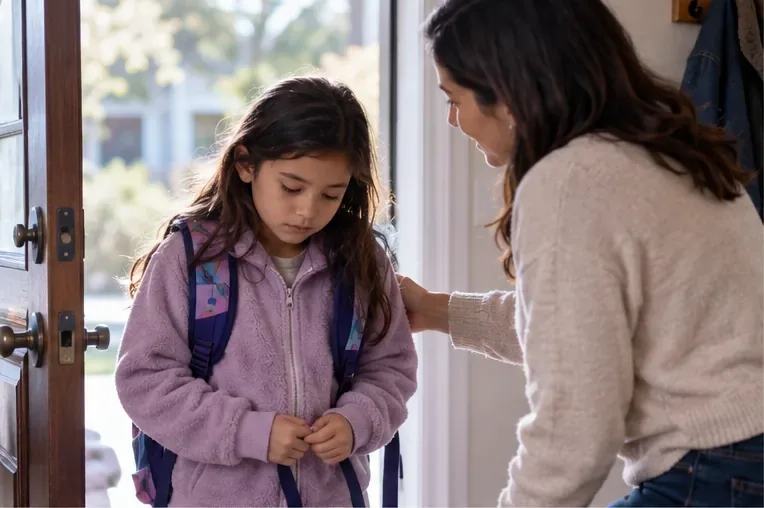
How to Teach Chores Without Redoing Every Task for Your Child

Teach kids to do chores with fewer reminders: set a clear finish line, model one task, step back, and correct only what is unsafe or unfinished.
Every child's toddler step is the joy of the parents. At this point, you need to choose to buy for your baby the right shoes to support your child walking.
The leg has a complex structure of 26 bones and 35 joints. The joints are joined together and supported by ligaments. Children begin to walk from 8-18 months. Most toddlers have flat soles or inward-facing feet as muscles and ligaments are in the process of developing. Therefore, you should choose the shoes that best match your child's feet.
Choosing footwear is an important part of helping children move and be protected. Do not choose shoes with hard and unstable soles, causing pain, blistering, and difficulty walking children. Toddlers usually don't need shoes until they are walking for two months, you need to buy shoes to protect their feet from sharp objects.
It is important that you keep your baby barefoot regularly to help him develop balance, coordination and gait. When choosing footwear, be careful about what size it should fit, by measuring each foot length and width. Babies' feet develop very quickly and shoe sizes need to change after a few months. Tight shoes can prevent children from walking, ingrown nails or bursitis to the big toe.
Some of the best options in choosing shoes for toddlers:
The shoe is sturdy, comfortable in both length and width
Cover your toes, keeping your toes out
Simple shoes
Heel support
There should be laces or patches to hold the foot in, to avoid slipping of the foot inside the shoe.
Normal soles of the feet have a certain degree of curvature formed by the muscles and ligaments. During the first two years of life, your baby's soles have less curvature. Young children with flat legs are normal due to weak muscles, large fat pads, loose ankle ligaments that cause their legs to point inward.
As your child walks well, the ligaments and muscles strengthen and the pad is in an area of imperceptible curvature. Around the age of 5, the child's soles of the feet are arched normally in both legs.
Many toddlers have a dove-like gait with one or both feet facing inward. In most cases, this is simply a sign of growth (standing, walking, sitting) and balance. This problem does not require medical intervention and will go away on its own after 3-5 years of age.
If your child still shows signs of pointing inward and does not improve, take him to a specialist hospital for a correct assessment. This symptom may be related to a number of hip joint problems.

This rare condition, when walking with a child's feet outward, is common in premature babies. In most cases, this will go away as you walk and keep your balance better. However, if you are concerned about this problem, you can take your child to a specialist for examination.
See your doctor if you are concerned about your child's foot shape or movement if you notice:
The toes are abnormally shaped
Ingrown toenails cause pain
Big toe bursitis or other deformities of the foot
Hard feet
Limp legs
Children feel pain when walking or crossing their legs when walking
Have serious inward or outward-facing foot problems
Flat feet over 5 years
Sudden change in the child's gait
2-year-old child that cannot walk.
Teach kids to do chores with fewer reminders: set a clear finish line, model one task, step back, and correct only what is unsafe or unfinished.
Learn why toilet-trained children may start having pee or poop accidents again, what patterns to track, how to respond calmly, and when to call the pediatrician.
A child may repeat a reassurance question to process information, seek connection, or manage worry. Learn how to respond and when persistent anxiety needs support.
Learn how to set screen-time boundaries with predictable routines, warnings, calm follow-through, and better transitions—without turning every device handoff into a fight.
Teach children to handle losing without shame or explosive anger by validating feelings, setting behavior limits, modeling recovery, and practicing at the right difficulty.
A calm, practical plan for after-school meltdowns: reduce overload, keep limits clear, track patterns, coordinate with school, and know when to seek help.
Learn how to respond when a child feels unwanted, ask supportive questions, recognize bullying or ongoing distress, and know when to seek extra help.
Learn how to set up a shared bedroom for siblings with different bedtimes, from planning around age-based sleep needs to creating separate sleep spaces and quiet routines.
Compare full-day, gradual, and temporary at-home return plans, plus health checks and school supports that can help a child reenter safely.
Learn when a child can try to solve a friendship problem, when adults should step in, and how to tell whether support is helping or needs to change.