Home
» Pregnancy
»
How to Prepare Older Children for a New Baby Without Pressure
How to Prepare Older Children for a New Baby Without Pressure
Start with a realistic promise: the baby will change routines, but your older child still belongs
You can prepare an older child for a new baby without asking them to feel excited, act grown-up, or become a helper. The most useful preparation is usually simple and repeated: explain what will change in language they understand, be honest about what newborns can and cannot do, protect familiar connection where possible, and let the child choose whether to take part in baby preparations.
No script can guarantee that a child will feel happy or adjust quickly. The American Academy of Pediatrics (AAP) notes that age and individual personality affect how children respond; school-age children may understand more than toddlers and still resent the attention a newborn receives. Treat preparation as support, not a way to manage or judge your child’s reaction.
A parent talks with an older child at eye level; a calm, open conversation can make room for questions without requiring excitement.
Misconception: “If we explain it well, our child should be happy about the baby.”
What guidance supports: Children can have mixed feelings about a new sibling. The AAP describes possible jealousy or resentment, and UNICEF notes that joy and jealousy can occur together. A child may love the idea of a baby and later dislike the crying, interruptions, or attention shift. Their first reaction is not a verdict on the sibling relationship.
What depends on the child: Age, temperament, developmental stage, family routines, and other changes all shape what a child understands and how they show it. A toddler may not grasp that “in a few months” is a long time. An older child may ask practical questions about privacy, school, or whether a parent will still attend activities.
Try this: Replace “Aren’t you excited to be a big brother?” with an open invitation such as, “What are you wondering about the baby?” or “Is there anything you think might be hard?” Listen without correcting the feeling. You can say, “It makes sense to miss having me to yourself. We’ll keep finding time for us.”
Tell the truth in small, age-appropriate pieces
Young children often understand concrete details better than abstract promises. Explain that the baby will sleep, eat, cry, and need an adult’s help; a newborn will not be ready to play right away. For a school-age child, describe what the birth and first days may look like, including who will care for them, how they will get to school or activities, and when they can visit or meet the baby if that is part of your plan.
Use words and timing suited to your child. A picture book, family photos from when they were a baby, or a doll for pretend play can make the change easier to picture. If the baby’s arrival is months away, connect it to a season or familiar event rather than expecting a young child to track a calendar countdown. Let questions set the pace; children may ask the same thing more than once.
Reading together in a nursery offers a low-pressure way to talk about what babies do while keeping the activity focused on the older child.
Misconception: “An older sibling should help with the baby.”
What guidance supports: AAP and UNICEF both suggest including children in age-appropriate ways, but inclusion does not require caregiving. An older child can choose a storybook, point out a song, or simply stay nearby. A child who is not interested can still be adjusting normally.
What is not knowable in advance: You cannot know whether your child will want to hold the baby, bring a diaper, or prefer to keep doing their own activity. Do not promise that the baby will become a playmate immediately, and avoid making affection or assistance a test of being “good.”
Try this: Offer one small, optional choice: “Would you like to pick a book for us to read near the baby, or would you rather do your puzzle with me?” Thank the child for a gentle action if it happens, but do not assign responsibility for feeding, soothing, or supervising. An adult stays responsible for the newborn, and children should be supervised around the baby.
Protect familiar routines and connection where you can
Some changes are unavoidable, especially around birth and recovery. Still, try not to bundle a non-urgent transition—such as a new bedroom, bed, childcare arrangement, or toilet-training push—into the same narrow period if you can avoid it. AAP guidance warns that several changes at once may feel overwhelming to preschoolers; MedlinePlus also advises against pushing toilet training right before or after the birth. If a change must happen, explain it plainly and give your child time and support to practice.
Before the birth, make a practical plan for who will stay with your older child, how they will reach you, and what familiar parts of the day can continue. After the baby arrives, a short, predictable one-on-one ritual may be more realistic than promising a large block of uninterrupted time: a bedtime story, a walk, or a few minutes talking after school. A partner, relative, or trusted caregiver can help protect these moments.
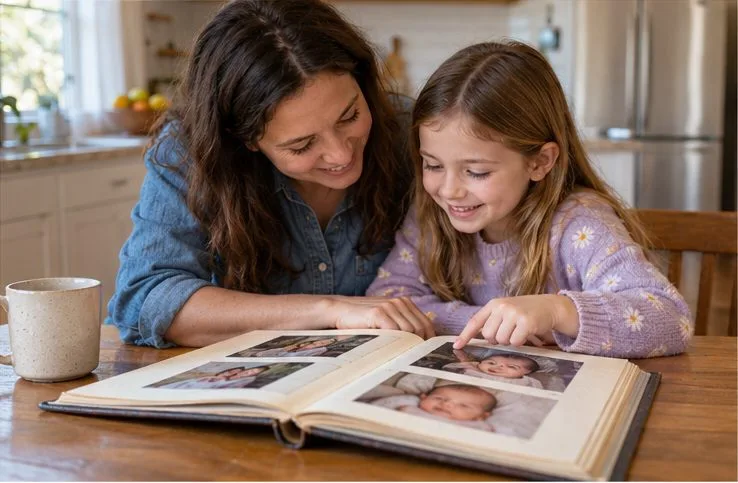
A parent and child look through a family album together, linking the older child’s own baby story to the family’s new chapter.
After the baby comes: make room for feelings, not pressure
Do not require the older child to act “like a big kid” or to be cheerful every time the baby needs attention. The AAP and MedlinePlus describe temporary younger-seeming behaviors in some children, such as wanting extra help or using baby talk; UNICEF also lists sleep changes and regression among possible responses in toddlers and preschoolers. This does not prove that every behavior is caused by the new baby, and it does not tell you how long adjustment will take.
Respond calmly, keep reasonable limits, and offer reassurance without turning every difficult moment into a lecture about being a sibling. If the baby needs you first, explain what is happening and, when possible, name when you will reconnect: “I’m changing the baby, then I’ll come sit with you for our book.” Ask visitors to greet and talk with the older child too, rather than making every visit only about the newborn.
An older child works on a puzzle with a parent while another adult holds the newborn, showing how ordinary one-on-one time can continue.
When might extra support help?
Some jealousy, questions, or temporary clinginess can be part of adjusting, especially for younger children. Consider checking in with your pediatrician or a child and family mental health professional if distress is intense or persistent, daily functioning changes substantially, your child seems unable to manage ordinary routines, or you are worried about anyone’s safety. These signs do not identify a diagnosis; they are reasons to ask for individualized guidance. The available sources do not establish one timeline that fits every family.
Sources and review note
Reviewed October 1, 2026. The AAP page was last updated February 10, 2026; MedlinePlus lists a review date of October 20, 2024. Advice should be adapted to a child’s age, temperament, family structure, and birth or care plans.