Home
» Pregnancy
»
What Can Cause Leg Cramps During Pregnancy at Night?
What Can Cause Leg Cramps During Pregnancy at Night?
Example scenario: Maya is 30 weeks pregnant. She wakes with a sudden, tight pain in one calf that eases after she pulls her toes toward her shin. The muscle feels tender for a while, but by morning her leg looks and feels like usual. This is an illustrative example, not a real patient story. It shows a common pattern of a brief muscle cramp; persistent one-sided pain or swelling needs a different response.
Nighttime leg cramps in pregnancy are common, especially later in pregnancy, but their exact cause is often unclear. A cramp is a sudden tightening of a muscle, usually in the calf or foot. Pregnancy-related changes and extra strain on the legs may play a part, yet there is no single proven explanation for every episode. A cramp by itself does not prove that you are dehydrated or low in a mineral.
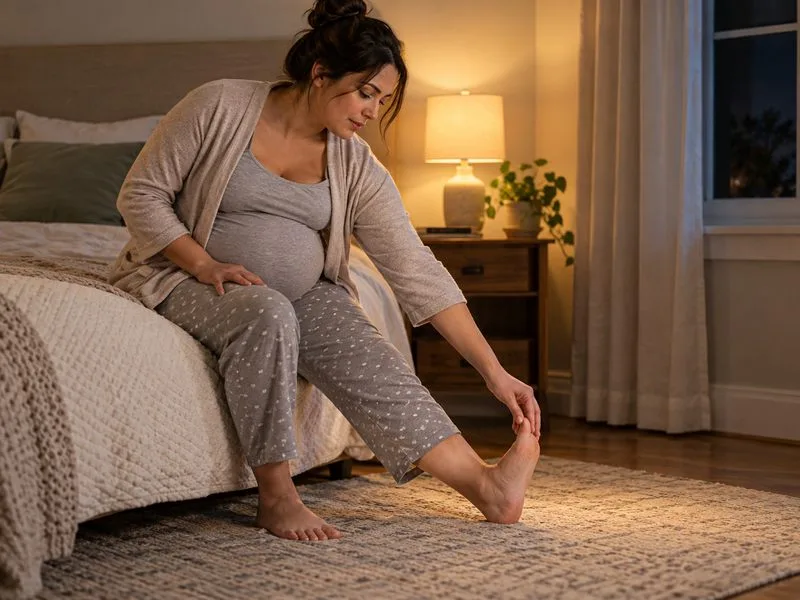
A gentle ankle-and-calf stretch can help ease a typical nighttime muscle cramp.
Why can a leg cramp happen at night during pregnancy?
Pregnancy is listed as a cause of leg cramps, and cramps are often noticed at night or while resting. They commonly affect the calf and sometimes the foot; the pain can be sharp and the muscle may stay sore after it relaxes. The NHS pregnancy guidance describes this nighttime pattern and recommends gentle ankle and leg movement. The U.S. National Library of Medicine’s MedlinePlus notes that cramps are common in the last months of pregnancy and that extra weight can contribute to leg aches.
These facts do not establish one exact mechanism. Changes in the body, added load on muscles, activity during the day, and how long the legs remain still may all be relevant for some people. But a clinician usually cannot identify one cause from the timing alone. If Maya has a brief calf spasm that releases with a stretch and no ongoing swelling, the pattern fits an ordinary muscle cramp more than a continuing leg problem—but an article cannot diagnose her.
Does a cramp mean low magnesium, calcium, or potassium?
Not necessarily. It is common to hear that pregnancy cramps always mean a mineral deficiency, but that conclusion cannot be drawn from a cramp alone. Poor intake, vomiting, certain health conditions, or medicines can affect fluid or mineral balance, so a clinician may consider those factors when the history suggests them. Routine self-treatment with high-dose magnesium, potassium, calcium, or electrolyte products is not a reliable way to identify the cause and may be unsuitable in pregnancy. Ask your prenatal clinician before starting supplements or changing a prescribed prenatal vitamin.
Dehydration can contribute to cramps in general, but a nighttime cramp does not establish dehydration either. Keep up with your usual pregnancy hydration advice, especially if you have been vomiting or are unwell; do not force excessive water as a cramp treatment. If you cannot keep fluids down, contact your maternity care team for advice.
What can you do when a typical cramp wakes you?
If the pain is a sudden muscle tightening and there are no warning signs, try a slow, gentle stretch: straighten the knee if comfortable, then bring the toes toward the shin. Rub the tight muscle or stand and put weight on the affected leg only if you can do so safely. The NHS recommends pulling the toes upward and massage; MedlinePlus says that pressing the feet against a wall or standing on the leg may help. Avoid bouncing or forcing a painful stretch. Once the spasm settles, move carefully in case the leg is still sore.
For prevention, gentle ankle and leg movement during the day may help. You can try a short calf stretch before bed if it feels comfortable. The NHS suggests repeated ankle flexing and rotations in pregnancy; MedlinePlus also notes that stretching before bed may reduce cramps. These measures may help, but they cannot guarantee that cramps will stop. If you have been told to limit activity or have pain with movement, ask your maternity clinician which exercises are appropriate.
Returning to Maya’s example: she could note whether episodes are brief, whether stretching helps, which leg is affected, and whether the discomfort fully settles. If cramps recur often or disrupt sleep, she should mention them at a prenatal appointment rather than assuming she needs a supplement. A symptom note can help the clinician decide whether to review exercise, hydration, medicines, or other possible causes.
When should you get medical advice?
Contact your maternity clinician or doctor if cramps are frequent, severe, persist after the muscle relaxes, keep disturbing sleep, or come with numbness or swelling. They can ask about your symptoms and health history and decide whether an examination or tests are needed. Do not take quinine, pain medicine, or another treatment for cramps during pregnancy without checking that it is appropriate for you.
Pregnancy also raises the risk of deep vein thrombosis (DVT), a blood clot in a deep vein. A DVT can cause pain or tenderness and swelling, warmth, or redness in one leg; the whole leg or part of it may feel heavy. Those symptoms are different from a brief muscle knot that releases and leaves the leg looking normal. They do not prove that there is a clot, but they need prompt medical assessment. The Royal College of Obstetricians and Gynaecologists’ guidance advises seeking immediate medical advice for these symptoms.
Seek emergency help immediately for sudden unexplained difficulty breathing, chest pain or tightness, coughing up blood, or collapse, which can be signs of a pulmonary embolism. Do not wait to see whether stretching fixes these symptoms.
How to judge the pattern
More like a typical cramp: sudden tightening in a calf or foot, often at night; it eases over seconds or minutes; the muscle may remain sore, but there is no persistent one-sided swelling, warmth, or redness.
Call for prompt medical advice: ongoing pain or tenderness in one leg, especially with warmth, redness, swelling, or a heavy feeling.
Get emergency help: sudden shortness of breath, chest pain or tightness, coughing blood, or collapse.
For Maya, the short-lived cramp and return to her usual leg appearance make gentle stretching and mentioning recurring episodes at prenatal care reasonable. If her calf stayed painful and became warm or swollen on one side, she should seek prompt assessment instead. The key is not to guess at a nutrient shortage or dismiss every leg pain as a pregnancy cramp: use the pattern, how long it lasts, and accompanying symptoms to decide what to do.
Guidance checked October 1, 2026. NHS pregnancy page last reviewed April 22, 2024; MedlinePlus page review date November 8, 2024. This information supports, but does not replace, individualized prenatal care.