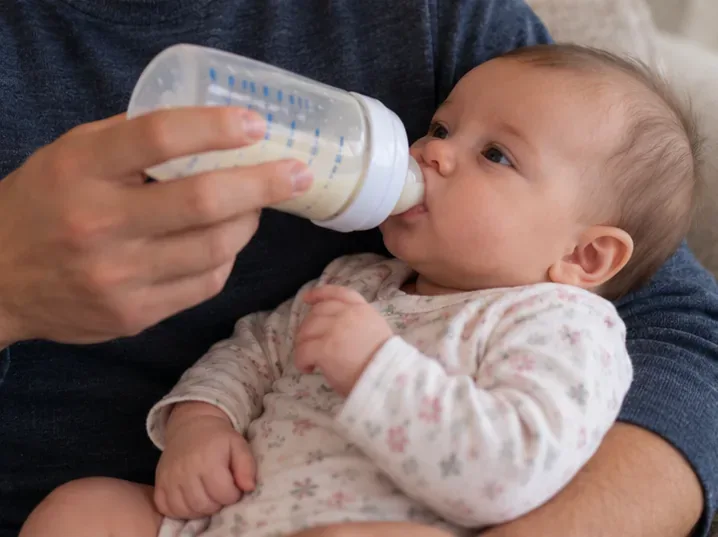
Based on the baby's daily eating needs, mothers choose the appropriate weaning method. As well as personality, the story of eating also depends on each baby. So 8 months old baby how much food is enough?
content
What do 8-month-old babies eat?
Diet for 8 months old baby
Timetable suggested
The principle of weaning should be remembered
Some suggested porridge dishes
There is no exact answer for how much food is enough for an 8-month-old baby, but there are basic rules for weaning moms know to properly supplement nutrition for the baby.
What do 8-month-old babies eat?
Breast milk is still the best food at 8 months of age. If you are back at work, you can give your baby more formula. Children weaning at this time only act as nutritional supplement but in very small quantity.

For 8 months old, breast milk (formula) is still the main source of nutrition
Children 8 months old should still maintain a diet of porridge or pureed porridge. This form of food and easy to swallow, just give the baby enough vitamin A, vitamin C, fiber, carbohydrates, proteins and dare-groups of substances necessary for the comprehensive development of the baby healthy and phase I are growing .
If you want to recommend that babies at this age eat solid foods, mothers should feed them before feeding or drinking formula. Or that meals should be spaced an hour apart enough for the baby to digest the food.
Diet for 8 months old baby
Baby 8 months eat 3 meals / day. At this time, the baby can eat with the whole family in each family meal. The baby's stomach is still very small, so the mother should give the baby one to two tablespoons with each food, then can add more if the baby finishes.
The weaning diet at this point should ensure:
Baby breastfed at least 5 meals or 770ml - 950ml formula or a combination of both.
Drink 60ml-120ml of water or fruit juice
2-3 servings of cereals or nuts (1 serving = 1- 2 tablespoons of cereals and dry nuts)
2 servings of fruit (1 serving = 2-3 tablespoons of fruit)
2-3 servings of vegetables (1 serving = 2-3 tablespoons of vegetables)
1-2 protein servings (1 serving = 1-2 tablespoons)
Timetable suggested
Depending on the health and the health of each baby, the mother applies a suitable schedule.
7:00 - Wake up and breastfeed (breast milk / formula)
8:15 - Breakfast (snack)
9:00 - Sleep (at least 1 hour)
10:00 - Breastfeeding (breast milk / formula)
11:00 - Lunch (snack)
12:30 - Breastfeeding (breast milk / formula)
13:00 - Lunch (at least 1 hour)
14:00 - Breastfeeding (breast milk / formula)
4:00 PM - Take a nap if you want (30-45 minutes)
16:30 or 17:00 - Dinner (snack)
18:15 - Start a bedtime routine (personal hygiene, reading, storytelling ...)
19:00 - Breastfeed (breast milk / formula) and sleep
The principle of weaning should be remembered
Before adding new foods to your baby's diet, mothers should note the following principles of weaning:
It is advisable to wait 2-3 days to get used to the food before introducing a new one
Mom can let your baby try many foods at the same time, he will eat the food he likes
In order for your baby to easily accept new foods, choose when your baby is really hungry, set the food on the table and only feed a little bit before you want your baby to eat the correct amount of daily consumption.
If you want to feed your baby, mothers must be present because this kind of food can easily cause choking. At this time, she used her hand to gently put the food in her mouth.
![How much food is enough for 8 months old baby and here is the answer for mom]()
3 safety principles when preparing baby food It is not possible to equip yourself with an absolutely sterile kitchen or a high-quality sterilization machine, but with some of the following food safety and hygiene principles Here, the dishes that mothers prepare for babies to eat will be much safer and better quality
Some suggested porridge dishes
Baby 8 months is when mothers can add seafood to the menu as well as a variety of porridge dishes to change taste every day.
![How much food is enough for 8 months old baby and here is the answer for mom]()
Porridge for a baby to eat just right is delicious and beautiful
Pork squash porridge
Ingredients: Rice flour (ground rice), 1 piece of squash, minced pork
Directions: Mix pureed meat with water to dissolve evenly. Squash puree.
Boil the meat mixture, add the squash and boil until the squash is tender. Turn off the heat, mix ground rice.
Mushroom pork porridge porridge
Ingredients: Rice flour, mushrooms, ground pork, cooking oil
Directions: Mushrooms are picked clean, soaked in salt water. Boiled, pureed.
Add ground pork and stir well with water or porridge flour. Add the mushrooms to cook, turn off the heat, wait less hot, add cooking oil, stir and let your baby enjoy.
Fish and carrot porridge
Ingredients: Rice, carrots, fish fillets
Directions: Carrots peeled, boiled, pureed. Freshly steamed fish, puree.
Put the ground rice in the pot and add some boiled water. Mix fish, carrot oil to eat. Turn off the stove, let it cool and let your baby enjoy.
![How much food is enough for 8 months old baby and here is the answer for mom]()
8 tips for a baby's menu from 8-10 months of age Unlike when babies start weaning, 8-10 months old babies will have the opportunity to come into contact with a wider range of foods. Mom also has more "land" to try cooking! Let's take a look at the delicious dishes below
The matter of how much baby 8 months old is eating is enough to be considered, but there is no need to place any "standard" weight. Each child has each food capacity, at this age, mother do not force the baby to eat a lot for fat. This will be counterproductive, the baby not only does not absorb nutrients and also has anorexia.