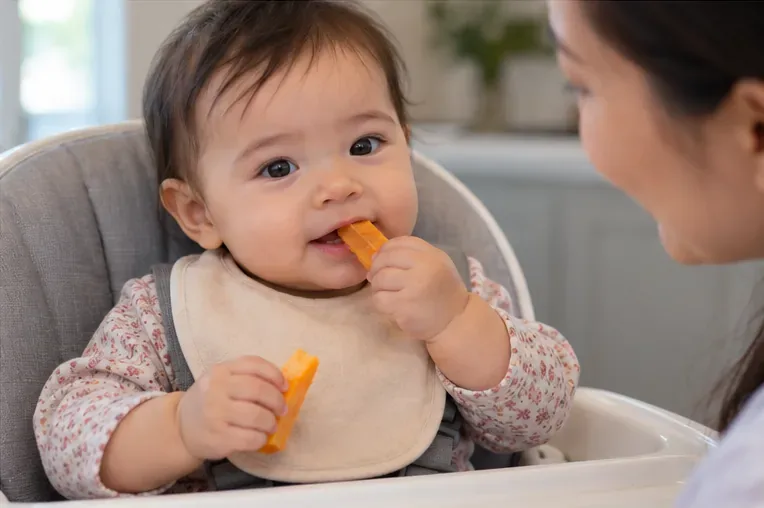
Do you know why doctors recommend using fruits and vegetables to start weaning instead of meat, fish or eggs? That's because babies aren't at the right age to try all of the above foods. Arbitrary use of food without referring to age appropriate levels can make babies have difficulty digesting, at worst, babies can be poisoned.
In an interview, Dr. Jatinder Bhatia, a specialist in neonatology and Chair of the Nutrition Board of the American Pediatric Association said: “We still don't have concrete evidence that can prove it. Which foods will be better for your baby?

Certain foods are thought to cause allergies or be difficult for children to absorb
The controversy in the scientific world
Some foods are on the not-for-food list because scientists have found the dangers they pose to health. However, we still cannot be sure that items not on that list will be safe.
Although health organizations often recommend that we should not feed babies before 4-6 months of age, there has been no convincing evidence to date that delaying weaning of Before this stage, the baby will have a significant protective effect on the baby from allergies , whether he or she is breastfed or formula fed. The delay is also linked to foods with a high risk of allergies, such as fish, eggs, and foods containing protein in peanuts.
Overall, the current evidence for these controversial studies is not sufficient to suggest a strong association between the timing of solids and infant allergies. In fact, a few small studies have come up with completely contradictory conclusions. For example, in 2009, a team of scientists found that babies and young children in Israali were less likely to have a peanut allergy than children in the UK, and one very surprising reason was that children there were exposed to peanuts from a very early age. From there, they showed an inverse correlation between early peanut exposure and peanut allergies.
However, with foods that have been reported to cause allergies, parents are still advised to be cautious when using them in baby's nutrition.
New information on “forbidden” foods for infants and young children
Many foods that were previously not recommended for babies under the age of 1 are now thought to be safe for babies as young as 6 months. For more detailed reference, mother can follow the table below.
Kind of food
The appropriate age
Honey (does not cause allergy, potential risk of botulium poisoning for children under 1 year old) Children over 1 year old
Peanut butter Children 6 months to 2 years old (formerly over 12 months to 2 years)
Nuts (can cause babies to choke, suffocate) Children 6 months to 2 years old (formerly over 12 months to 2 years old)
Citrus family
(Does not cause allergies but will cause intestinal distress or acid digestive disorders. The acid content of lemons, aroma and oranges are different. Tomato, not in the citrus family, but still acidic)
Children 6 to 12 months (formerly over 12 months)
Fresh strawberries, raspberries and mulberries Children 6 to 12 months (formerly over 12 months)
Corn (may cause allergies and not many nutrients) Children 6 to 12 months (formerly over 12 months)
Egg whites (egg whites of baked eggs can feed babies around 8-9 months) Children 6 to 12 months (formerly over 12 months)
Whole milk products (lactose and cow's milk proteins cause allergies and indigestion, except yogurt and cheese.) Fresh milk also interferes with the absorption of iron and iron. plays an important role in the first year of life) Children over 12 months
Wheat flour (for infants with no problem with oat or barley gluten and no history of wheat allergy or gluten intolerance) Children 6 to 12 months (formerly after 9 months to 12 months)
Grapes (do not cause allergies but will risk making babies choke, suffocate so be wary when feeding baby) Children from 10 to 12 months
Shellfish / Crustaceans (high risk of allergies) Children 6 to 12 months (formerly 1 to 2 years old)